Venezuela Edges Past US in Spain Crude Sales in August

ENERGY · VENEZUELA
Key Facts
- —The country Venezuela holds the world’s largest proved oil reserves. Acting president Delcy Rodríguez has run it since US forces captured Nicolás Maduro in January, with oil sales under US licences.
- —Why it matters Europe is a second outlet for Venezuelan barrels beside the US Gulf Coast. Spain, home of oil company Repsol, is now one of its biggest European buyers.
- —Why now Cores, Spain’s strategic oil reserves agency, published its August crude import figures on Monday 5 October 2026.
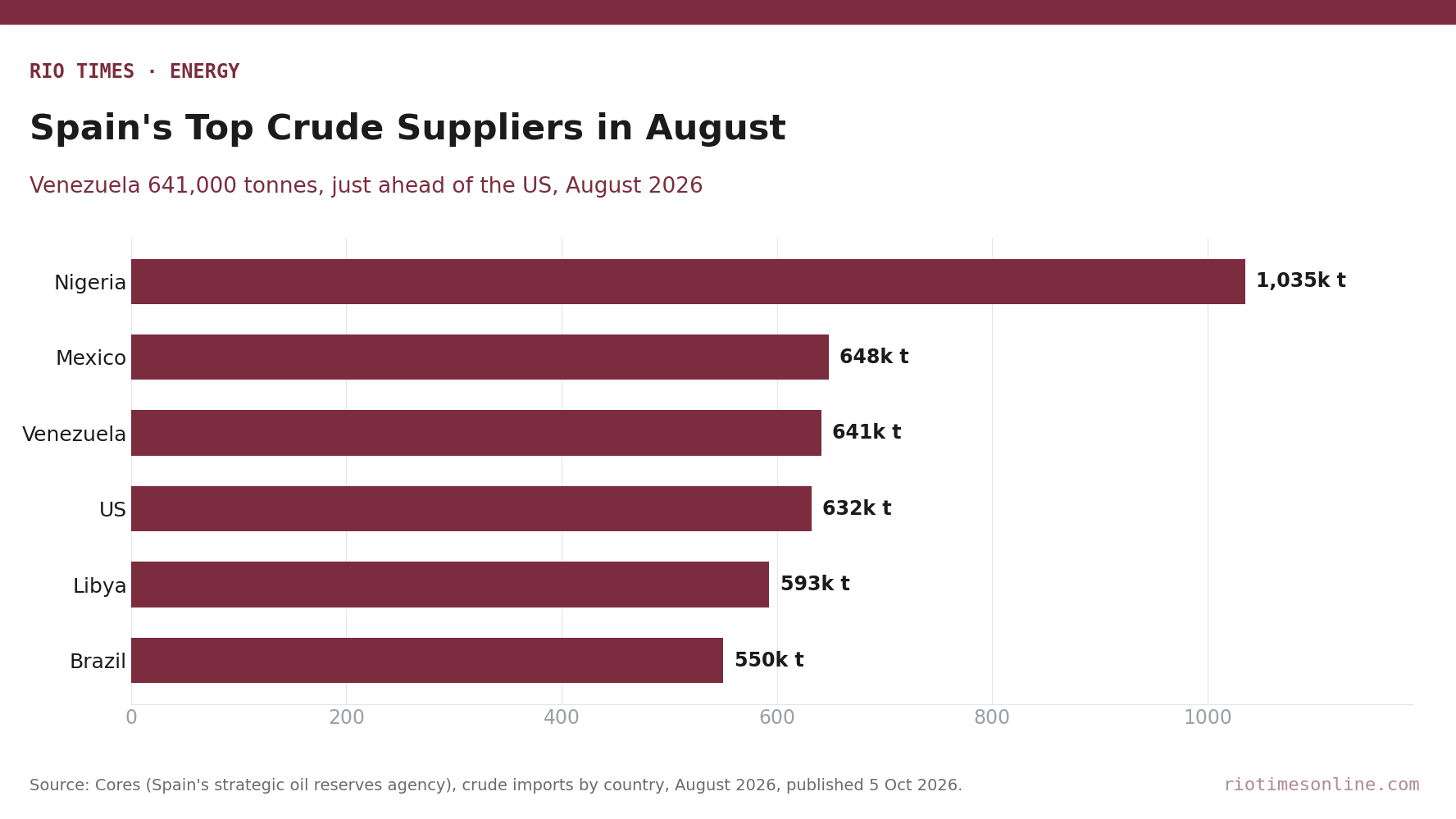
- —What happened Spain imported 641,000 tonnes of Venezuelan crude in August, 11.2% of its total. It bought none in August 2025, Cores says.
- —The numbers Venezuela ranked third in August, just above the US on 632,000 tonnes. From January to August Spain took 2.32 million tonnes, up 211.9%.
- —What it means for you US crude lost ground in one European market: its August sales to Spain fell 26% year on year. US pump prices are not affected by this shift alone.
- —Still open Whether the flow holds after September, when tanker data showed Venezuelan sales to Europe falling to about 86,000 barrels a day.
Spain imported 641,000 tonnes of Venezuelan crude in August, edging past US oil, official data published in Madrid on Monday show. Venezuela ranked third among Spain’s suppliers, a year after selling it nothing.
For US readers, the figures show Venezuelan barrels returning to Europe under the US licensing system that followed Maduro’s capture. They also show American crude losing a little ground in one of its European markets.
What the August Figures Show
Cores, the agency that holds Spain’s strategic oil stocks, reports to the Ministry for the Ecological Transition. It publishes import data by country each month. Its August bulletin was dated Monday 5 October 2026.
Spain imported 5.7 million tonnes of crude in August, up 11.0% from a year earlier. The oil came from 13 countries and covered 30 grades.
Nigeria was the largest supplier with 1.04 million tonnes, or 18.1% of the total. Mexico followed with 648,000 tonnes and Venezuela with 641,000 tonnes, or 11.2%.
The United States came fourth with 632,000 tonnes, 11.1% of the total and 26.0% less than in August 2025. Libya and Brazil completed the top six.
Spain bought no oil at all from Venezuela in August 2025, the Cores table shows. That makes the year-on-year comparison for the month meaningless, so the agency left it blank.
A Year of Rising Shipments
From January to August, Spain imported 2.32 million tonnes from Venezuela, up 211.9% on the same period of 2025. That equals 5.8% of all crude Spain bought this year.
The Energy Post, an industry site, reports that this is the highest January to August total since 2006, citing Cores records. The Rio Times has not checked that historical series.
The United States remains Spain’s largest supplier for the year so far, with 5.61 million tonnes and a 14.0% share. Mexico, Nigeria, Libya and Brazil follow it.
Venezuela still accounts for only 3.8% of Spain’s imports over the past 12 months. August alone supplied more than a quarter of this year’s total.
Repsol and the US Licences Behind the Flow
Madrid daily La Razón links the rise to agreements between the Trump administration and Rodríguez to revive Venezuela’s oil industry. Venezuelan oil sales now depend on licences from the US Treasury.
Repsol, the Madrid-based oil company, is the main Spanish link. It holds 40% of Petroquiriquire, a joint venture with state oil company PDVSA, which owns the other 60%.
In June the two firms signed a memorandum to explore new areas on Lake Maracaibo’s eastern shore, Caracas outlet El Cooperante reported. PDVSA president Héctor Obregón said it could add about 20,000 barrels a day.
Repsol chief executive Josu Jon Imaz said at the signing that the company would keep investing in Venezuela. Repsol is also studying a partial sale of an offshore gas field, as covered in Eni and Repsol Weigh Partial Sale of Perla Gas Field.
A Weaker September for Europe
Venezuela’s crude exports fell to 1.08 million barrels a day in September from 1.19 million in August. Maracaibo daily Panorama reported this, citing tanker data.
Shipments to Europe dropped to about 86,000 barrels a day from 260,000, the same data show. Sales to the United States rose to 629,000 barrels a day from 553,000.
Higher freight costs drove part of the shift, Panorama said. Commodity traders Vitol and Trafigura pressed PDVSA for bigger discounts, delaying some cargoes.
US firms are also moving deeper into Venezuelan energy, as shown in Baker Hughes Signs Venezuela Gas Deal on 5 October. Most of Venezuela’s oil still heads north rather than to Europe.
What It Means for You
For US investors, Spain’s data show Venezuelan heavy crude competing with American oil in Europe. US crude sales to Spain fell 26% in August, though the US still leads for the year.
For US drivers, nothing changes from this alone. Spain’s imports are a small slice of world oil trade, and the larger Venezuelan flow still goes to US refiners.
For anyone following sanctions, every cargo depends on Washington. A change in US licensing policy would hit these flows faster than any market move.
What Is Not Known
Cores does not say which companies imported the Venezuelan crude or at what price. It also does not say how the cargoes were paid for.
It is not known whether September volumes to Spain held up, since Cores will publish that data next month. Neither Repsol nor PDVSA had commented on the August figures by Monday evening.
How much Venezuelan crude did Spain import in August 2026?
Spain imported 641,000 tonnes of Venezuelan crude in August 2026, 11.2% of its total crude imports, according to Cores. It imported none in August 2025.
Did Venezuela overtake the United States as a supplier to Spain?
In August only, yes. Venezuela supplied 641,000 tonnes against 632,000 from the United States, but the US remains Spain’s largest supplier for January to August.
Why is Venezuelan crude reaching Spain again?
Venezuelan oil sales resumed under US licences after Nicolás Maduro was captured in January. Repsol, which holds 40% of the Petroquiriquire venture with PDVSA, is the main Spanish link.
Sources: Cores, crude imports by country, August 2026; El Cooperante; La Razón; Panorama; The Energy Post.
Editorial responsibility: Matthias Camenzind, Editor-in-Chief · Editorial standards · Report an error
LatAm Markets: Live Signals → — real-time movers, turnover leaders and FX across Latin America.