
POLITICS · VENEZUELA
Key Facts
- —The country Venezuela is replacing every judge on its Supreme Tribunal of Justice (TSJ), the top court, which now has 32 seats.
- —What happened On 2 October the National Assembly opened applications for 12 civil-society seats on the committee that shortlists judges. The window closes on 9 October.
- —Who is involved The committee will have 23 members: 11 deputies, eight from the ruling PSUV, plus the 12 civilians (Efecto Cocuyo, El Pitazo, 30 September–2 October).
- —What it means for you The new court will rule on contracts, property and elections. Investors and residents gain a clearer timetable for its renewal.
- —Still open Who applies and how profiles are scored. The final 12 go to the Assembly floor on 15 October.
The Venezuela TSJ nominations process moved into its public phase on Friday 2 October. The National Assembly opened a call for citizens to join the committee that will shortlist candidates for the Supreme Tribunal of Justice.
Applications run until 9 October, from 9:00 to 16:00 at the Assembly’s Bolivarian Museum in Caracas. Twelve civil-society members will be chosen, according to the call reported by El Pitazo and Unión Radio.
How the Venezuela TSJ nominations committee is built
The committee will have 23 members: 11 deputies and the 12 civilians now being recruited. Eight of the 11 deputies belong to the ruling United Socialist Party of Venezuela (PSUV), El Pitazo reported.
On 1 September the Assembly reformed the court’s founding law to raise the civilian share from 11 to 12. EFE said the change answered a deal with the opposition faction that is negotiating with the government.
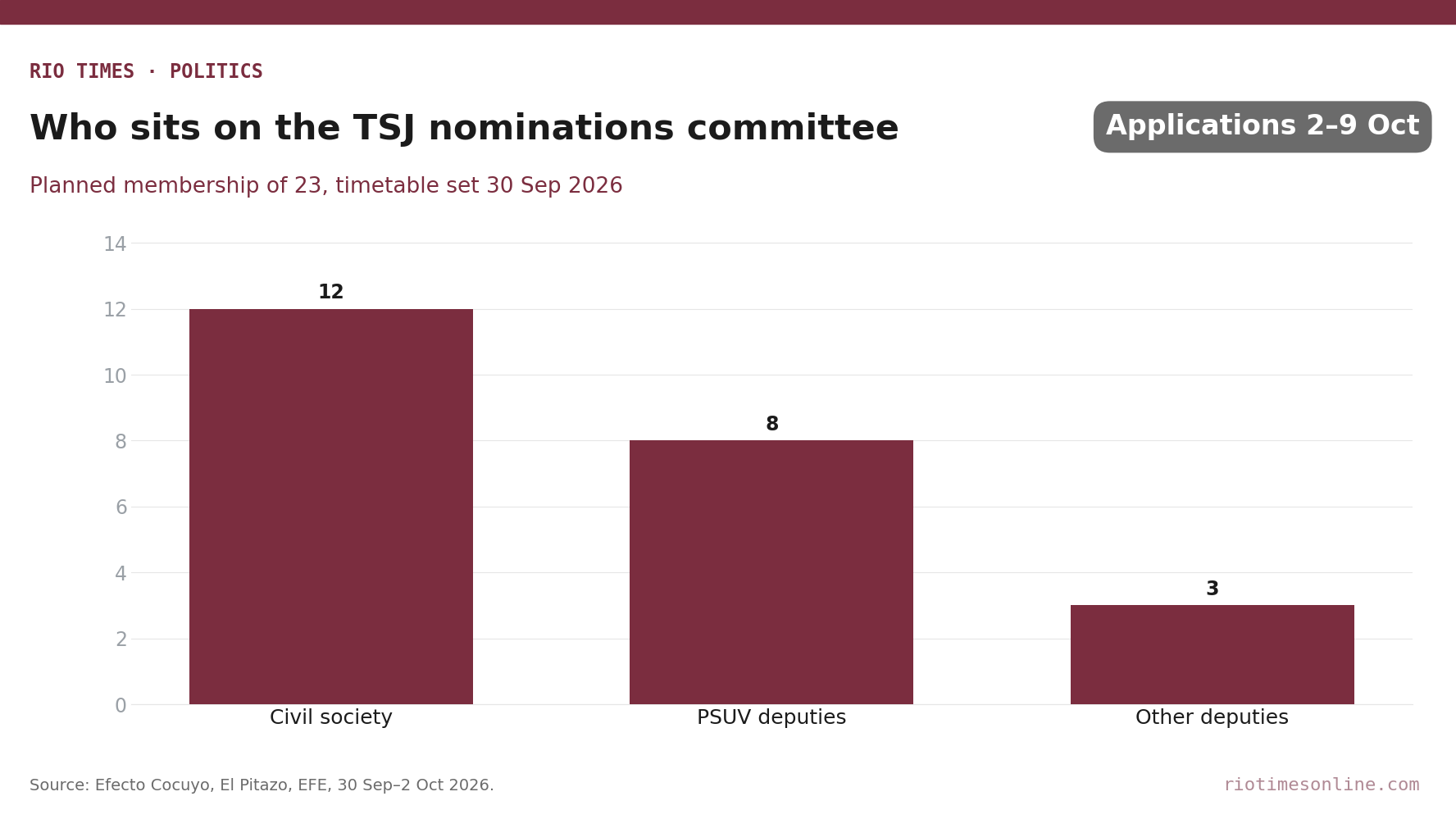
That reform gives non-party members a simple majority on paper. Whether they act independently will depend on who is picked, and the Assembly that picks them is controlled by the governing camp.
The timetable to 16 October
The preliminary commission, chaired by PSUV deputy Giuseppe Alessandrello, set the dates at its first meeting on 30 September. Profiles will be evaluated after 9 October, and the chosen 12 go to the full Assembly on 15 October.
Deputy Luis Florido, a commission member, told reporters the full committee would “surely” be sworn in on 16 October. Only then will it publish requirements for people who want to become magistrates.
Applicants must file a nomination letter from an organisation or a personal application. They also need a copy of their identity card and proof of their studies, with foreign degrees legalised and translated.
A second filter from the talks
The process grows out of talks between the government and delegates of the opposition-led Assembly elected in 2015. Those talks, which restarted in Caracas in mid-September, also produced a council of seven jurists.
That council will review the credentials of every candidate for the court. EFE reported that four of the seven are trusted by the opposition, which offers a counterweight to the Assembly majority.
El Pitazo noted that three council members are former TSJ judges chosen by earlier government-controlled parliaments. One of them sat on the bench that stripped the 2015 Assembly of its powers in 2017.
Pressure from outside is also visible. Relatives of detainees marched on the judiciary on 28 September, demanding an inquiry into judges in political cases.
What Is Not Yet Known
The Assembly has not said how it will score applicants or whether the civilian shortlist will be published before the vote. It is also unclear how long the committee will take to propose candidates.
The broader plan to replace all magistrates has no fixed end date yet. The next fixed point is the plenary session on 15 October, when the 12 names should be known.
Sources: Efecto Cocuyo (2 October 2026); El Pitazo (2 October 2026); EFE via Banca y Negocios (30 September 2026); Unión Radio (2 October 2026).
This article was produced by The Rio Times’ automated newsroom system. How we use AI · Report an error · Editorial responsibility: Matthias Camenzind, Editor-in-Chief