Africa Intelligence Brief — Wednesday, September 23, 2026
Executive Summary
Africa Intelligence Brief for 23 September 2026: Tigray forces take Mekelle airport and Ethiopian Airlines pulls out of three northern airports, South Africa's Reserve Bank raises rates into a fuel shock, Morocco votes with its lowest turnout in years, and Washington withholds a visa from...
Africa Intelligence Brief — Wednesday, 23 September 2026

Africa spent Wednesday watching one ceasefire come apart and one central bank choose caution over comfort. In Ethiopia’s north an airport changed hands, and the regional government called the fighting a defensive battle.
Elsewhere the day was decided in offices rather than on roads. South Africa made borrowing dearer, Morocco counted a thin vote, and Sudan’s army chief found the door to New York closed.
Tigrayan forces took control of the Alula Aba Nega International Airport at Mekelle, the capital of Ethiopia’s northern Tigray region, overnight. Ethiopian Airlines then suspended flights to Mekelle, Axum and Shire from Wednesday, Al Jazeera reported.
In Pretoria the South African Reserve Bank did what few had expected. It raised its repo rate (the rate at which the central bank lends to commercial banks) by a quarter point to 7.25 per cent, and Governor Lesetja Kganyago said the fuel-price shock “has intensified”.
Moroccans chose a new lower house, and few of them bothered. Final turnout was 38.02 per cent, which Hespress, a Moroccan news site, called the country’s second-lowest since 2002.
What steadies the day is thin, and each piece carries its caveat. Nigeria’s stock market inched up to a record, Morocco’s interior ministry said voting went smoothly, and the march in Kinshasa drew a lighter police presence than the opposition’s did last week.
Read in English and French, across the continent’s largest outlets and our own Africa desk. Every figure below carries the source that published it and the date.
Tigray Turns An Airport Into A Front Line
The clearest sign yet that Ethiopia’s northern peace has failed arrived as a change of control. Tigrayan forces took over the Alula Aba Nega International Airport at Mekelle overnight, and Euronews reported that a small number of federal police guard the airport and that their situation was unknown.
The staff heard it from their own supervisor. An airport employee said the supervisor telephoned the driver to say “the airport had been taken over by Tigray forces” and, since there were no flights, told them to return home.
The national carrier rearranged its timetable around the fighting. Ethiopian Airlines, the state-owned airline that is the country’s largest company, cited “the current situation” in suspending flights to Mekelle, Axum and Shire from Wednesday, and apologised to customers, Al Jazeera reported.
The Tigray regional government published its own account of the fighting. It said the Tigrayan army had been instructed “to counter the attack and genocidal invasion launched against us” and had “entered into a defensive battle”, Al Jazeera reported.
The federal answer reversed the direction of the blame. Getachew Reda, an adviser to Prime Minister Abiy Ahmed, said the Tigray People’s Liberation Front had “launched an all-out offensive against government positions in Afar and Amhara”, and had taken over federally controlled airports in Tigray.
The claims about ground held are thinner than the claims about intent. One former senior official of the front said the rebels controlled Berhale, Erebti, Abala, Megale, Dalul and Konoba in the Afar region, Euronews reported, and this desk could not confirm it.
A first-time reader needs the scale of what went before. The war in Tigray between 2020 and 2022 killed about 600,000 people, according to African Union estimates, and tolls for that war vary widely; about one million people are still displaced, Al Jazeera reported.
Seven Rebellions Learn To Speak As One
Ethiopia’s separate wars now have one address. Seven armed groups announced an alliance on Sunday 20 September, when their founding statement was read on Tigrai TV, a Tigrayan broadcaster, Al Jazeera reported.
The list reaches across the country. It takes in the Amhara Fano National Movement, the Tigray People’s Liberation Front, the Oromo Liberation Army, the Ogaden National Liberation Front, the Afar Revolutionary Democratic Unity Front, the Benishangul Peoples’ Liberation Movement and the Gumuz Peoples’ Democratic Movement.
One name needs explaining for a first-time reader. Fano is an Amhara militia that rebelled in 2023, after Mr Abiy ordered the regional special forces folded into the federal army, Al Jazeera reported.
The alliance describes itself as a rescue rather than a coup. Its spokesman, Michael Asgedom of the Tigray front, said it “was created to bring peace and democracy to Ethiopia” and would build a new order “over the ruins of Abiy Ahmed’s system”.
He put the case in plainer terms as well. Mr Asgedom said this was “the right time to eradicate the regime”, and that any fight “will be for survival”, Al Jazeera reported.
The government’s answer was to look across the border. Billene Seyoum, the prime minister’s spokesperson, told Reuters that the alliance’s members had been collaborating for some time with Eritrean financial backing, an accusation Asmara has repeatedly denied.
Al Jazeera drew the wider conclusion in its own words, without quoting a researcher. It wrote that the alliance has brought several of Ethiopia’s separate conflicts into the same political framework and, potentially, into the same military calculation.
The people who watch Ethiopia for a living disagree about how far this has gone. Alan Boswell, the Horn of Africa director at the International Crisis Group, a conflict-prevention organisation, said the groups’ pledge to topple the government is “something very close to a declaration of war”.
He added a warning about the speed of it. Mr Boswell said: “We’ve seen quite an escalation over the past day.” He went on: “So if we’re not all the way back into something like a full war, we are very, very close.”
A colleague at the same organisation reads it more calmly. Magnus Taylor said this is “substantially a domestic Ethiopian phenomenon”, and that “all these groups have their own different beef with the federal government”.
Key Facts
South Africa Pays More For Money, And Blames A Barrel
South Africa’s central bank chose the harder option, and said so plainly. The Reserve Bank raised its repo rate (the rate at which it lends to commercial banks) by a quarter point to 7.25 per cent on Wednesday, taking the prime lending rate charged to customers to 10.75 per cent.
The reason was the price of fuel. Governor Lesetja Kganyago said, in remarks EWN, the Johannesburg radio news service Eyewitness News, reported at 13.15 UTC: “A few months back, it seemed that the fuel-price shock might be unwinding, but now it has intensified.”
His second reason looked beyond South Africa. Mr Kganyago said: “We are also seeing global rates moving higher.” He added that the bank had taken “a measured approach to rate setting, in conditions of high uncertainty”.
The committee was of one mind. SAnews, the South African government’s news service, said the committee decided unanimously, and the new rate applies from 25 September.
Two other outlets agree on that unanimity. Time News, an international news site, and BusinessDay Nigeria, a Lagos business daily, also called the decision unanimous, and BusinessDay called it the first increase since May 2026, after a hold at 7 per cent in July.
The figures behind it are modest but moving the wrong way. Consumer price inflation reached 4.4 per cent in August, from 4.3 per cent in July, and the bank cut its growth forecast for 2026 to 1.2 per cent from 1.4 per cent.
The cause is priced in a barrel of oil. Brent crude’s front-month November contract settled at US$103.08 a barrel on Wednesday, up US$3.83, Reuters reported.
South Africans have already felt it at the pump. Petrol rose by 1.34 rand a litre (about US$0.08) and diesel by as much as 3.15 rand a litre (about US$0.19) in September, TechFinancials, a Johannesburg technology and business site, reported.
Those dollar values come from the house conversion table. It uses 16.3471 rand to the dollar, the European Central Bank cross rate for 23 September.
What could reverse the tightening is the bank’s own caution. Mr Kganyago said “our decisions will continue to be taken on a meeting-by-meeting basis”, and put the aim at returning inflation to the 3 per cent target towards the end of 2027, SAnews reported.
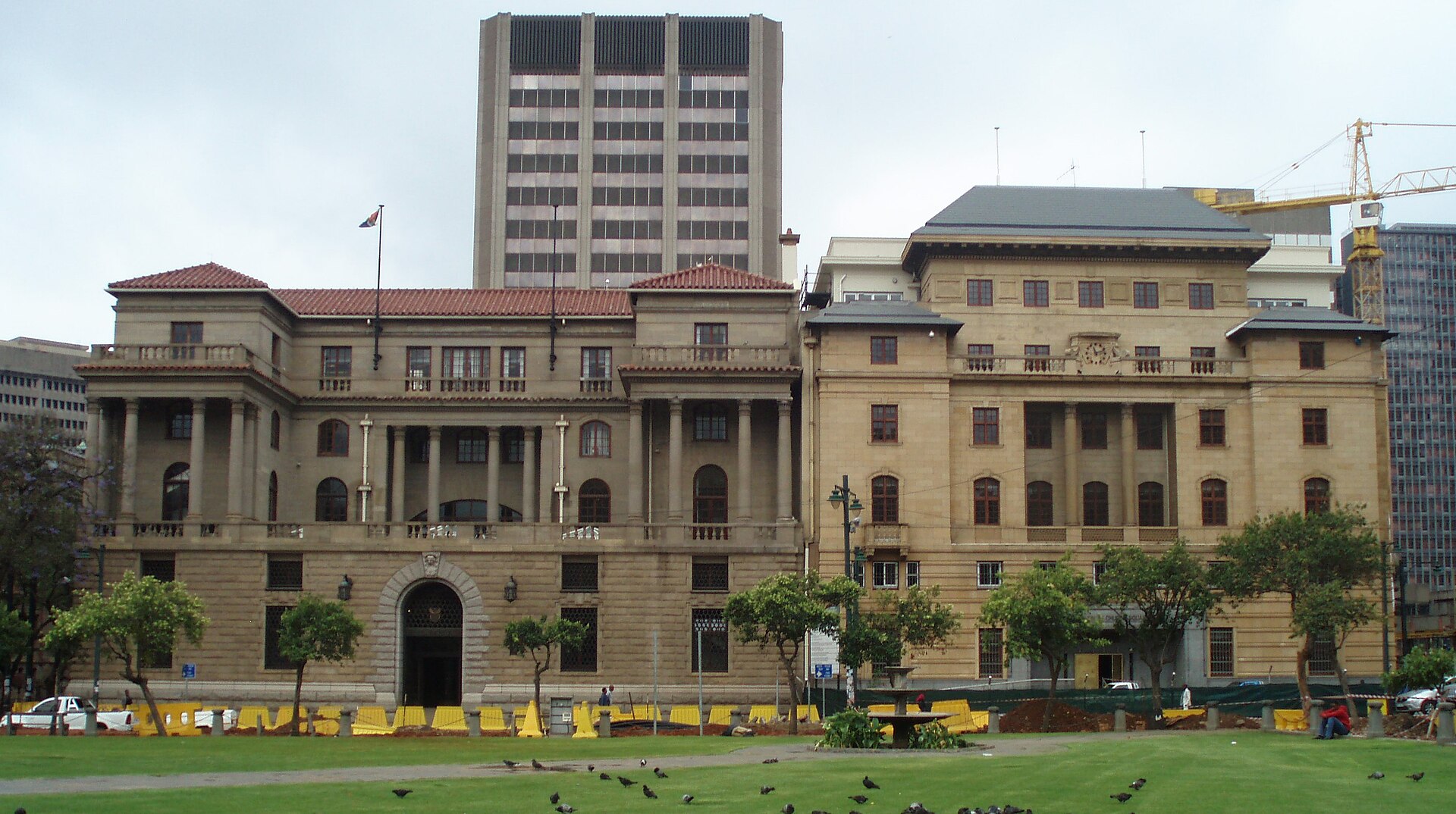
South Africa’s Other Fear, And A Promise Of Technology
The second South African mood has little to do with money. Nine women have been found dead in Ekurhuleni, the metropolitan municipality east of Johannesburg, and the killings are unsolved.
The President answered the fear in person and in the first person. Cyril Ramaphosa said on Monday 21 September, at a fundraiser for the governing party’s veterans at a country club in Woodmead, Johannesburg: “We will be pulling out all stops to find these perpetrators.” Sunday World, a Johannesburg weekly, reported his words.
He turned from the police to the public. Mr Ramaphosa said that “the message must also go to men” and that men “must continue respecting women, honouring women”.
The state’s answer is more people and more equipment. Mr Ramaphosa said two senior officers, Lt-Gen Dumisani Khumalo and Lt-Gen Nhlanhla Mkhwanazi, would be deployed, and promised more funding, resources and technology through the inter-ministerial committee on gender-based violence and femicide.
The case itself is at an early stage. Sunday World reported that three people, one man and two women, were arrested over the ninth death, of a woman found partly unclothed beside a road in Dawn Park, a residential area of Ekurhuleni, and that they were expected at the Boksburg magistrates’ court on Monday.
One date in the same case is fixed. EWN reported on 22 September that two women held over one of the killings stay in custody until a bail hearing on 1 October, in Boksburg, a town within Ekurhuleni.
Morocco Votes, And The Thin Turnout Is The Story
Morocco chose a new lower house on Wednesday, and the count of voters told more than any manifesto. Final national turnout was 38.02 per cent, the interior ministry said, and Hespress, a Moroccan news site, called it the country’s second-lowest since 2002.
The day built slowly to that figure. The ministry put participation at 4.23 per cent at 10 a.m. local time and 11.34 per cent at noon, then 21 per cent at 3 p.m. and 28.05 per cent at 5 p.m., two hours before the polls shut at 7 p.m.
The ministry was keen to say the day itself passed well. It said voting went smoothly across the country, with only a handful of isolated, limited exceptions, and that counting began at once in the polling stations, Hespress reported.
The result is another matter. No official result had been announced when this desk last checked at 22.55 UTC, and Hespress reported that party observers’ own counts are circulating without confirmation from the interior ministry’s central offices or the judge-led counting commissions.
The electorate is large and old. Nearly 16 million voters were registered to fill 395 seats in the House of Representatives, with 198 needed for a majority, and Morocco World News, a Rabat English-language site, reported that 29 per cent of the roll is over 60 and 4 per cent aged 18 to 24.
The disaffection was easy to find. Majda Bakatir, 59, in Rabat, said: “I’m not going to vote because I have lost all faith in the political class.” She cited health care, education and purchasing power, Courthouse News Service, an American legal news agency, reported.
Others turned out with low expectations. Karim Ennaciri, 55, said of his vote: “This will allow us to see if there’s a renewal within the parties.”
The party leaders asked for seriousness rather than promising it. Abdelilah Benkirane, who leads the Justice and Development Party, said Moroccans should stand up and say “we want seriousness” from those who manage public affairs and reach parliament, Morocco World News reported.
The stakes reach past the chamber. The king appoints the prime minister from the ranks of the winning party for a five-year term, and the Authenticity and Modernity Party fields Fatima Ezzahra Mansouri, who Courthouse News reported could become Morocco’s first female prime minister.
Sudan Is Shut Out Of The Room
Sudan’s war reached New York this week as a paperwork dispute. The United States is withholding a visa for the army chief, Gen Abdel Fattah al-Burhan, who is scheduled to address the United Nations General Assembly on 26 September, Sudan Tribune, a Sudanese news site, reported on 22 September.
Sources told Reuters that the visa carried a condition. Sudan Tribune reported that it appears to have been made conditional on Gen Burhan agreeing to sign a 90-day ceasefire proposed by Massad Boulos, the American senior adviser for Arab and African affairs.
Khartoum answered with the law. Sudan’s ambassador to the United Nations, Al-Harith Idriss, said his country had completed all entry requirements and argued that barring a head of state violates the 1947 United Nations Headquarters Agreement, Sudan Tribune reported.
The United Nations took the complaint upstairs. Its spokesperson, Stéphane Dujarric, said the Secretary-General was very concerned by reports that the visa remained unissued, and that the Secretariat had raised the matter with American officials and was following up.
Washington’s language about both Sudanese sides hardened the same day. The State Department spokesman, Tommy Pigott, said of the Sudanese Armed Forces and the paramilitary Rapid Support Forces: “They rule through force of arms alone.” The National, an Abu Dhabi English-language daily, reported his words on 22 September.
He went further than that. Mr Pigott said: “The conduct of each leader of the warring factions renders them ineligible to govern the country.” He added: “We seek to restore peace and give power back to the Sudanese people.”
There is an offer inside the rebuke. Mr Pigott said Washington had “repeatedly asked the two parties to accept a humanitarian truce as presented without preconditions, and to commit to an inclusive political dialogue that leads to a transition to a civilian government”. He said both had refused, and had stepped up drone attacks that kill civilians.
The background explains the temperature. The United States imposed sanctions on Gen Burhan in January 2025 over alleged military abuses and obstruction of peace efforts, Sudan Tribune reported.
Nigeria’s Market Edges Up, And Still Waits For Its President
Nigeria’s stock market barely moved on Wednesday, and set a record anyway. The Nigerian Exchange’s All-Share Index closed at 251,191.02 points, up 0.23 per cent, or 576.36 points.
The value of the listed market reached a record 163.06 trillion naira (about US$122.7 billion), a gain of 374.14 billion naira (about US$281.5 million). Turnover was 1.59 billion shares in 49,736 deals, and Nairametrics, a Lagos business site, put the advance down to sustained buying in banking and other large companies.
The dollar figures rest on a rate the desk will name. The house conversion table uses the Central Bank of Nigeria’s official central rate of 1,329.30 naira to the dollar, dated 21 September and carried forward, because the bank’s rate page served no dated figure for Wednesday.
Tuesday’s decision behind the week was an unusual piece of understatement. The central bank reset its monetary policy rate to 23 per cent from 26.5 per cent at its 307th meeting in Abuja on 22 September. Governor Olayemi Cardoso presented it as an adjustment of the bank’s rate corridor rather than a change of stance.
What the country is still waiting for is its head of state. President Bola Tinubu, who left for London on 30 August, “will return to Nigeria at the weekend”, his office said on 21 September, and the desk could not establish on Wednesday that he had arrived.
The grief that framed Tuesday has a clock on it. A ten-member federal panel opened on 22 September has two weeks to report on the 37 detainees who died in custody on 17 September in Minna, capital of Niger State in north-central Nigeria. Their jailers were the Nigeria Security and Civil Defence Corps, a federal paramilitary force under the interior ministry.
Kinshasa’s Loyalists Say The Quiet Part
The purpose of Tuesday’s march in the Congolese capital is now on the record. Supporters of President Félix Tshisekedi’s Union for Democracy and Social Progress gathered at the Martyrs’ Stadium, the big arena on Kinshasa’s triumphal boulevard, to back a constitutional change that would allow him a third term.
They had a second grievance as well. The marchers also condemned Rwandan aggression in the east of the country, RFI, the French public broadcaster, reported.
The crowd made its case as inheritance. A marcher named Véronique said «Nous avons été 37 ans l’opposition, nous savons ce que c’est la lutte et nous sommes prêts à continuer», which means the party spent 37 years in opposition, knows what a struggle is and is ready to carry on.
The policing was gentler than a week earlier. RFI reported that the security presence, while notable, was less imposing than at the opposition’s march of 15 September, when police broke up protests against changing the constitution.
The epidemic in the country’s east still sets the limits. The Ebola outbreak stood at 7,672 confirmed cases and 3,699 deaths across seven provinces, Africanews, a pan-African news channel, reported on 22 September, citing the national public health institute, and the desk found no newer count on Wednesday.
What This Means From Latin America
Latin America knows what an eroding peace deal looks like. Colombia signed its accord with the FARC guerrillas in 2016 and then watched splinter groups keep fighting, which is the question now facing the agreement Ethiopia signed in November 2022.
South Africa’s decision also lands on screens in São Paulo. Brazil’s Selic (its benchmark interest rate) stands at 13.75 per cent, and investors who price South African and Brazilian debt together will read Pretoria’s quarter point as a signal about oil, not about South Africa alone.
Morocco’s thin turnout is a familiar worry on this side of the Atlantic. Governments across the region have argued for years about whether a parliament that few people trouble to elect can still speak for the country.
What We Are Watching
- Overnight into Thursday 24 September: Morocco’s first results — Preliminary outcomes were expected overnight, Courthouse News Service reported, after final turnout of 38.02 per cent.
- Thursday 24 September: Nigeria speaks at the United Nations — Vice-President Kashim Shettima is to deliver Nigeria’s national statement, and the desk will check the speakers list before quoting any African leader.
- Thursday 24 September: the Central Bank of Egypt decides — Its overnight deposit rate stands at 19.0 per cent and most analysts expect a hold, EnterpriseAM, a Cairo business newsletter, reported on 20 September.
- Friday 25 September: South Africa’s new rate applies — The 7.25 per cent repo rate takes effect, SAnews reported, and borrowers meet the prime lending rate of 10.75 per cent.
- Saturday 26 September: Gen Burhan’s slot in New York — Sudan’s army chief is scheduled to address the General Assembly, with his visa unresolved as of 22 September, Sudan Tribune reported.
- The weekend of 26 and 27 September: President Tinubu’s return — His office said on 21 September that he “will return to Nigeria at the weekend” after extending a working holiday in Europe.
- Monday 28 September: the general debate closes — The United Nations General Assembly ends its annual debate, after which the African speeches can be read as a set.
- Thursday 1 October: the Boksburg bail hearing — Two women held over one of the Ekurhuleni killings apply for bail, EWN reported, and Nigeria marks its Independence Day the same day.
- Early October: the Minna panel reports — The ten-member federal panel opened on 22 September has two weeks to account for the 37 deaths in civil defence corps custody.
The Bigger Picture
In Ethiopia the question moved from what armed groups say to what they hold. An airport and a disputed list of Afar towns are a different order of claim from a founding statement read on television on Sunday 20 September.
In South Africa the state chose discomfort over reassurance, and named a barrel of oil as the reason. In Morocco the electorate answered in its own way, and 38.02 per cent of it turned out.
What steadies the day is real and partial. A record on the Lagos exchange, a Moroccan polling day the ministry called smooth, and a lighter police presence in Kinshasa are all true, and none of them settles anything.
Sources: Al Jazeera, Euronews, SAnews, EWN, TechFinancials, BusinessDay Nigeria, Sunday World, Hespress, Yabiladi, Morocco World News, Courthouse News Service, Sudan Tribune, The National, Nairametrics, RFI, Africanews, Reuters · 20-23 September 2026.
Frequently Asked Questions
What happened at Mekelle airport?
Tigrayan forces took over the Alula Aba Nega International Airport at Mekelle overnight on 23 September, and Euronews reported that a small number of federal police guard it and their situation was unknown. Ethiopian Airlines then suspended flights to Mekelle, Axum and Shire.
Did South Africa raise or lower its interest rate?
It raised the rate, by a quarter point to 7.25 per cent on 23 September, taking the prime lending rate to 10.75 per cent. SAnews said the committee decided unanimously, and the new rate applies from 25 September.
How many Moroccans voted?
Final turnout was 38.02 per cent, the interior ministry said, and Hespress called it the country’s second-lowest since 2002. No official result had been announced when this desk last checked at 22.55 UTC.
Why is Sudan arguing with Washington about a visa?
The United States is withholding a visa for the army chief, Gen Abdel Fattah al-Burhan, who is due to address the United Nations on 26 September, Sudan Tribune reported. Sudan’s ambassador argued that barring a head of state violates the 1947 United Nations Headquarters Agreement.
This article was produced by The Rio Times’ automated newsroom system. How we use AI · Report an error
LatAm Markets: Live Signals → — real-time movers, turnover leaders and FX across Latin America.
Read More from The Rio Times
- Issawa Music, the Sufi Brotherhood Repertoire of Morocco, Reaches a Casablanca Concert Stage on 17 October 2026 at 200 Dirhams a Ticket
- Moroccan Philharmonic Orchestra Opens Its 30th Season With Beethoven in Rabat, Morocco, on 8 October 2026, Then Casablanca and Tangier
- Abu Simbel Sun Festival: Sunrise Light Reaches the Sanctuary 63 Metres Inside Egypt’s Great Temple at About 6 a.m. on 22 October 2026