USMCA Review Leaves the Trade Pact in Limbo as the 2036 Expiry Clock Starts
USMCA: 2026
Updated 1 time · Latest: 19 September 2026
Key Facts
—Trade volume. The three USMCA members trade roughly US$1.6 trillion in goods per year, per US Census Bureau data. Two-way US-Mexico goods trade was US$839.6 billion in 2024, and Mexico remained the United States’ largest goods trading partner in 2025, ahead of China and Canada.
—Review held. The first six-year joint review under Article 34.7 took place on July 1, 2026. USTR had opened the process with a September 17, 2025 Federal Register notice and public hearings in late 2025. The parties left the July meeting without confirming a 16-year extension, moving the pact into annual review cycles.
—Steel dispute. US Section 232 tariffs on steel and aluminum — reimposed on Mexico and Canada in March 2025 and doubled to 50% in June 2025 — are Mexico’s top grievance in the review. Washington has so far declined to restore the exemptions.
—Rules of origin. The 75% North American content rule for automobiles, up from NAFTA’s 62.5%, has driven US$34 billion in new auto-parts investment in Mexico since 2020, according to Mexico’s Secretariat of Economy.
—Sunset risk. With no affirmation at the July 2026 review, the agreement remains in force but faces annual joint reviews; absent a future confirmation, it would expire in 2036.
—Next round. Trump has ruled out withdrawal. A negotiating round was set for 28–29 September in Washington, after the 16 September Trump–Sheinbaum call. We have not confirmed the outcome.
The USMCA passed its first mandatory six-year review in July 2026 without a confirmed extension, leaving roughly US$1.6 trillion in annual goods trade, a 50% steel-tariff dispute, and a structural sunset clause to define North American commerce for the next decade.
The Trade Math: Why the Numbers Matter
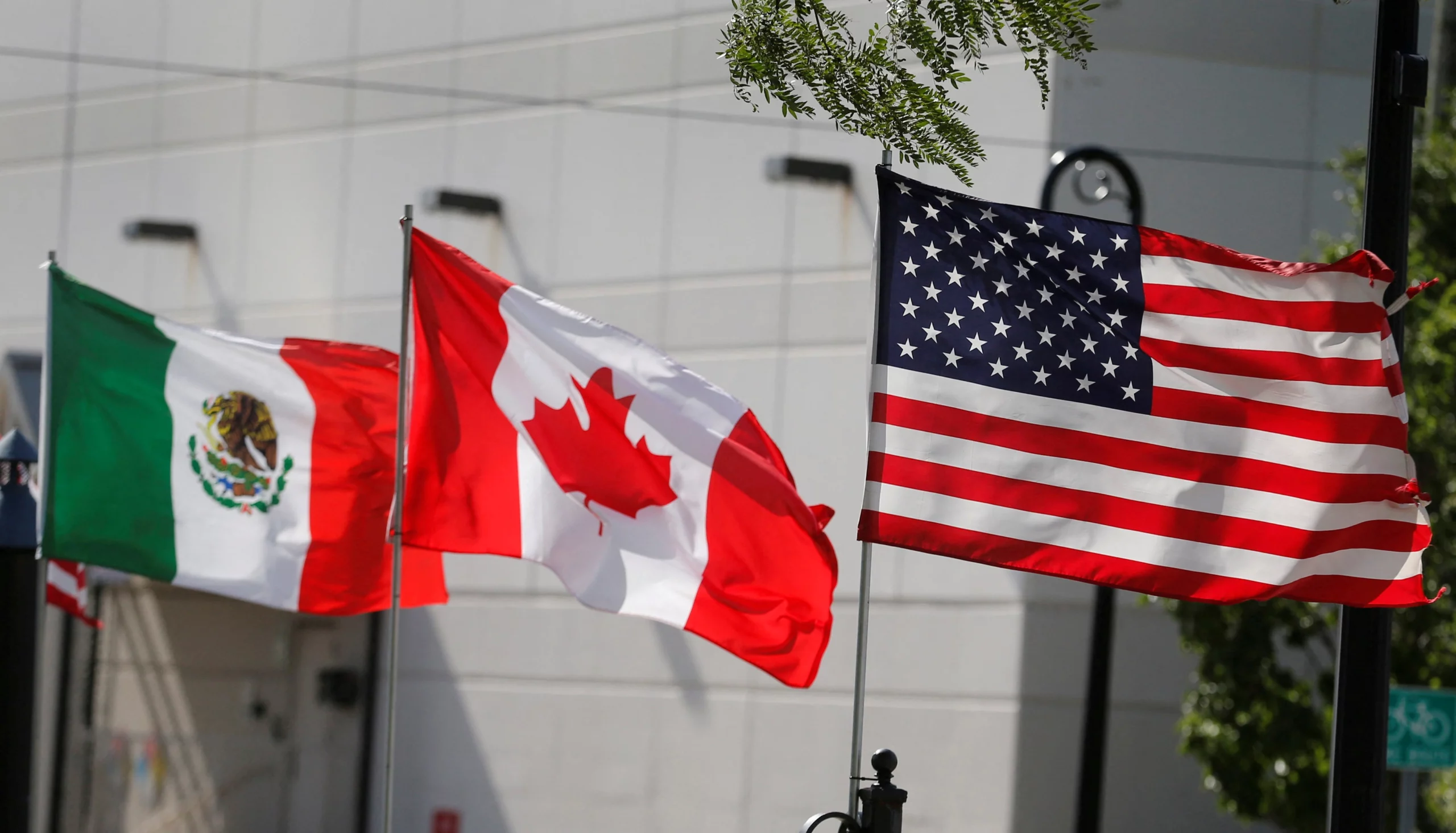
The USMCA is not merely a trade agreement; it is the economic backbone of North America. Member countries trade roughly US$1.6 trillion in goods per year, according to US Census Bureau data — a figure larger than the GDP of all but a handful of countries. Services trade — finance, transport, telecommunications, professional services — adds an estimated US$400–500 billion, though precise measurement is complicated by the intangible nature of services.
The bilateral US-Mexico relationship is the most significant component. Two-way goods trade was US$839.6 billion in 2024, and Mexico remained the United States’ largest goods trading partner in 2025, ahead of both Canada and China. For Mexico, the US market accounts for roughly 80% of exports. For the United States, Mexico is the largest trading partner, ahead of Canada and China. This asymmetry gives Mexico enormous stakes in the pact’s survival but also limits its bargaining power: it cannot afford a breakdown.
Canada’s position is different. The US-Canada trade relationship is more balanced in per-capita terms, but Canada’s economy is smaller and more dependent on commodity exports. Canadian lumber, energy, and agricultural products all depend on USMCA rules of origin and tariff schedules. A renegotiation that tightened rules or added quotas would disproportionately hurt Canadian exporters.
The Six-Year Review: Procedure and Power
Article 34.7 of the USMCA requires a joint review six years after entry into force. The mechanism was added at US insistence during the 2018–2019 negotiations as a compromise between those who wanted a permanent agreement and those who wanted periodic renegotiation. The first review fell due on July 1, 2026, the sixth anniversary of the pact. USTR opened the process early: a Federal Register notice on September 17, 2025 solicited public comments, followed by public hearings in late 2025. Mexico’s Secretariat of Economy and Global Affairs Canada ran parallel consultations.
The procedure is deliberate. Each party could submit recommendations ahead of the July 1, 2026 meeting of the Free Trade Commission, which then assessed whether the pact is functioning as intended. Had all three parties confirmed the agreement, it would have continued for another sixteen years. That did not happen: the July 1 meeting ended without a confirmation — the United States declined to endorse an extension — so the pact now moves into annual joint reviews and, absent a future confirmation, would expire in 2036.
This creates a complex bargaining dynamic. Each party holds a veto over extension, and the threat of expiration is still a decade away — so immediate pressure is limited. The real leverage comes from the uncertainty: businesses making long-term investment decisions need to know whether the rules will persist. If the review process becomes contentious, investment in cross-border supply chains will slow regardless of whether the pact actually expires.
The Steel Fight: Mexico’s Central Grievance
The most concrete dispute is steel and aluminum. The United States first imposed Section 232 tariffs on national-security grounds in 2018 — 25% on steel and 10% on aluminum — then lifted them for Mexico and Canada in 2019 as part of finalizing the USMCA. That relief ended abruptly: the exemptions were revoked on March 12, 2025, and in June 2025 the headline rates were doubled to 50% on both metals. Mexico’s Secretariat of Economy has made restoring exemptions its top priority for the review cycle, but Washington has so far declined.
US officials have cited the need to protect domestic producers — American steelmakers have lobbied aggressively against any return of exemptions. The political geography is clear: steel-producing states like Pennsylvania and Ohio are swing states in US elections, and neither party wants to be seen as soft on foreign steel.
For Mexico, the steel issue is economically significant but not existential. Mexican steel exports to the US run at roughly US$4 billion a year. That is a small fraction of total bilateral trade. But the dispute is symbolically important: if the US refuses to budge on steel, Mexico may be less willing to compromise on other issues, such as agricultural quotas or energy market access.
The Auto Sector: Where Rules of Origin Bite
The most consequential USMCA provision for Mexico is the automotive rules of origin. The agreement requires 75% North American content for automobiles to qualify for tariff-free treatment, up from 62.5% under NAFTA. It also mandates that 40–45% of auto content be produced by workers earning at least US$16 per hour — a provision designed to shift some production from Mexico to the United States or Canada.
The results have been significant. Mexico’s Secretariat of Economy reports that tens of billions of dollars in new auto-parts investment were announced in Mexico between 2020 and 2025, much of it from suppliers seeking to meet the 75% threshold. At the same time, new US tariffs on vehicles and parts have squeezed Mexican output — see our report on Mexico’s auto-sector decline under US tariffs. But the wage requirement has been harder to implement. Mexican auto workers earn roughly US$4–6 per hour on average, far below the US$16 floor. Some plants have responded by automating more processes; others have simply absorbed the cost.
The auto sector is where a USMCA renegotiation would have the most immediate impact. If the rules of origin were tightened further — say, to 80% — some suppliers would be unable to comply and would face tariffs. If they were loosened, the incentive to source within North America would diminish, potentially benefiting Asian suppliers. Neither outcome is obviously desirable for all three parties.
The review opened on 1 July 2026 without a confirmed extension, so the pact now runs on annual reviews toward 2036.
President Trump has ruled out withdrawal. After a 16 September call between Trump and President Claudia Sheinbaum, the next negotiating round was set for 28–29 September in Washington. We have not confirmed what that round produced. Every date is tracked in our USMCA review countdown.
What Happens If the Pact Breaks Down
The worst-case scenario is not an immediate collapse but a slow unraveling — and it has already begun. With the six-year review ending without affirmation, annual joint reviews are now the default. The pact remains fully in force, but businesses face a countdown to 2036. In that environment, long-term investment in cross-border supply chains becomes riskier. Companies may begin to diversify production away from Mexico, not because they expect the pact to fail, but because they cannot be certain it will survive.
A full renegotiation is possible but difficult. It would require legislative approval in all three countries. In the United States, that means a two-thirds Senate majority for a treaty, or a simple majority for a congressional-executive agreement. In Mexico, it requires Senate ratification. In Canada, it requires parliamentary approval. Given the polarization in all three legislatures, a renegotiation would be a multi-year process with no guarantee of success.
Legal analyses published after the July review, including by White & Case, note that the US decision not to confirm an extension has turned the annual reviews into standing leverage: each year now offers an opportunity to extract concessions rather than affirm the status quo. That uncertainty is already affecting investment decisions in cross-border supply chains.
The LatAm Angle: Why Mexico’s Neighbors Care
For countries outside North America, the USMCA review matters because Mexico is a gateway. Central American exporters — Guatemala, Honduras, El Salvador — rely on Mexican transport corridors to reach the US market. If USMCA were to break down and tariffs were reimposed, Mexican logistics costs would rise, and some of that cost would be passed on to Central American shippers.
More broadly, the USMCA remains the template for US trade policy in the Western Hemisphere, and the review has already spilled into narrower bilateral fights — see our coverage of the Mexico cheese-names trade dispute. If the pact fails, the credibility of that model collapses. If it succeeds, it creates pressure on other Latin American countries to align their regulatory frameworks with US standards — a process that benefits US exporters but can strain domestic industries in smaller economies.
Frequently Asked Questions
How much trade does the USMCA cover?
Roughly US$1.6 trillion in goods per year, per US Census Bureau data. US-Mexico goods trade was US$839.6 billion in 2024, with Mexico the top US trading partner.
What happens if the review fails?
This already happened at the July 1, 2026 review: no extension was confirmed, so annual joint reviews have begun. The pact remains in force but would expire in 2036 unless all three parties affirm it before then.
What are Mexico’s steel demands?
Mexico wants its Section 232 exemptions back. The US revoked them in March 2025 and doubled the tariffs to 50% on steel and aluminum in June 2025. Washington has not committed to relief.
Connected Coverage
North American trade policy shapes investment decisions across Latin America.
Sources: Office of the US Trade Representative; US Census Bureau; Mexico Secretariat of Economy; White & Case; INEGI.
This article was produced by The Rio Times’ automated newsroom system. How we use AI · Report an error · Editorial responsibility: Matthias Camenzind, Editor-in-Chief
In depth