U.S. and Saudi Arabia Finalize $600 Billion Deal, Largest Bilateral Commercial Pact in America’s History
The White House confirmed on May 13, 2025, that the U.S. and Saudi Arabia signed a $600 billion economic and defense agreement, the largest commercial pact ever between the two nations.
Negotiated over four months, the deal directs Saudi investments into American energy, technology, and military systems while expanding U.S. exports to the Kingdom.
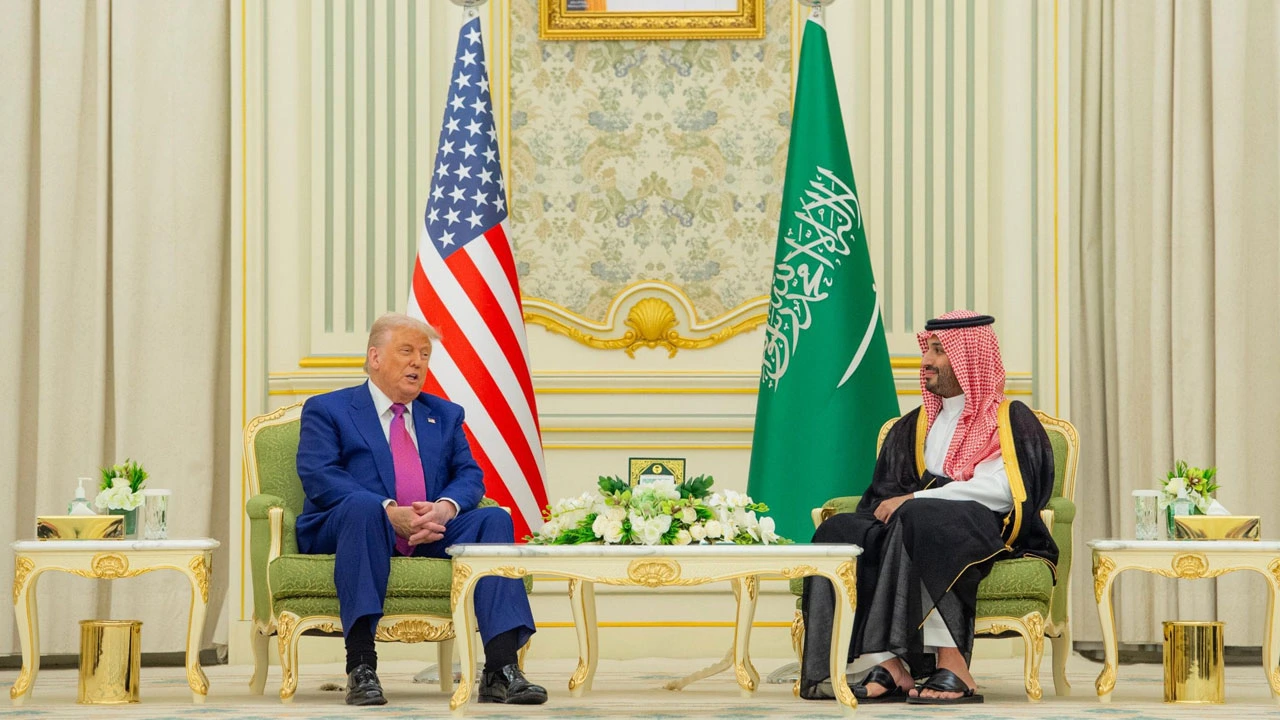
President Donald Trump framed the partnership as a jobs-focused victory during his Riyadh visit, emphasizing immediate economic gains over geopolitical disputes like Israeli-Saudi normalization.
At its core lies a $142 billion defense package, the largest arms sale in U.S. history, supplying Saudi Arabia with advanced fighter jets, missile defense systems, and cybersecurity upgrades.
Over a dozen U.S. defense firms will provide equipment across air force modernization, maritime security, and border surveillance. The agreement includes training programs for Saudi forces, reinforcing Riyadh’s reliance on American military expertise amid regional instability.
Saudi investments target critical U.S. sectors. Tech firm DataVolt pledged $20 billion for AI data centers and energy infrastructure. A coalition including Google, Oracle, and AMD committed $80 billion to develop AI and advanced manufacturing in both countries.
U.S.–Saudi Pact Deepens Ties with $600B in Trade
U.S. companies like AECOM and Parsons secured $2 billion in contracts for Saudi megaprojects, including the $500 billion Qiddiya entertainment hub and King Salman International Airport.
Energy and aerospace exports form another pillar. GE Vernova will supply $14.2 billion in gas turbines, while Boeing finalized a $4.8 billion deal to deliver 737-8 jets to Saudi lessor AviLease.
In healthcare, Shamekh IV Solutions plans a $5.8 billion Michigan facility to produce intravenous fluids, addressing U.S. supply chain vulnerabilities. Sector-specific funds-$5 billion for energy, $5 billion for aerospace, and $4 billion for sports-aim to channel Saudi capital into U.S. ventures.
For the U.S., the pact promises job creation in manufacturing and tech, building on Saudi direct investments that reached $9.5 billion in 2023. Riyadh gains expertise to diversify its oil-reliant economy under Vision 2030, leveraging U.S. innovation to modernize infrastructure.
Bilateral trade hit $25.9 billion in 2024, yielding a $443 million surplus for the U.S. Analysts see the deal as a strategic realignment, deepening Saudi dependence on U.S. arms and technology while countering Chinese and Russian influence in the Gulf.
The agreement’s scale reflects Trump’s transactional diplomacy, prioritizing economic wins over complex geopolitics. With $600 billion now committed, the partnership reshapes global trade dynamics, positioning Washington as Riyadh’s indispensable ally in an era of economic uncertainty.
This article was produced by The Rio Times’ automated newsroom system. How we use AI · Report an error
Read More from The Rio Times