Trading Pattern Shifts: Brazilian Real Outperforms as USD/BRL Tests New Support Levels
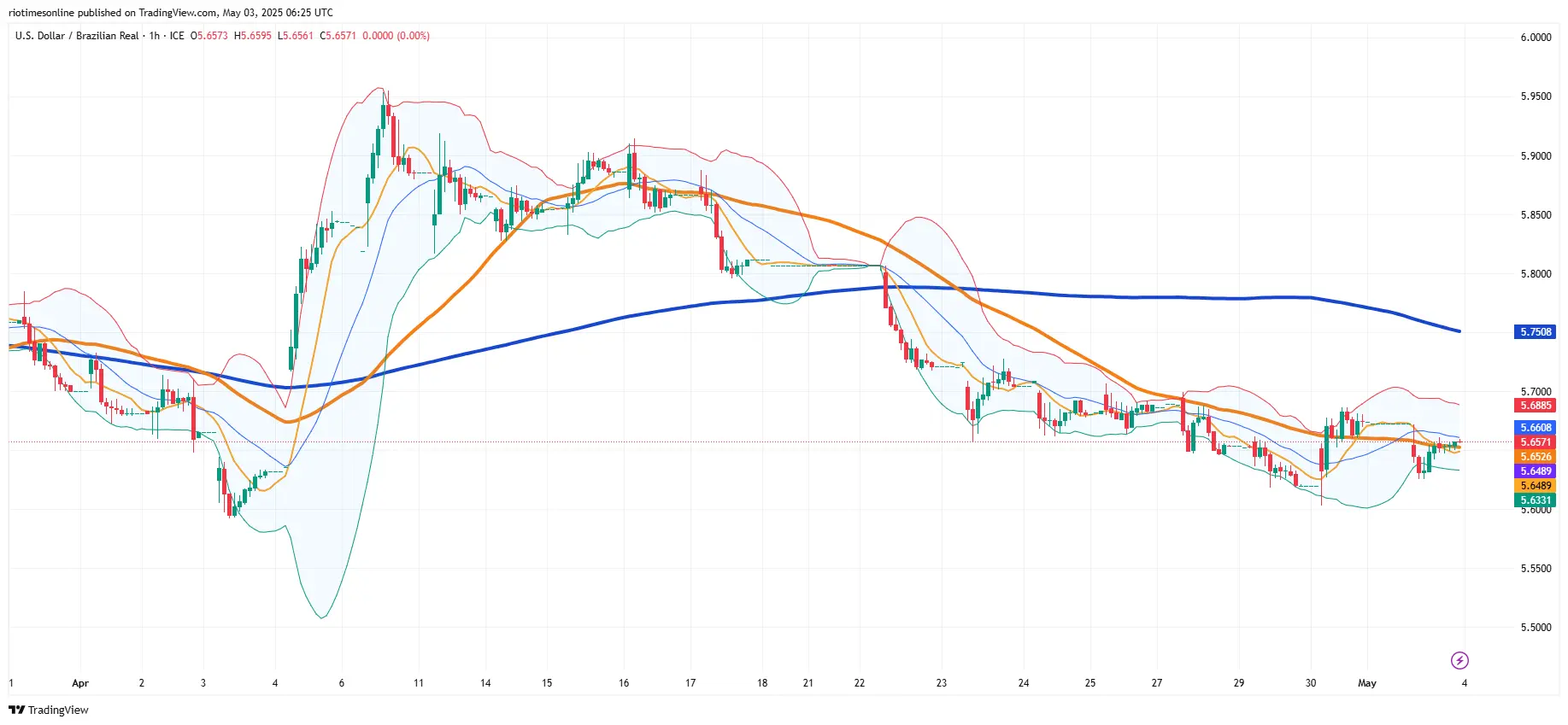
The Brazilian real traded at 5.6573 against the US dollar Saturday morning, showing modest strength after closing at 5.666 on Friday.
Trading data reveals the currency has steadily gained ground since mid-April. This appreciation continues despite mounting domestic inflation concerns and slowing growth projections for the Brazilian economy.
Brazil’s central bank has maintained an aggressive monetary policy stance. Policymakers raised the benchmark Selic rate to 14.25% in March, its highest level since October 2016.
This decisive action targets inflation, which accelerated to 5.49% in mid-April-the highest rate in over two years. Food and beverage prices surged 1.14% in the first half of April alone.
Meanwhile, the US economy unexpectedly contracted by 0.3% in the first quarter of 2025. This downturn marks a sharp reversal from the previous quarter’s 2.4% growth.
Increased imports and decreased government spending drove the decline, despite some gains in investment and consumer spending areas.
Brazil faces significant economic headwinds despite the real’s current stability. Growth projections show a slowdown to 1.6% for 2025, down from around 3% in recent years.
Analysts expect stronger performance initially, followed by marked deceleration later this year. The agricultural sector provides some support against high interest rate constraints.
Trading Pattern Shifts: Brazilian Real Outperforms as USD/BRL Tests New Support Levels
Trading volumes remain balanced as investors position cautiously ahead of key economic releases. Technical analysis shows the USD/BRL pair testing support levels near 5.65. Current patterns suggest potential for further real strength if global risk sentiment remains positive.
The substantial interest rate differential between Brazil and major economies continues to attract capital flows. Foreign investors find Brazilian assets appealing despite ongoing economic uncertainties. However, global trade tensions and domestic fiscal policy concerns create headwinds that could affect these flows.
The real has traveled a volatile path in 2025, reaching as high as 6.24 in early March before strengthening to current levels. Year-over-year, the currency has weakened 10.15% against the dollar. Market participants now await Brazil’s next monetary policy decision in May, which could determine the real’s direction through the summer months.
This article was produced by The Rio Times’ automated newsroom system. How we use AI · Report an error · Editorial responsibility: Matthias Camenzind, Editor-in-Chief
LatAm Markets: Live Signals → — real-time movers, turnover leaders and FX across Latin America.