Latin American Steel Sinks on China Fears, Brazil Policy
Key Facts
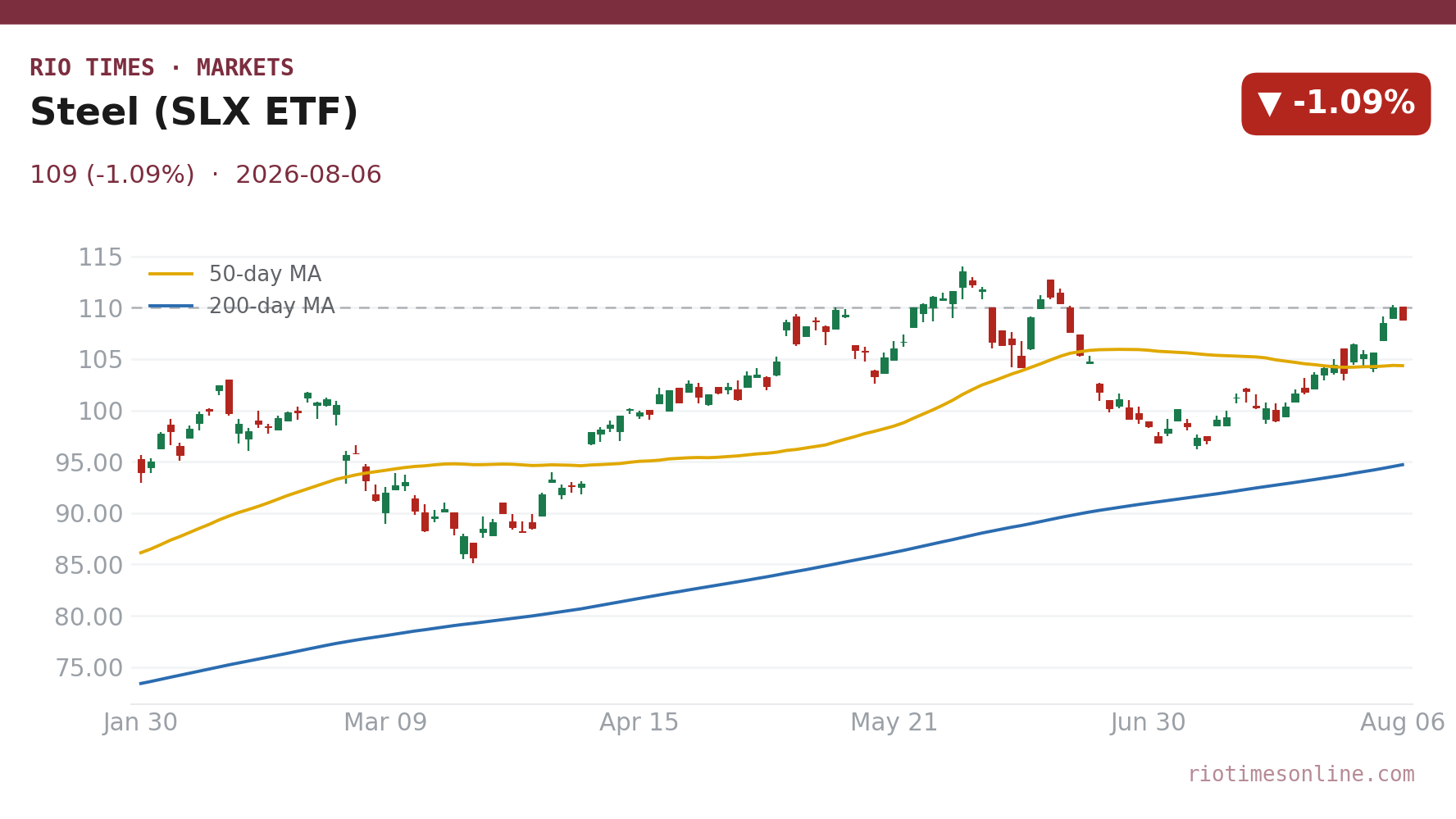
- The SLX steel-producers ETF slid 1.09% to US$108.80 reflecting broad pressure across the global steel complex as investors reassessed industrial demand signals.
- Mexico’s Ternium bore the brunt of selling, down 3.39% to US$51.89 as traders fretted over US market access and a relentless tide of low-cost Chinese steel flooding Latin corridors.
- Brazil’s CSN endured the deepest blow with its ADR falling 3.86% to US$0.9438 a move linked to cooling domestic construction activity and thin auto-sector order books.
- Long-steel bellwether Gerdau retreated 1.95% to US$5.04 highlighting a session devoid of safe havens within the region’s metals complex.
- Brazil’s industrial sector index fell 1.10% in the São Paulo session underscoring fears that even after Wednesday’s Copom cut, borrowing costs remain high enough to smother heavy-industry demand.
- Brazil mid-July inflation slowed to 4.52% annually, reported July 28 offering little relief to steelmakers who face squeezed margins between soft local prices and sticky credit costs.
Today’s Focus
Latin American steel equities tumbled Thursday as a cocktail of geopolitical noise, Chinese oversupply fears and softening Brazilian construction data slammed producer stocks. The broad-based steel ETF SLX settled 1.09% lower at US$108.80, dragged by heavyweight Latin names Ternium, CSN and Gerdau.
Investors ran for the exit after Brazilian industrial sector gauges fell over one percent, coinciding with a Copom decision that trimmed the Selic to 14.00%, still a punitive level for construction borrowers. With Brazil’s basic materials sub-index down 0.14%, the session cemented a risk-off posture for manufacturers of structural and flat steel alike.
Ternium bled the most in dollar terms, sliding 3.39% to US$51.89 as the persistent flood of tariff-skirting Chinese slab and coil made price recovery in Mexico look distant. CSN’s ADR cratered 3.86% to US$0.9438, a signal that even low-cost integrated producers are struggling to preserve margins as domestic construction orders thin and auto makers trim run rates.
What matters today. Mexico and Brazil’s steel sectors are being squeezed by excess Chinese supply and stubbornly high local interest rates, leaving little room for equity recovery until either demand or protectionism shifts.
01 The session in one read
Latin American steel stocks slumped hard on Thursday, with every major name from Brazil and Mexico closing deeply in the red. The SLX exchange-traded fund, a basket of global steel producers, fell 1.09% to US$108.80, while the sharpest individual sell-offs landed on Mexico’s Ternium and Brazil’s CSN.
A fresh wave of anxiety about cheap Chinese metal, paired with stale construction demand in Brazil’s high interest-rate environment, sapped any remaining appetite for the sector. The moves came even as the broader Ibovespa showed mixed signals, with Brazil’s industrial sector index tumbling 1.10% during São Paulo trading.
Latin American steel equities are pricing in a grim combination of oversupply from China and anaemic construction demand in Brazil, whose industrial sector fell 1.10% on Thursday. With Brazil’s Selic rate cut to 14.00% at Wednesday’s Copom meeting — a fourth straight reduction, but still one of the highest policy rates in the world — credit-sensitive building activity faces more headwinds, making any near-term earnings upgrade unlikely. The variable to watch is whether a new round of anti-dumping tariffs emerges from Brasília or Mexico City to cap the tide of discounted Chinese metal.
02 The board
Mexico’s Ternium, which runs massive flat-steel operations in Nuevo León and across the USMCA region, dropped 3.39% to US$51.89, its worst session of the week. Brazil’s CSN fared worse on a percentage basis, with its New York-traded ADR plunging 3.86% to US$0.9438, while long-steel leader Gerdau shed 1.95% to US$5.04.
The red ink was unusually uniform: no flagship Latin steel name escaped a decline. Brazil’s basic materials gauge retreated 0.14%, a softer but telling signal that miners and steelmakers alike were out of favour on Thursday amid thinning order flows from construction and automotive clients.
| Asset | Level | Change |
|---|---|---|
| Steel (SLX ETF) | US$108.80 | -1.09% |
| Gerdau | US$5.04 | -1.95% |
| CSN (ADR) | US$0.9438 | -3.86% |
| Ternium | US$51.89 | -3.39% |
Source: EODHD close, 2026-08-06. Where a commodity has no spot feed, an exchange-traded tracker or leading producer is shown as a labelled proxy.
Live Market IntelligenceThe live market board
Rio Times · Live Market Intelligence
Latin America — Cross-Market Board
| Instrument | Last | Change | YoY | Prev. | High | Low | Volume |
|---|---|---|---|---|---|---|---|
| IBOV | 175,546.36 | -1.23% | +30.48% | 177,726.17 | — | — | — |
| IPSA | 11,275.15 | +1.05% | — | 11,157.69 | 11,342 | 11,149 | 1,513,213,483 |
| IPC MEX | 66,396.15 | -0.19% | +16.17% | 66,525.18 | — | — | — |
| MERVAL | 3,100,732 | -1.76% | +28.39% | 3,156,332 | — | — | — |
| COLCAP | 2,350.44 | +0.24% | — | 9.04 | 9.05 | 9.02 | 4,133 |
| BVL PERÚ | 58,781.02 | +0.81% | — | — | — | — | — |
| USD/BRL | 5.11 | +0.04% | -6.35% | 5.11 | 5.11 | 5.10 | — |
| EUR/BRL | 5.89 | -0.70% | -7.42% | 5.93 | 5.89 | 5.88 | — |
| USD/MXN | 17.17 | -0.30% | -7.70% | 17.22 | 17.22 | 17.17 | — |
| USD/CLP | 915.30 | -0.06% | -6.06% | 915.84 | 915.30 | 915.30 | — |
| USD/COP | 3,152 | -0.93% | -22.06% | 3,181 | 3,152 | 3,151 | — |
| USD/PEN | 3.38 | +0.15% | -4.77% | 3.38 | 3.38 | 3.38 | — |
| USD/ARS | 1,500 | +0.22% | +12.61% | 1,496 | 1,500 | 1,500 | — |
| USD/UYU | 40.24 | +1.43% | +1.57% | 39.67 | 40.24 | 40.24 | — |
| USD/PYG | 5,919 | +1.21% | -19.77% | 5,848 | 5,919 | 5,919 | — |
| USD/BOB | 11.81 | -1.30% | +74.89% | 11.97 | 11.81 | 11.81 | — |
| USD/DOP | 58.22 | +0.38% | -4.16% | 58.00 | 58.23 | 58.19 | — |
| USD/CRC | 449.80 | +1.97% | -8.99% | 441.11 | 449.80 | 449.80 | — |
03 What moved it
China’s steel mills continue to export at elevated volumes, sending hot-rolled coil and rebar into Latin American ports at prices domestic mills cannot profitably match. Traders watching the Mexican market noted that even Ternium’s high-margin downstream finishing plants are feeling the heat from imported Chinese substrate.
On the demand side, Brazil’s central bank cut the Selic to 14.00% on Wednesday, its fourth straight quarter-point reduction, but left borrowing costs painfully high for developers and homebuilders. A 14% policy rate validated investor fears that construction steel demand will stay muted well into the second half of 2026.
04 The Latin American read
For international investors, Thursday’s rout is a reminder that Latin American steel equities are a double-edged exposure: high operational leverage to construction cycles but extreme vulnerability to Chinese trade flows. Brazil’s mid-July inflation reading of 4.52%, reported by Reuters on July 28, offered little comfort because sticky services prices keep the central bank from cutting rates faster.
The IMF’s latest Article IV review projects Brazil’s economy will expand 2.4% in 2026, but warns that inflation may hit 5.6% by year-end. That outlook dampens the idea that a rapid credit easing will revive heavy-civil or residential building any time soon, leaving steel order books patchy.
05 The names to watch
Gerdau, with mills across the Americas and a hefty US long-steel footprint, remains a bellwether for regional infrastructure spend. CSN, as an integrated slab-and-flat producer, is the name most directly sensitive to any Brazilian anti-dumping action against Chinese cold-rolled and galvanised sheet.
Ternium’s fate is tied to both Mexico’s auto assembly plants and Washington’s trade stance toward Asian steel. Should the US tighten rules of origin or impose new countervailing duties, Ternium would be the first Latin issuer to reprice.
06 The outlook
The path ahead is pinned to two variables: Beijing’s willingness to curb steel exports and Brasília’s ability to pass new protective tariffs swiftly. Until one of those changes, Latin steel equities will trade more like distressed deep cyclicals than steady industrial compounders.
07 What to watch
- China export data: Surprise drop in Chinese shipments would be the single biggest catalyst for a sharp Ternium and CSN rally.
- Brazil construction PMI: Any new employment or orders reading above 50 would challenge the bear thesis on Gerdau’s future volumes.
- US-Mexico trade policy: A tightening of rules around steel used in autos would re-rate Ternium’s earnings multiple.
- Copom forward guidance: Minutes due next week; any hint of a larger rate cut in September would spark steel-stock buying.
Frequently Asked Questions
Why did Latin American steel stocks fall on Thursday?
Cheap Chinese imports continue to undercut regional prices while Brazil high interest rates are strangling construction demand, creating a double squeeze for steel producers.
What hit Mexico’s Ternium hardest this session?
Ternium shed 3.39% to US$51.89 as abundant Chinese slab and coil, partly rerouted through trade-friendly jurisdictions, undercut domestic flat-steel prices.
Why was Brazil’s CSN the worst percentage loser?
CSN ADR dropped 3.86% to US$0.9438 because of falling domestic demand for flat products and investor disappointment that the Copom cut the Selic only to a still-crushing 14.00%.
Is the rest of Latin America equally affected?
Yes, because China ships steel to all major Latin ports and most regional governments have been slow to impose airtight anti-dumping duties.
This article was produced by The Rio Times’ automated newsroom system. How we use AI · Report an error
LatAm Markets: Live Signals → — real-time movers, turnover leaders and FX across Latin America.
Read More from The Rio Times