Mexico Markets: IPC & the Peso — August 7, 2026
Key Facts
- Mexico’s S&P/BMV IPC index slipped 0.19% to 66,396 points, tracking a cautious session on Wall Street as jitters about oil prices and US employment set the tone.
- The peso closed virtually unchanged at 17.22 per dollar, consolidating near its strongest levels of the year as Banxico held its key interest rate steady for a second straight meeting.
- The Bank of Mexico kept borrowing costs on hold at 6.50%, judging that inflation will not drift back to the 3% target until the final quarter of 2027.
- Trading was concentrated in heavyweights: Cemex slipped 1.9% on global growth nerves, while Walmex gained 0.7% as investors rotated into domestic consumer defensives.
- Airport operators bucked the decline, with GAP up 2.2% and ASUR rising 1.5%, making them the session’s standout gainers on Mexico’s main stock exchange.
Today’s Focus
Mexico’s benchmark S&P/BMV IPC index—the barometer for the country’s largest listed companies—eased 0.19% on Thursday, closing at 66,396 points. The move mirrored a flat-to-lower session on Wall Street, where the S&P 500 slipped 0.18% and the Dow Jones shed 0.85% as traders hesitated ahead of a key US jobs report.
The spotlight in Mexico City, however, was on the central bank. Banxico left its reference interest rate unchanged at 6.50%, extending the pause that began in June after May’s quarter-point cut. Policymakers warned that although headline inflation has improved, getting it back to the 3% target will be a lengthy job, likely stretching into late 2027.
The peso barely budged, closing at 17.22 per dollar. That leaves the Mexican currency sitting near the strongest end of its 52-week range and suggests foreign investors are comfortable holding Mexican assets so long as the interest-rate cushion remains generous.
What matters today. Mexico’s central bank signalled patience on rate cuts, keeping a high floor under local yields even as stock investors grew cautious ahead of US payroll data.

01 The session in one read
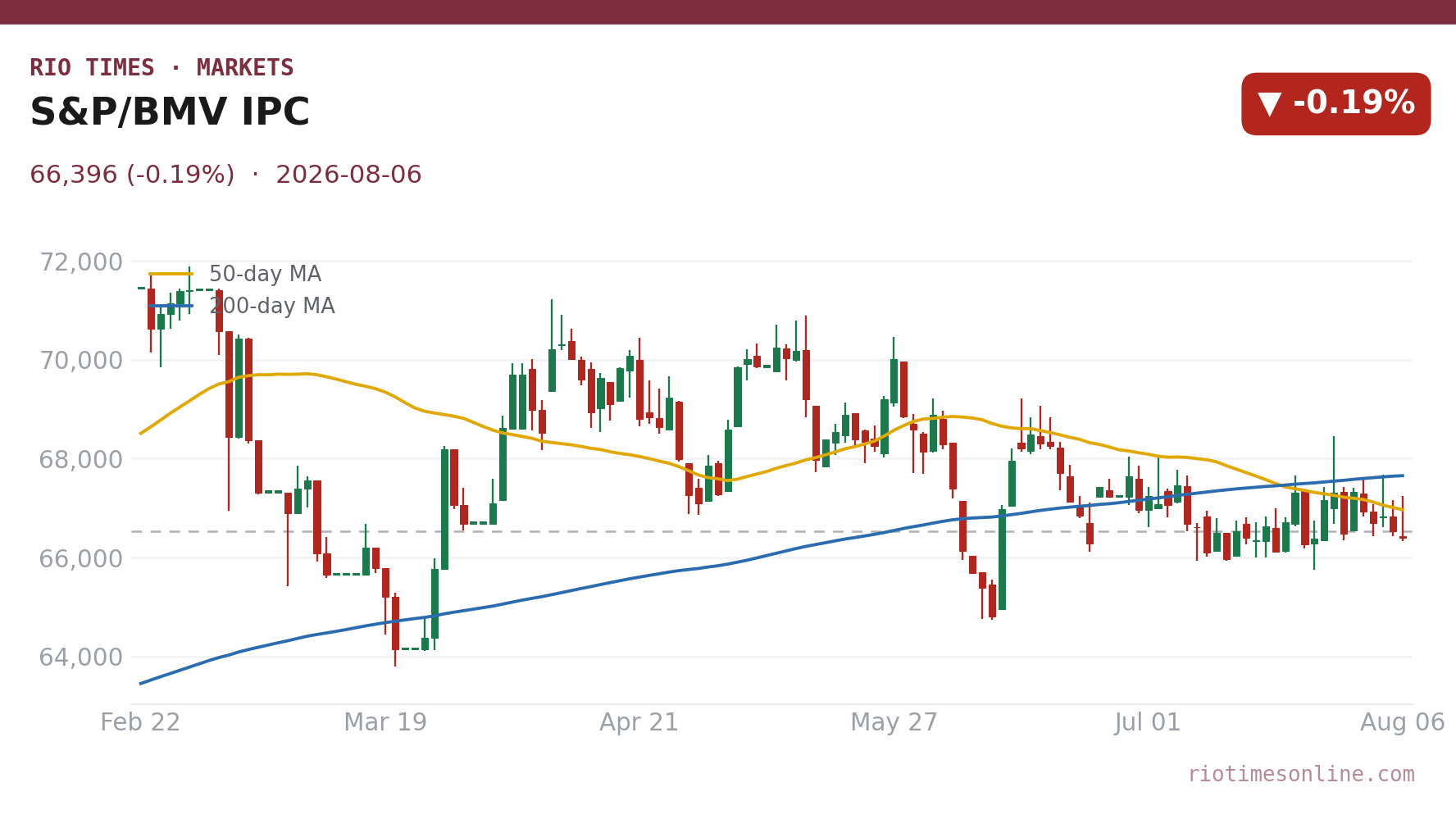
Mexico’s stock market took a small step back on Thursday, with the S&P/BMV IPC slipping 0.19% to 66,396 points. The mood was tethered to Wall Street, where a rise in oil prices and nervousness before the US employment report kept major indices in check.
At home, the central bank gave investors plenty to digest. Banxico’s decision to hold its benchmark rate at 6.50% was the second such pause in a row, and the statement made clear that officials see no quick path to their 3% inflation target. That message helped anchor the peso, which closed at 17.22 per dollar, a mere 0.02% firmer on the day.
Activity clustered around the market’s biggest names. Cement giant Cemex fell 1.9% on the heaviest share volume among the blue chips, while retail heavyweight Walmex rose 0.7%. The airport operators GAP and ASUR led the gains, rising 2.2% and 1.5% respectively.
The mix of a unanimous Banxico hold, a virtually frozen peso, and a shallow IPC decline points to a market that is waiting rather than panicking. Losses were concentrated in the globally exposed names—cement and mining—while domestic retail held up, a classic ‘risk-off but not running for the exits’ story. The biggest variable to watch now is Friday’s US nonfarm payrolls print—a strong number could jolt US rate expectations and rattle the peso, while a soft one might quickly reignite bets on Banxico easing before year-end.
02 The day’s numbers
| Measure | Level | Change | Read |
|---|---|---|---|
| IPC (S&P/BMV IPC) | 66,396 | −0.19% | Mexico’s benchmark index |
| USD/MXN | 17.22 | −0.02% | Peso near 52-week high |
| 52-week range | 58,070 – 71,601 | — | Closed 7.3% below peak |
| S&P 500 | 7,710 | −0.18% | US equities cautious |
| VIX | 15.15 | −4.17% | Wall Street’s fear gauge fell |
The IPC closed comfortably inside its recent range, sitting 7.3% below its 52-week closing high of 71,601 points, set in February. The index has spent recent months drifting sideways as investors weigh Banxico’s high rates against a slowing global economy.
The peso, meanwhile, is trading close to its strongest level in a year. At 17.22 per dollar, it is about 0.55% away from the 17.13 floor of USD/MXN’s 52-week band—the point at which the peso was at its firmest. A falling VIX—Wall Street’s so-called fear gauge, which dropped 4.17% to 15.15—suggests global markets are watchful rather than fearful as they await US payrolls data. The market board below streams live prices, which will move away from Thursday’s closes once trading resumes. Rio Times · Live Market Intelligence
Live Market IntelligenceMexico — Live Market Board
Mexico — Live Market Board
Instrument Last Change YoY Prev. High Low Volume
IPC MEX
64,317.86
-0.22%
+12.17%
64,456.59
66,121
65,405
108,886,187
USD/MXN
17.06
-0.24%
-8.58%
17.10
17.08
17.01
—
WALMEX
48.07
-0.62%
-14.38%
48.37
48.65
48.02
10,781,446
GMEXICO
223.28
+0.35%
+73.59%
222.50
226.18
222.17
1,325,556
FEMSA
201.19
-0.24%
+25.67%
201.67
206.71
199.56
750,706
CEMEX
19.32
+0.89%
+19.10%
19.15
19.35
19.04
14,327,054
GFNORTE
193.98
+1.18%
+14.36%
191.71
195.79
191.83
1,579,115
BIMBO
60.98
-0.96%
+11.89%
61.57
61.46
60.29
1,048,115
TELEVISA
9.71
+0.21%
+12.78%
9.69
9.75
9.60
577,851
AMX
19.80
-0.95%
+12.53%
19.99
20.05
19.70
58,058,525
GAP
366.23
+0.43%
-21.21%
364.68
370.85
362.82
226,946
ASUR
275.04
+1.25%
-15.28%
271.64
275.08
271.31
15,451
OMA
233.50
+0.62%
-6.48%
232.06
235.00
230.62
555,693
KOF
188.04
+0.86%
+18.94%
186.44
188.56
185.52
425,273
GRUMA
252.90
+0.11%
-21.85%
252.61
254.74
250.36
90,048
KIMBER
39.74
+0.43%
+8.85%
39.57
40.09
39.33
490,551
AMX ADR
23.38
-0.23%
+22.25%
23.43
23.49
23.06
1,347,445
03 Why it moved — Banxico holds, Wall Street hesitates
The August 6 session had two pulses: a cautious global beat and a steady local drum. On Wall Street, the Dow fell 0.85% and the S&P 500 shed 0.18%, with traders citing nervousness over a rebound in oil prices and uncertainty ahead of Friday’s US jobs report. Crude-tracking funds jumped more than 3% on the day. That filtered directly into Mexico through the heavyweight stocks that foreign funds trade most.
At the same time, Banxico removed any doubt about its near-term intentions. The five-member board voted unanimously to keep the key interest rate on hold for a second consecutive meeting. The accompanying statement showed policymakers believe inflation will not sustainably reach the 3% target until the fourth quarter of 2027—pushed back from the second quarter previously projected—making any cut before year-end a distant prospect.
That high-rate backdrop is a double-edged sword for Mexican equities. It keeps the peso attractive for carry traders—investors who borrow in low-yielding currencies to buy higher-yielding ones—but it also raises borrowing costs for Mexican companies. The result was an uneven session: globally exposed names such as Cemex and Grupo México fell, while domestic retailer Walmex and the regulated airport operators gained. Bottler and convenience-store group Femsa was the notable exception among consumer names, dropping 2.3%.
04 The day’s movers
| Stock | Close | Change | Note |
|---|---|---|---|
| Cemex (CEMEXCPO) | MXN 19.52 (US$1.13) | −1.9% | Global construction bellwether |
| Femsa (FEMSAUBD) | MXN 209.73 (US$12.18) | −2.3% | Bottling and OXXO retail group |
| Walmex (WALMEX) | MXN 48.99 (US$2.84) | +0.7% | Defensive rotation beneficiary |
| GAP (GAPB) | MXN 382.15 (US$22.19) | +2.2% | Airport group led the gainers |
| ASUR (ASURB) | MXN 476.96 (US$27.69) | +1.5% | Second airport operator higher |
| Grupo México (GMEXICOB) | MXN 219.82 (US$12.76) | −1.3% | Mining giant dragged by commodity nerves |
The split between global and domestic exposure told the session’s real story. Cemex, Mexico’s globally diversified cement producer, fell 1.9% on the heaviest share volume of the blue chips. Traders treat Cemex as a proxy for worldwide construction demand, so its decline reflected the broader unease about economic growth. Grupo México, the copper and infrastructure group, shed 1.3% as commodity nerves spread.
Retailer Walmex, by contrast, added 0.7%. It is a classic defensive name—people still buy groceries when the economy cools. Femsa, the vast bottling and convenience-store conglomerate that owns OXXO, was the exception, dropping 2.3%. The airports were the brightest spot: Grupo Aeroportuario del Pacífico (GAP) gained 2.2%, and Grupo Aeroportuario del Sureste (ASUR) rose 1.5%, extending a run of strength for Mexico’s tourist-facing infrastructure stocks.
05 The regional scoreboard
| Index | Country | Change |
|---|---|---|
| IPC | Mexico | −0.19% |
| Ibovespa | Brazil | −1.23% |
| IPSA | Chile | +1.05% |
Mexico’s 0.19% dip left it in the middle of a mixed Latin American pack. Brazil’s Ibovespa—the region’s largest stock market—suffered the sharpest decline of the major regional benchmarks, down 1.23% as commodity and rate worries weighed. On the winning side, Chile’s IPSA jumped 1.05%, making it the regional outperformer as copper-linked names rallied.
06 The technical picture
The IPC at 66,396 points is stuck in a well-defined range. The index is 7.3% below its 52-week closing high of 71,601, but it sits roughly 14% above the 52-week closing low of 58,070 points. Chart watchers often focus on the 65,000 level as a psychological floor—breaks below that have been brief and quickly bought in recent months.
For the peso, the technical story is one of quiet strength. USD/MXN at 17.22 is about 0.55% above the 17.13 low of its 52-week range, which marks the peso’s firmest close of the past year. A concerted push down through that 17.13 level would signal a new leg of peso appreciation, but that would likely require a clear catalyst, such as a surprisingly weak US jobs print on Friday or a sudden dollar sell-off.
07 What to watch
- US employment: Friday’s US July nonfarm payrolls report will set the short-term direction for the peso and index heavyweights like Cemex.
- Banxico minutes: Investors will parse the minutes, due in the coming weeks, for any hint of when the board might discuss rate cuts.
- Oil price path: The crude rebound spooked global markets on Thursday; sustained gains could hurt Mexico’s subsidy-sensitive fiscal outlook.
- Airport traffic data: GAP and ASUR have led the market; upcoming passenger figures will test that rally.
More: Mexico news in English, every day from The Rio Times.
Frequently Asked Questions
What happened to the Mexican stock market on August 6?
The S&P/BMV IPC fell 0.19% to 66,396 points, tracking a cautious Wall Street and reacting to Banxico’s decision to hold interest rates steady.
Why did Banxico keep its interest rate unchanged?
The bank’s five-member board voted unanimously to hold at 6.50%, judging that inflation will not return to the 3% target until the fourth quarter of 2027, so cutting now would be premature.
Which Mexican stocks moved the most?
Femsa dropped 2.3% and Cemex fell 1.9%, while Walmex rose 0.7% and the airport groups GAP and ASUR gained 2.2% and 1.5% respectively.
Where is the peso trading against the dollar?
The peso closed at 17.22 per dollar, 0.02% firmer on the day and about 0.55% from its strongest close of the past 52 weeks.
This article was produced by The Rio Times’ automated newsroom system. How we use AI · Report an error
In depth
LatAm Markets: Live Signals → — real-time movers, turnover leaders and FX across Latin America.
Read More from The Rio Times
- JPMorgan Uruguay Office Is Under Study, Not Decided, While Licensed Wealth Firms in Uruguay Manage US$47.29 Billion for 88,298 Clients
- Chile-Australia Strategic Partnership Begins Without a Signature as Foreign Ministers Meet at the United Nations on 22 September 2026
- Guyana Gas-to-Energy Plant Aims to Fire Its First Turbine Around 4 December 2026, Adding 57 MW of a Planned 300 MW