SOS Amazonia: “Don’t Buy Brazilian Products,” Urges Indigenous Activist
RIO DE JANEIRO, BRAZIL – “Soy kills and poisons us. Livestock kills and drives us away,” explained indigenous activist Alessandra Korap at the climate strike last Friday.
At the Fridays for Future rally, the Brazilian called for a boycott of soy and meat products from Brazil: “Don’t buy any Brazilian products that have indigenous blood on them.”

The woman from the Munduruku people stands barefoot, in a T-shirt and jeans on stage in front of the Brandenburg Gate. She explains how she sees the Brazilian government: “President Bolsonaro doesn’t like indigenous people, he doesn’t like virgin rainforests and rivers. He refuses to designate our reserves and instead wants to sell land to the US.”
At the invitation of the action group Solidarity World and the research and documentation center Chile-Latin America (FDCL), the activist of the indigenous women’s rights movement talks about the causes for the threat to the Amazon region and about the feared genocide of the “peoples of the forest”.
Their fear is that if the Mercosur Treaty is ratified, the European Union’s free trade agreement with the Mercosur states of South America, Brazilian agribusiness will grow even faster.
The world sees that the Amazon is on fire. They are experiencing the consequences of deforestation in Brazil.
“The Amazon region is sick. The jungle and the people are contaminated with agricultural poisons, mercury, and wastes. Amazonia is threatened every day and every minute. When forests burn down, we indigenous groups lose the very foundation of our lives. The forest and the rivers give us everything, including medicine and food. We see the jungle as our supermarket and our church.
You have spoken at Fridays for Future participants in Berlin. How do you feel about the movement in Germany?
“I am grateful that such a large crowd, including so many young people, children and elderly people, are worried about the planet. But the Germans don’t know exactly what is happening in Brazil. I am here to make it public. In Berlin, I was able to deliver the message of my people and I felt: We are not alone.
In April, 4,500 Brazilian natives organized a protest march to the capital city of Brasília and demanded land rights.
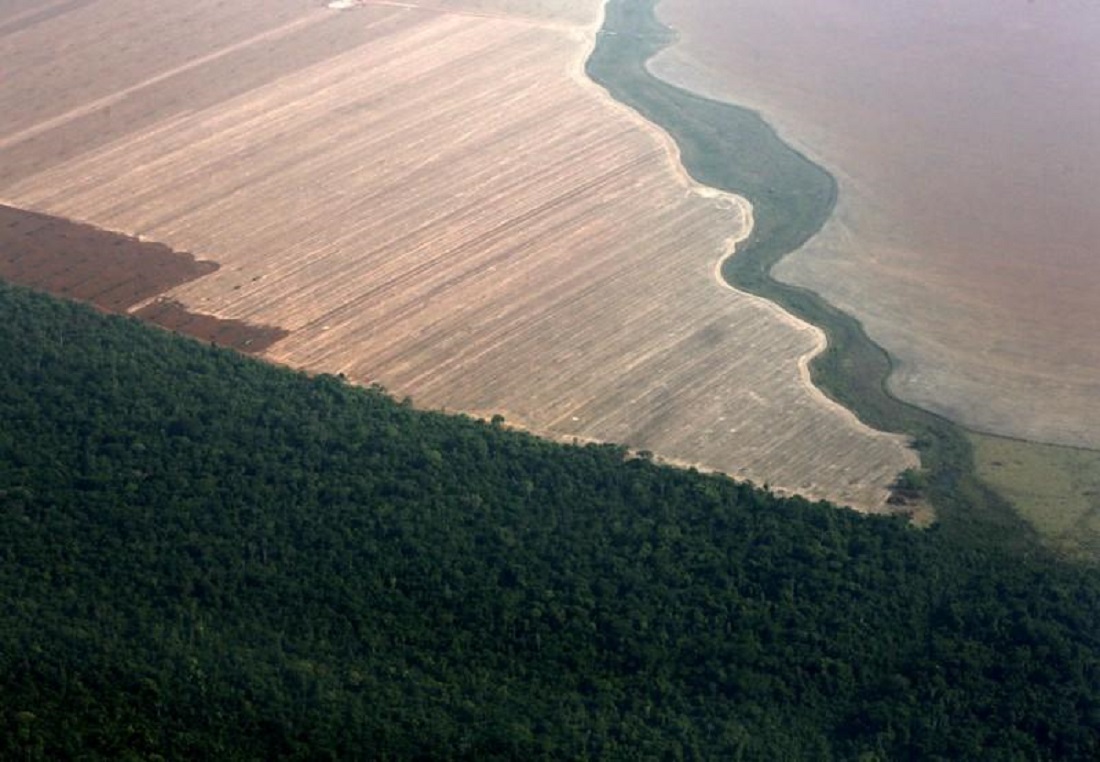
“Deforestation is destroying our sacred places. The forest is destroyed for all kinds of economic activity: for timber extraction, for soy and maize cultivation, for cattle grazing, for the extraction of mineral resources, for loading docks, for hydroelectric power stations, for a new railway line.
“Only 20 kilometers from the city lies the large river port of the Rio Tapajós, where fishermen are observing strange things.
“When the soybean harvest is loaded onto giant ships, there is a large cloud of soy dust. The soy dust drops into the river water, where fish eat the grains. However, the particles are so heavily contaminated with agricultural poison that they sicken fish. They survive, but they are foul and inedible. Fishermen increasingly talk about such catches. I have also seen these contaminated fish.
There are 36 new loading docks for soy and maize planned by the government in your Pará region.
“Six of these river harbors have already been built. The Rio Tapajós is the most important tributary river of the Amazon. The Amazon flows into the Atlantic, from where the massive soy harvest is exported all over the world.
“The São Luiz do Tapajós hydroelectric power plant has successfully barred Munduruku protests, made together with Greenpeace 2016. But a total of 43 new hydropower plants are planned in Brazil, four of which have already been built. The government’s next controversial infrastructure project is a more than 1,000-kilometer-long train line to carry the soy harvest from Mato Grosso to the river port near Santarém in the Amazon region.
“We are fighting against the construction of the Ferrogrão railway line, which is used solely for agribusiness. If soy production expands, this will result in the complete destruction of many indigenous areas.
Munduruku warriors walked 100 kilometers through their territory in July to drive out illegal loggers.
“We indigenous people have been resisting for 519 years. But Brazil is bathing in the blood of indigenous peoples.
“Chiefs and indigenous leaders are murdered. Our children die because of capitalism. When the Mercosur-EU Trade Agreement comes into force, more rainforest will be destroyed – for export: the land will be exploited even further. More money will be at stake.
“Capitalism does not care about its neighbors, only about its own profits. We are here to defend our future.
“Stop consuming beef and soy from Brazil. We need your help.”
More: Brazil news in English, every day from The Rio Times.
This article was produced by The Rio Times’ automated newsroom system. How we use AI · Report an error · Editorial responsibility: Matthias Camenzind, Editor-in-Chief