
ECONOMY · SENEGAL
Key Facts
- —The country Senegal is a West African coastal state that uses the CFA franc, pegged to the euro and managed by the BCEAO, the central bank shared by eight countries.
- —Why it matters Food is about 45% of the national price basket, and the government raised pump prices in August to curb fuel subsidies.
- —Why now The statistics agency ANSD posted its September consumer price note on Friday 9 October; the October figures are due on Tuesday 10 November.
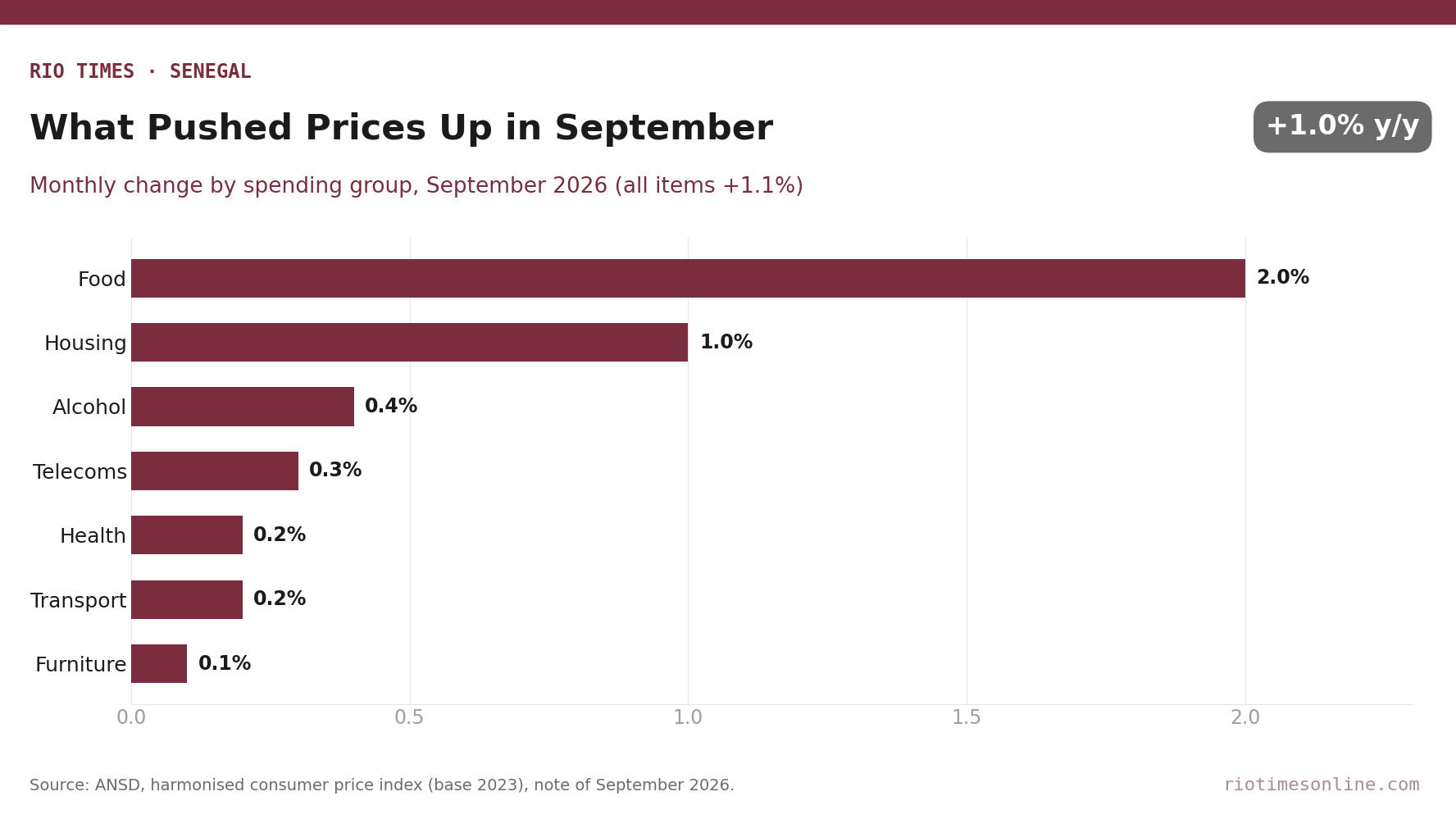
- —What happened Annual Senegal inflation eased to 1.0% in September from 1.2% in August, while prices rose 1.1% within the month after a 2.0% jump in August.
- —The numbers Food rose 2.0% in a month, leafy vegetables 23.9%, electricity 3.8% and fuel 4.4%, according to ANSD.
- —What it means for US readers Low inflation helps a government whose debt foreign investors watch closely, but monthly food and fuel jumps show pressure on households.
- —Still open Whether vegetable prices fall back after the rainy season, and whether the government adjusts pump prices again as it trims subsidies.
Senegal inflation eased to 1.0% in September from 1.2% in August, the national statistics agency said in its monthly price note. Prices still rose 1.1% within the month, driven by vegetables, electricity and the fuel price rise decided in August.
For US readers, the link runs through dollar-priced fuel imports and Senegal’s public finances, which foreign investors watch closely. Low annual inflation helps the government, but the monthly jumps show that households are feeling food and energy costs.
The figures come from the Agence nationale de la Statistique et de la Démographie (ANSD), the state statistics office in Dakar. It posted the September harmonised consumer price index on Friday 9 October, and the next release is due on Tuesday 10 November.
Food and Power Drove a Monthly Jump
Food and non-alcoholic drinks rose 2.0% in a month, according to ANSD. That matters because food carries about 45% of the weight in the national price basket.
Leafy vegetables jumped 23.9%, fruit vegetables such as tomatoes 4.4% and tubers 5.4% in September. ANSD linked the rise to a continued drop in supply during the rainy season.
Fresh meat rose 3.5%, with 3.7% for processed fish, 4.1% for live goats and 0.5% for rice, the agency said. Citrus fruit fell 10.1% and sugar 0.5%, which softened the overall increase.
Housing, water, electricity and gas rose 1.0% in the month, mainly because average electricity prices climbed 3.8%. ANSD described September as a period of strong power demand.
Transport rose only 0.2% in the month, even though fuel prices climbed 4.4% after the pump price adjustment. Air fares for passengers fell 4.9% and offset part of that increase.
Core inflation, which strips out energy and fresh food, rose just 0.2% in the month and 1.0% over the year. That suggests the September jump came from volatile items rather than a broad rise in prices.
The Fuel Decision Behind the Pump Prices
From Saturday 15 August, super petrol rose 70 CFA francs (about US$0.12) to 990 CFA francs a litre (about US$1.69). Diesel rose to 755 CFA francs a litre (about US$1.29), an increase of 75 CFA francs (about US$0.13).
The government said the move only restored prices to their level before a cut on 6 December 2025. It blamed a conflict in the Middle East that began on 28 February 2026 for higher world oil prices.
Fuel subsidies had cost more than 245 billion CFA francs (about US$418 million) since January, the government said. Without adjustments, it projected energy subsidies of 1,069 billion CFA francs (about US$1.8 billion) for 2026.
That compares with 250 billion CFA francs (about US$426 million) budgeted by the National Assembly, according to the same statement. It said super still sells below its real cost of 1,019 CFA francs (about US$1.74), and diesel below 1,044 (about US$1.78).
All conversions here use the BCEAO reference rate of 586.67 CFA francs per dollar on Monday 12 October. The CFA franc is fixed at 655.957 per euro, so its dollar value moves with the euro.
Local Goods Rise as Imports Ease
Over twelve months, prices of local products rose 1.4%, while imported goods fell 0.2%, ANSD said. That split points to domestic supply, not imported inflation, as the main source of pressure.
Saint-Louis in the north recorded the sharpest monthly rise, at 3.3%, and the highest annual rate, at 2.3%. Dakar rose 0.7% in the month and 1.2% over the year, while Kaolack was flat on the year.
Across the eight-country West African monetary union, annual inflation was 1.3% in August, according to ANSD’s regional comparison. Mali stood at 3.3% and Burkina Faso at 3.0%, while Côte d’Ivoire matched Senegal at 1.2%.
Earlier this month, ANSD reported that Senegal Industrial Output Falls 2.2% in August. Growth has also slowed, as covered in Senegal’s Economy Slows to 2.5% as Debt Talks Begin.
What It Means for US Readers
For foreign investors in Senegalese government debt, low Senegal inflation is a stabiliser while the budget carries heavy energy subsidies. The pump price rise shows the government is willing to pass some costs to consumers.
Because fuel imports are priced in dollars and the CFA franc tracks the euro, a stronger dollar raises Senegal’s import bill. At current rates, super petrol costs about US$6.39 a gallon and diesel about US$4.87.
For travellers and expatriates in Dakar, the annual rate of 1.2% in the capital is modest by regional standards. Fresh produce, meat and electricity, however, rose noticeably in September.
What Is Not Known
ANSD does not say how much of the September vegetable surge in Senegal inflation will reverse once the rainy season ends. The agency’s October note on 10 November will be the first test.
The government has not said whether it will adjust pump prices again or how it will close the subsidy gap. It has also not published a new subsidy estimate since the August statement.
Frequently Asked Questions
What was Senegal inflation in September 2026?
Senegal inflation was 1.0% a year in September 2026, down from 1.2% in August, according to the national statistics agency ANSD. Prices rose 1.1% compared with August.
Why did prices rise 1.1% in one month?
Food rose 2.0%, led by leafy vegetables, as supply fell during the rainy season. Electricity rose 3.8% and fuel 4.4% after the August pump price increase.
How much does fuel cost in Senegal now?
Since 15 August 2026, super petrol costs 990 CFA francs a litre (about US$1.69) and diesel 755 CFA francs (about US$1.29), according to the government.
Who publishes Senegal’s inflation data?
The Agence nationale de la Statistique et de la Démographie (ANSD) publishes the harmonised consumer price index each month. The next release is due on 10 November 2026.
Does low inflation matter for US investors?
Yes, it eases pressure on household incomes and public finances while Senegal carries large energy subsidies. It does not settle the country’s wider debt questions.
Sources: ANSD, harmonised consumer price index page and September 2026 note (PDF), posted 9 October 2026; Government of Senegal, fuel price adjustment statement, 15 August 2026; BCEAO, reference exchange rates, 12 October 2026.
This article was produced by The Rio Times’ automated newsroom system. How we use AI · Report an error · Editorial responsibility: Matthias Camenzind, Editor-in-Chief
Part of our ongoing coverage
Africa: The New Scramble — the great-power contest over the continent.