São Tomé and Príncipe Pins Export Hopes on Cocoa and Oil as IMF Debt Program Holds
Economy · São Tomé
—The stakes. Africa’s second-smallest economy needs new export earnings to reduce chronic reliance on imported fuel, food, and foreign aid.
—The date. A new IMF Extended Credit Facility was approved on December 19, 2024, and extended to 52 months in December 2025, guiding fiscal repair beyond 2026.
—The debt burden. The IMF still classifies São Tomé and Príncipe as in debt distress, with unresolved arrears to Angola, Brazil, and Equatorial Guinea.
—The export base. High-quality cocoa dominates a small export basket whose scale is disputed: World Bank trade data record total exports of about US$17 million for 2023, with cocoa beans at roughly US$10 million.
—The growth bet. Boutique tourism now contributes about 11% of GDP as the government courts small-scale, higher-spending visitors.
São Tomé and Príncipe enters 2026 as a compact island economy still balancing between survival and a slow structural pivot. Its external accounts remain fragile, but cocoa, oil diplomacy, and boutique tourism each carry a different kind of investor hope.
A Tiny Economy With Outsized Import Needs
São Tomé and Príncipe is one of Africa’s smallest economies, with nominal GDP of about US$696 million in 2023 rising to roughly US$1.0 billion in 2025.
The country graduated from UN Least Developed Country status in December 2024, a separate United Nations category from the World Bank income classification.
This transition sits awkwardly against its persistent dependence on imported food and fuel.
External earnings are small, leaving the country exposed to global price swings and shipping disruptions.
Services dominate the economy, accounting for roughly 79% to 81% of GDP, while agriculture contributes about 11% to 14%.
Cocoa Remains the Export Anchor
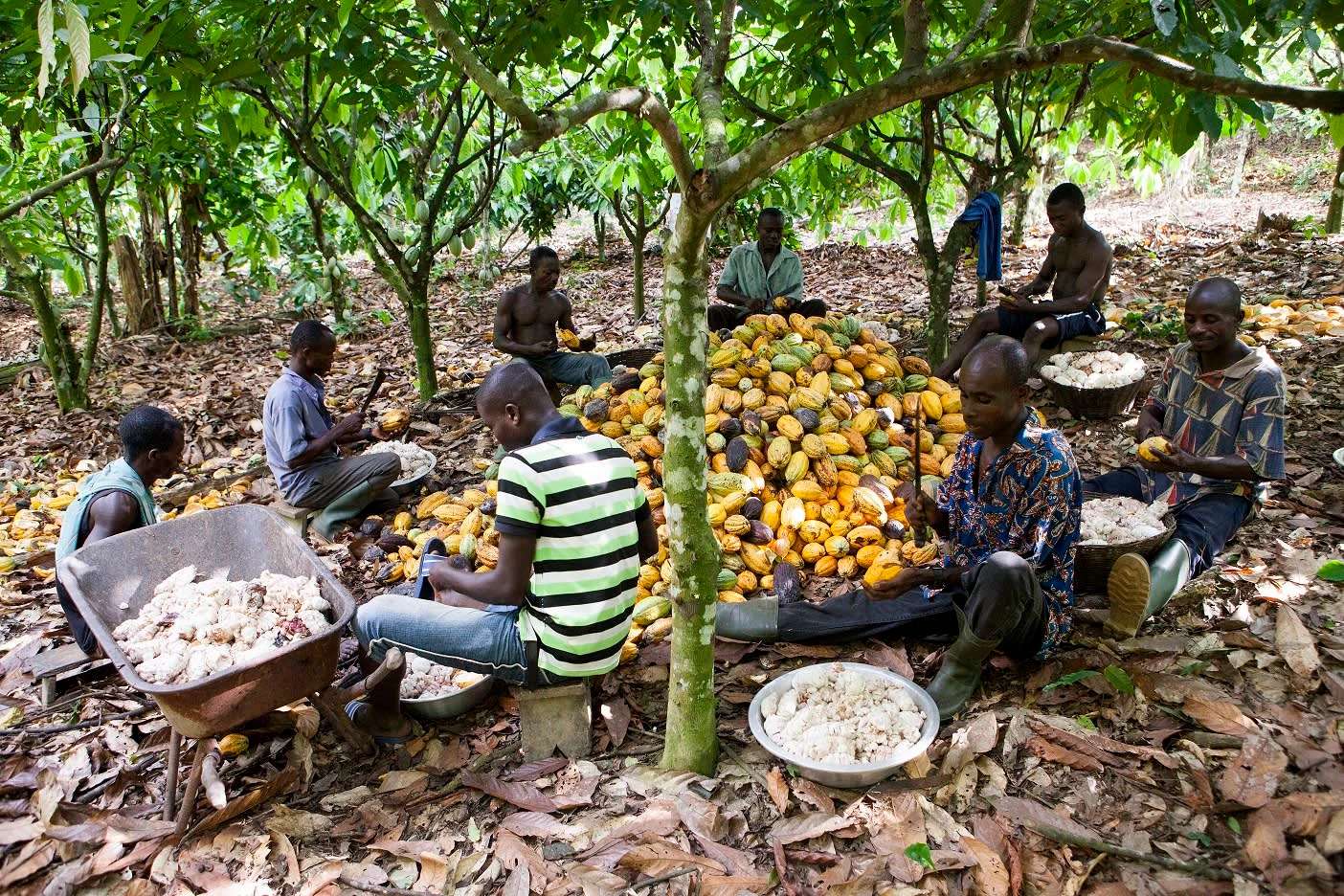
High-quality cocoa remains the country’s most reliable export base and a central source of foreign exchange.
The World Bank put total export earnings at about US$37.9 million in 2024, though national factsheets cite higher figures of US$50 million to US$60 million.
Record high cocoa prices in 2024 supported growth, alongside moderating oil import costs and a gradual recovery in tourism.
Still, cocoa earnings alone cannot close the gap with much larger import bills.
The economy carries a chronic trade deficit, reflecting its small production base and heavy reliance on external supplies.
Growth Rebounds Slowly From Energy Shocks
Real GDP growth strengthened to about 1.1% in 2024, according to IMF and World Bank estimates, up from roughly 0.4% in 2023.
The AfDB recorded 1.1% growth in 2024, boosted by cocoa and tourism.
Growth reached about 2.1% in 2025, as electricity shortages eased.
Inflation has been falling but remains high, dropping from 21.1% in 2023 to 14.4% in 2024 and 11.0% in 2025.
Lower inflation is tied to the IMF programme and cheaper imported fuel.
A Narrowing But Fragile External Deficit
The current account deficit improved sharply in 2024, with IMF data citing a decline to 1.9% of GDP from 12.3% in 2023, before widening again to 6.3% in 2025.
The World Bank sees the deficit averaging 4.3% of GDP in 2024 and 2025, down from over 10% in 2022 and 2023.
IMF staff described the 2024 improvement as driven by temporary factors rather than a durable export surge.
International reserves rose from US$38.9 million in December 2024 to US$69.4 million a year later, covering about 2.5 months of imports.
That buffer remains thin for a country highly exposed to commodity and climate shocks.
Aid Dependence Shapes the Budget
Grants accounted for around 40% of total government revenue in 2025, according to World Bank data.
This keeps São Tomé and Príncipe firmly reliant on donor support and concessional finance.
Public debt fell from 85.1% of GDP in 2021 to 65.2% in 2024 and 56.5% in 2025, helped by higher grant inflows and limited commercial borrowing.
Contingent liabilities were still estimated at 31.7% of GDP in 2024, adding hidden fiscal risk.
Aid flows may soften the debt burden, but they also underline how little room the state has for autonomous investment.
Debt Distress and the IMF Programme
The IMF still classifies São Tomé and Príncipe as in debt distress for both external and overall public debt.
At the end of 2024, total public and publicly guaranteed debt was 64.8% of GDP, with external debt at about 34%.
A new 40-month Extended Credit Facility was approved on December 19, 2024.
The programme is worth about US$31 million after the December 2025 augmentation to 155% of quota and focuses on fiscal consolidation, energy-sector reform, and stronger public financial management.
State utility EMAE is a key target for reform within the programme.
Unresolved Arrears Complicate the Debt Story
São Tomé and Príncipe carries unresolved post-HIPC external arrears to Angola, Brazil, and Equatorial Guinea.
Those arrears were about 1.6% of GDP at the end of 2023 and around 1.3% in 2024.
A US$30 million loan from Nigeria was excluded from the official debt stock because no signed contract with repayment conditions exists.
The arrears keep the country in debt distress in IMF assessments, even as headline debt ratios improve.
This classification limits access to some forms of external financing and shapes investor perceptions.
Offshore Oil Hopes Return to the Agenda
Oil exploration remains a long-term option rather than a near-term revenue source for São Tomé and Príncipe.
The country has its own Exclusive Economic Zone, where exploration hopes persist alongside the Joint Development Zone with Nigeria.
No signed oil production contracts or commercial discoveries are recorded in the verified research.
The Nigerian loan and joint zone relationship show how closely oil diplomacy and public finance are linked.
Investors view oil as a potential turning point, but the timeline remains uncertain.
Boutique Tourism as the Growth Bet
Tourism alone contributes roughly 11% of GDP, making it the clearest near-term diversification play.
The government is betting on small-scale, boutique tourism rather than mass resort development.
Gradual tourism recovery in 2024 and 2025 helped lift growth and narrow the external deficit.
The country’s small size suits low-volume, higher-value visitors focused on nature, cocoa heritage, and island isolation.
Tourism earnings help offset food and fuel imports, but infrastructure and energy constraints still limit expansion.
Fiscal and Energy Reforms Will Define 2026
The IMF programme ties continued disbursements to fiscal discipline and energy-sector restructuring.
Reducing losses at the state utility EMAE is a central condition for restoring budget credibility.
Public debt ratios vary by source, with the World Bank estimating 65.2% of GDP in 2024 and 56.5% in 2025, while other datasets cite lower figures after debt reclassification.
Higher cocoa prices helped in 2024, but dependence on a single crop leaves the economy exposed to price reversals.
The test for 2026 is whether budget reform, tourism growth, and oil exploration can produce more durable external earnings.
New Oil Wells Shift Exploration Mood
Recent wildcat wells have changed how companies view São Tomé and Príncipe’s offshore waters. Shell drilled the Falcao-1 well in Block 10, north of São Tomé, and confirmed a working petroleum system in 2025. Galp Energia had earlier drilled Jaca-1X in Block 6, east of São Tomé, in 2022. A working petroleum system means the rock layers can generate and hold oil or gas. The wells did not prove commercial reserves, but they showed that the geology works. That is a big step for a country with no oil production yet.
The government wants to use this interest quickly. The state oil company ANP-STP, led by executive director Álvaro Silva, is running a fast-track licensing round for Blocks 7, 8 and 9. These ultra-deepwater blocks sit off the west coasts of the islands. Bids were due by the end of June 2026, but the regulator ANP-STP rejected the only two bids, from Petrobras and Oranto, in July 2026 for insufficient competition. The earlier plan was to negotiate production sharing contracts in October and November 2026 and to sign these contracts by the end of 2026. A production sharing contract sets how a company and the state split any future oil output.
Several large companies are already active nearby. They include Shell, TotalEnergies, Petrobras, Galp Energia, Kosmos Energy and Oando. In April 2026 Petrobras took a 75 percent stake and operatorship in Block 3, reducing Oranto Petroleum to 15 percent and leaving ANP-STP with 10 percent. Petrobras also holds 45 percent in Blocks 10 and 13, 25 percent in Block 11, and 27.5 percent in Block 4. Seismic surveys map rock layers below the seabed to find drilling targets.
What Investors and Donors Are Watching
Foreign investors are tracking cocoa price trends, IMF programme compliance, and any concrete signals from offshore oil blocks.
Donors remain essential, since grants fund about two-fifths of public revenue.
The small reserve buffer means quick disbursements and temporary capital flow measures are still part of the policy toolkit.
A successful tourism season and stable electricity supply could lift services growth above recent weak levels.
For now, São Tomé and Príncipe remains a niche market for investors comfortable with high risk and long time horizons.
The Big Picture
Latest developments
- Africa Intelligence Brief — Monday, September 28, 2026 — 28 September 2026
- Niger’s North Hit by Repeated Water and Electricity Shortages — 28 September 2026
- First Cargo for Dangote Refinery Docks at Kenya’s Lamu Port — 28 September 2026
- Angola Says Industrial Plants Rose 44% in a Year as It Looks Beyond Oil — 27 September 2026
This article was produced by The Rio Times’ automated newsroom system. How we use AI · Report an error · Editorial responsibility: Matthias Camenzind, Editor-in-Chief