Rio’s Fastest-Growing Drug Faction Now Sits on the Airport Road
Rio de Janeiro · SECURITY
Key Facts
- —What happened A police operation in the Complexo de Israel shut Rio’s airport road and burned four lorries.
- —How big Around 457,000 people live in areas the study puts under this faction’s control.
- —The real story Its territory grew 75.7% in 2024 alone, against 22.7% across all of 2007 to 2018.
- —The catch We could not obtain the underlying report, so every figure here rests on press citing the institute.
- —Who it touches Avenida Brasil and Linha Vermelha carry airport traffic and freight to the port.
- —What comes next Police say the occupation runs indefinitely, and no state government statement has appeared.
The Rio armed groups map now puts the city’s fastest-growing faction beside its busiest road.
On Monday 24 August the road from Rio’s international airport was shut and four lorries burned on it. The cause was a police operation in a favela complex held by the city’s third-largest armed group.
A Morning of Shut Roads and Burning Trucks
On Monday 24 August, Avenida Brasil, Linha Vermelha and Rodovia Washington Luís were shut preventively from about 2:30am. The closure lasted roughly half an hour.
Around 9am, four trucks were set alight on Avenida Brasil at Coelho Neto and Vigário Geral, in both directions. The central lane stayed shut until early afternoon, with a partial reopening about 11:45am.
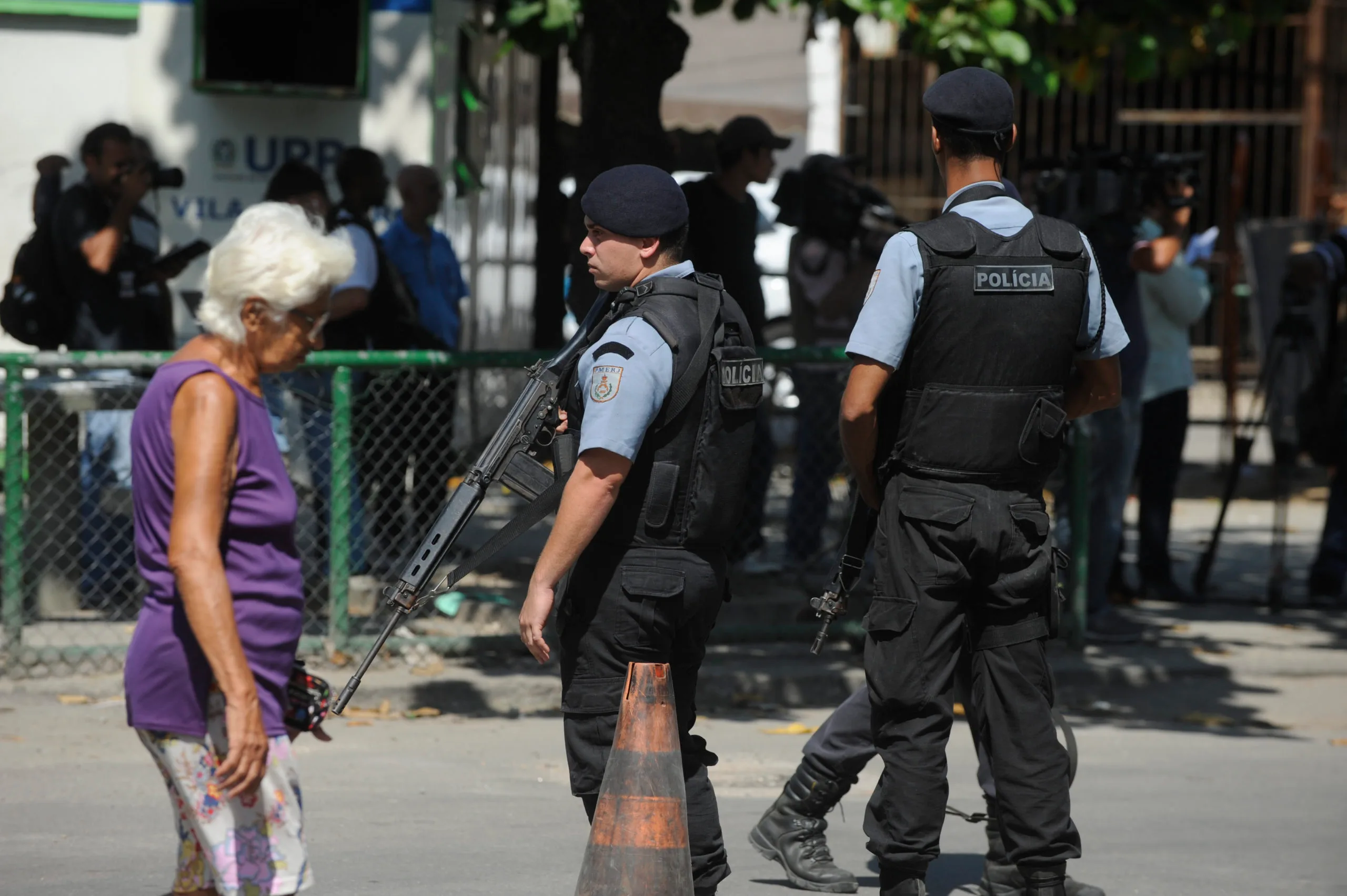
At least 20 bus lines were diverted. The police operation targeted the Complexo de Israel, a group of five communities in Rio’s north zone.
The complex includes Cidade Alta, Vigário Geral, Parada de Lucas, Cinco Bocas, and Pica-Pau. Gunfire was heavy, and the area is dominated by the TCP, or Terceiro Comando Puro.
The name was coined in July 2020 by the TCP leader known as Peixão, Álvaro Malaquias Santa Rosa. The faction named the complex itself, which tells you how settled its control is.
What the Rio Armed Groups Map Counts
Behind the morning chaos is a striking figure: 457,000 people live in areas dominated by the TCP in metropolitan Rio. That comes from the Mapa Histórico dos Grupos Armados, a study by Fogo Cruzado and GENI/UFF.
GENI/UFF is a research group at Fluminense Federal University. The TCP is the third-largest armed group by territory, behind the Comando Vermelho and the militias.
It holds 8.05% of areas controlled or influenced by armed groups. The study was reported by O São Gonçalo on 27 August 2026.
TCP territory growth was 75.7% in 2024 alone, and it grew 22.7% across the entire 2007-2018 period. That rapid expansion in one year is what researchers are highlighting.
The growth mechanism, according to the research, is that the TCP moved into ground other groups gave up. This That is the pattern the study describes.
What the Rio Armed Groups Map Shows Over Time
The faction is not growing alone. The area controlled by armed groups across metropolitan Rio grew 130.4% between 2007 and 2024, according to the research.
The militias expanded most across 2007-2024, with their area up 315%. The Comando Vermelho’s area grew 46% in the same period.
Researchers frame this as the state receding from territories. That framing is their analysis, not our conclusion.
For context, the TCP’s 75.7% growth is far steeper than the long-term trend. This suggests recent dynamics, not a steady process.
The research attributes the TCP’s movement into abandoned areas to this state retreat. But we could not verify the full methodology.
What We Could Not Verify in the Rio Armed Groups Map
We must be clear: we could not reach the underlying Mapa Histórico report. Every figure is confirmed only through press citing Fogo Cruzado and GENI/UFF, not in the primary PDF.
We asked for the report, but it is not publicly available. The methodology behind the 457,000 figure is not published in anything reachable.
We also could not determine how the study defines and measures control and influence over territory. The data series stops in 2024, while the events are from 2026, which raises a timing question.
The figure of 19 shootings in the Complexo de Israel this year is credited to Fogo Cruzado. We could not trace it to a report or to the institute’s public API.
It is only from press citing it. We have asked the institute for both.
No direct statement from Governor Cláudio Castro on the operation or occupation was found. We also found no full signed note from the Secretaria de Estado de Polícia Militar or the security secretariat.
So, while the press reports are consistent, the primary sources remain out of reach. That is a gap we want readers to know about.
We have written to Fogo Cruzado’s press office and to GENI/UFF asking for the report, the underlying data and the methodology. We will update this article if they send them.
The Police Position: Holding the Line
The PM, Rio’s uniformed state police, says it is holding the area to stop the Comando Vermelho from taking it. This is the official position, as quoted in press.
On 24 August, the PM formalised an indefinite occupation of the Complexo, staffed by COE units and 1st CPA battalions. The operation began on 21 August, and the PM announced it would remain in Cidade Alta.
The PM reported nine arrests, seven rifles, three pistols, and four grenades as a partial tally. On 26 August, the PM said it had detected a Comando Vermelho plan to invade the Complexo de Israel.
A PM note says the operation aims to stop criminal movement, contain territorial disputes, and prevent a rival faction expanding. It also aims to prevent expansion into surrounding communities.
The occupation continues indefinitely as of 27 August. The 24 August O Globo report also says the operation targeted religious intolerance in the area.
That is a secondary goal, but it is part of the official framing. That is precisely the mechanism the study describes, playing out live.
There is an irony worth naming here. Police say they must stay so a rival faction cannot move in, which is the study’s whole thesis.
What It Means for Foreign Residents and Businesses
For foreign residents and business owners, this is not abstract. Avenida Brasil and Linha Vermelha are the main road to the international airport and the freight route to the port.
When these roads shut, as they did on Monday, it directly affects commutes and logistics. The 20 bus lines diverted serve thousands of daily passengers.
The Complexo de Israel sits near these arteries, so any escalation has quick consequences. Further escalation would mean more of the same disruption.
For businesses, this means planning around potential road closures. The indefinite occupation adds uncertainty to an already volatile situation.
The Open Question, Not a Verdict
The study says the faction grew because the state pulled back. The police say they are now holding ground to stop a rival taking it.
Both can be true, and neither is settled by what is public today. The series ends in 2024 and the events are from this week.
We will keep asking for the report and the data behind it. Until they arrive, treat these numbers as credible but unconfirmed at source.
More: Brazil news in English, every day from The Rio Times.
Frequently Asked Questions
What does the 457,000 figure mean for Rio?
It means a significant population lives in areas dominated by the TCP, the third-largest armed group. That affects daily life and security in those communities.
How did the TCP grow so fast in one year?
According to the research, the TCP moved into territory that other groups abandoned. That is the mechanism cited by Fogo Cruzado and GENI/UFF.
Is the police occupation of the Complexo de Israel permanent?
The PM says the occupation is indefinite, as of 27 August 2026. The stated aim is to prevent a Comando Vermelho takeover.
What should I do if I need to travel through Avenida Brasil?
Check for road closures before heading out, as operations can shut lanes without much warning. Bus diversions are common, so plan extra time for your commute.
How can I verify the territory growth data?
The full report is not public yet, but you can follow Fogo Cruzado’s releases. Until then, treat the figures as press-cited, not primary-sourced.
What is the Rio armed groups map?
It is the Mapa Histórico dos Grupos Armados, a joint study by Fogo Cruzado and GENI/UFF. It tracks which armed groups hold which parts of metropolitan Rio over time.
Connected Coverage
Sources
- Fogo Cruzado and GENI
- O São Gonçalo – 27 Aug 2026 report on TCP territory growth
- O Dia – 24 Aug 2026 report on complex composition and name origin
- G1 – 24 and 26 Aug 2026 reports on road closures and PM note
- O Globo – 24 and 25 Aug 2026 reports on operation, bus lines, and PM tally
- RecordTV – 24 Aug 2026 report on truck fires
- TV Sim Brasil – 27 Aug 2026 report on continued occupation
This article was produced by The Rio Times’ automated newsroom system. How we use AI · Report an error · Editorial responsibility: Matthias Camenzind, Editor-in-Chief
Living in or visiting Rio de Janeiro? See this month's events and our Rio de Janeiro city guide with rents, safety and upcoming concerts.