Iguaçu Falls Walkway Shuts as Flow Tops 6 Times Normal

TRAVEL · BRAZIL
Key Facts
- —The country Brazil. Iguaçu Falls lies on the Argentine border in Foz do Iguaçu, western Paraná state. Its national park is UNESCO-listed.
- —Why it matters The falls are one of South America’s best-known sights. The closed walkway leads to the Devil’s Throat, the highlight of the Brazilian-side visit.
- —Why now Heavy rain in the Iguaçu River basin pushed the flow up sharply on Sunday 11 October, during a long holiday weekend.
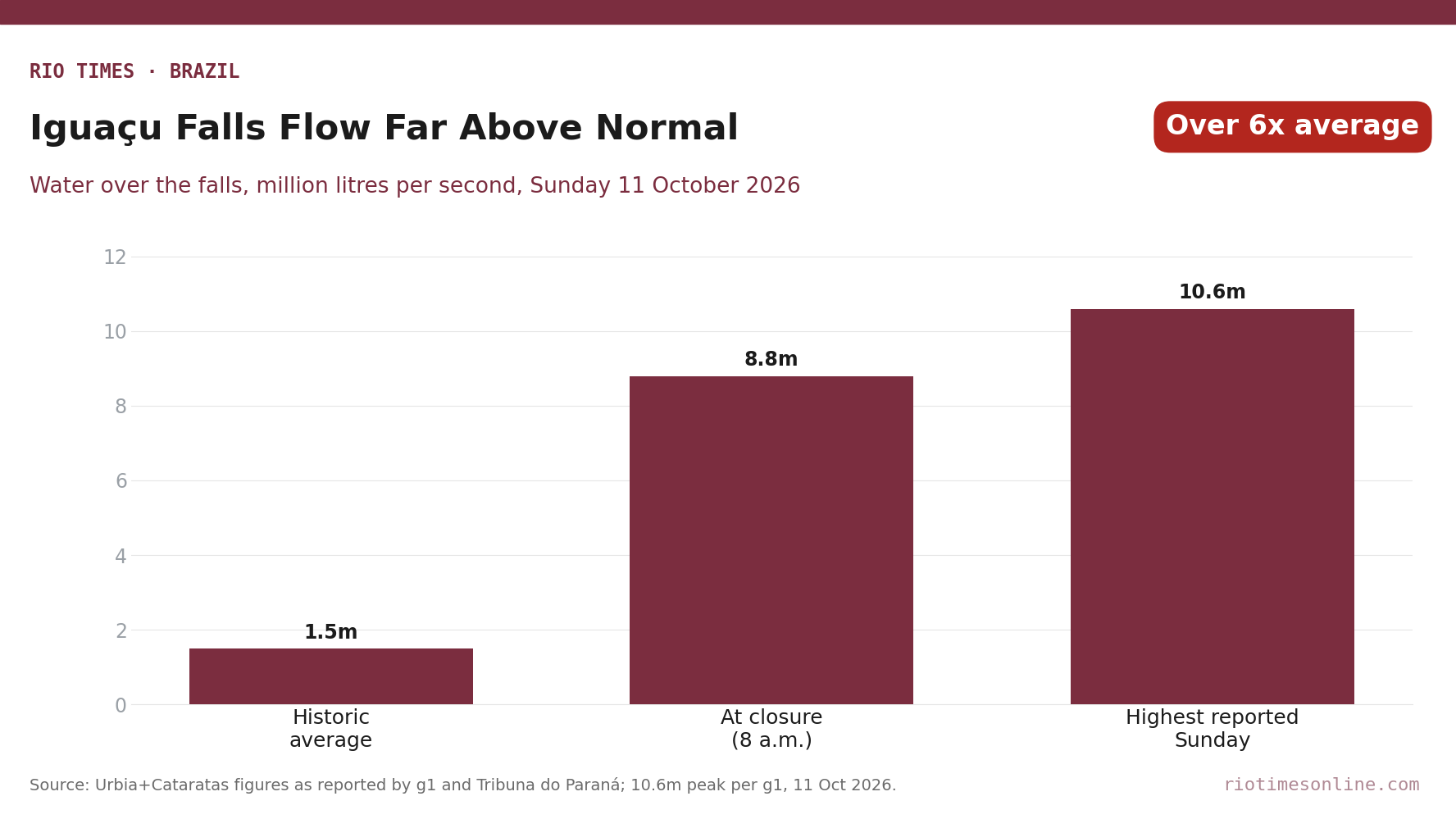
- —What happened The concessionaire shut the walkway at 8 a.m. on Sunday, with 8.8 million litres a second flowing. By 11 a.m. it had passed 10 million.
- —The numbers The historic average is about 1.5 million litres a second. The walkway also closed in July and, for four days, in September.
- —What it means for you The park, the main Falls Trail and its viewpoints stay open. Visitors lose the walk over the river, and two side paths are closed.
- —Still open There is no reopening date. Forecasters expect more heavy rain in western Paraná through Tuesday 13 October.
Brazil’s Iguaçu Falls walkway closed on Sunday 11 October after the river’s flow rose to more than six times its historic average. The walkway, in Foz do Iguaçu on the border with Argentina, takes visitors over the water to the Devil’s Throat. For American and other foreign travellers, the park stays open. Its most famous viewpoint, however, is off limits with no reopening date.
The closure began at 8 a.m. local time, when about 8.8 million litres of water a second were going over the falls. That is almost six times the average of about 1.5 million litres. By 11 a.m. it had reached about 10 million litres, Tribuna do Paraná reported. g1 put the later peak at about 10.6 million litres a second.
The decision was taken by Urbia+Cataratas, the concessionaire that runs tourist visits in Iguaçu National Park. The park itself is managed by ICMBio, the federal agency for protected areas. Both are monitoring the river, according to the concessionaire.
What the Park Has Closed
Only part of the visit is affected. The Iguaçu Falls walkway, the Passarela, is shut, together with two side paths, the Caminho das Bananeiras and the Poço Preto route. Both can flood when the river rises, the park administration said.
The main Falls Trail along the canyon remains open with all its viewpoints, and visits continue as normal. Visitors can still see the falls at full force from there. “The safety measures are taken preventively, putting the safety of visitors and staff first,” the company said, Tribuna do Paraná reported.
Urbia+Cataratas said access will return only when the flow falls to safe levels and no new rise is forecast. It gave no date for reopening.
A Third Closure This Year
This is the third time in 2026 that high water has shut the walkway. In July, it closed after the flow passed 9 million litres a second, about six times normal. In September, it stayed shut for four days when the flow topped 10 million litres, according to g1 and GZH.
The rise follows rain across the Iguaçu River basin, which crosses Paraná state before reaching the falls. MetSul Meteorologia, a private weather service in southern Brazil, links this year’s wet pattern to the El Niño phenomenon.
More rain is on the way. MetSul said parts of western Paraná could get 100 mm to 200 mm by Tuesday 13 October. Isolated totals may reach 300 mm. It warned that very heavy rain over short periods could cause flooding.
For a similar closure in 2022 and how it ended, see Brazil’s Iguaçu National Park reopens attractions after increase in water flow.
Itaipu Warns the Paraná River Will Rise
The same rain is swelling the Paraná River. The Iguaçu flows into it where Brazil, Argentina and Paraguay meet. On Sunday, the flood committee of Itaipu Binacional issued a bulletin warning of a rapid rise in the coming days. Itaipu is the hydroelectric dam on the Paraná that Brazil and Paraguay share.
At about 10 a.m. on Sunday, the river stood at 110.4 metres at the Friendship Bridge. The bridge links Foz do Iguaçu with Ciudad del Este, Paraguay. The bulletin projected up to 115.10 metres on Monday and 115.14 metres on Tuesday, Valor Econômico reported.
Itaipu said the new figures could mean impacts on structures and homes on the Brazilian bank. It said it had informed municipal and state civil defence agencies. On the Paraguayan side, 41 families in the San Rafael district had already been moved to safety, Itaipu’s press office told aRede. The dam is also weighing a gradual lowering of its reservoir to soften the peak.
What It Means for You
If you plan to visit Iguaçu this week, the Brazilian park is open and the falls are unusually powerful. What you cannot do is walk out over the river to the Devil’s Throat platform.
Check the park’s official channels on the morning of your visit, since the walkway reopens only after the river falls. Expect rain, slippery paths and heavy spray. Monday 12 October is a national holiday in Brazil, so crowds may be larger than usual.
Travellers crossing to Paraguay or Argentina should follow local civil defence advice near the rivers. Park officials say the open trails remain available as normal.
What Is Not Known
The park has not said when the Iguaçu Falls walkway will reopen or which flow level counts as safe. It is not clear whether the Argentine side has changed its own visitor routes. No statement from that park was found.
It is also unknown how high the Paraná River will rise, or whether homes in Foz do Iguaçu will need evacuating. Itaipu said the success of its reservoir plan depends on how much rain falls, and where.
Frequently Asked Questions
Is Iguaçu National Park open?
Yes. The Brazilian park was open on Sunday 11 October, with the Falls Trail and its viewpoints accessible. Only the walkway over the river and two side paths were closed.
Why was the Iguaçu Falls walkway closed?
Rain in the Iguaçu River basin raised the flow to 8.8 million litres a second by 8 a.m. on Sunday. The concessionaire closed it as a precaution.
When will the walkway reopen?
No date has been given. Urbia+Cataratas said it will reopen when the flow falls to safe levels and no new rise is forecast.
Sources: g1 Paraná; Tribuna do Paraná; GZH; SBT News; Valor Econômico (Itaipu bulletin); aRede (Itaipu); MetSul Meteorologia; Primera Edición.
This article was produced by The Rio Times’ automated newsroom system. How we use AI · Report an error · Editorial responsibility: Matthias Camenzind, Editor-in-Chief