By Humberto Vacaflor Ganam
Laws are not respected or complied with in the country, nor is there a separation of powers.
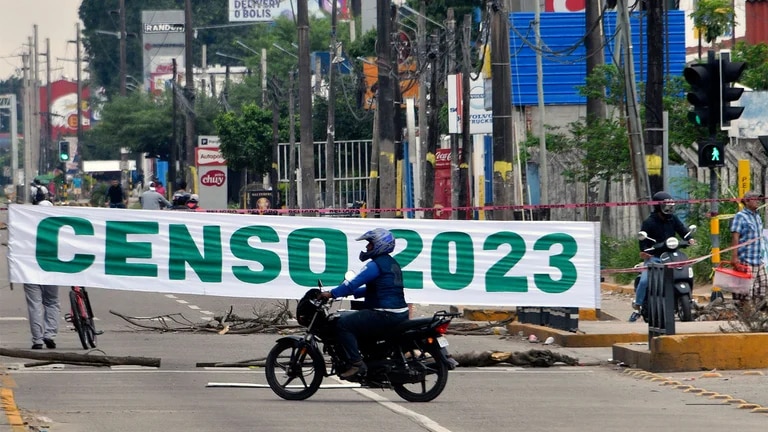
Bolivia is experiencing one of the most severe crises in its history, say two political actors, when the government of Luis Arce fails to resolve the conflict over the census and is about to plunge into economic bankruptcy.
Jaime Paz Zamora, former president (1989-1993) says that at this moment Bolivia has ceased to be a “plurinational” State and has become, in fact, a federal republic, with which he agrees, like almost all Bolivians.

José Carlos Sánchez, a young opposition figure, has a more radical reading of what is happening in Bolivia. He says directly that it is a “failed State.”
And he lists the following facts:
A study by the Central de Pueblos Indígenas de La Paz reveals that 71% of people living in the Amazon region have dangerous levels of mercury contamination.
Gonzalo Oliver, leader of the Central, says that the Movimiento al Socialismo (MAS) government does not pay attention to the indigenous people who ask it to stop illegal mining in the areas they inhabit.
Oliver has the exact figures on this health problem of his peers.
Three out of 10 indigenous people who live in areas influenced by gold mining in the north of the department of La Paz have, on average, levels of mercury contamination that triple the maximum tolerable limit, according to a study by the Central de Pueblos Indígenas de La Paz.
The research, carried out on 268 people from 27 indigenous communities, reveals that, while the maximum mercury tolerated by the body of a human being is one part per million (that is, one milligram per kilo), the members of the people of the “Esse ejja” have 6.9 parts per million (ppm), the “Mosetenes 2.7″, the “Uchupiamonas” 2.5, the “Tacanas” 2.1 and the “Lecos” 1.2 ppm.
A study by the Pulitzer Center’s Rainforest Journalism Fund showed details of gold mining by Chinese companies in the Bolivian Amazon region, associated with cooperatives that allow them to pay very little tax.
The indigenous peoples of these areas are the ones affected by the mercury that the Chinese throw into the rivers and jungles, but they cannot get the MAS government to enforce the country’s laws regarding the protection of nature.
The national parks have been invaded by coca growers and drug traffickers, but the government has decided to allow this to happen, which means a violation of the constitution in the articles referring to the protection of those parks.
On the contrary, the government of Luis Arce made a concession for mining in a “protected area,”, and did not even bother to change the name of that area.
Meanwhile, the Yuquis, a people originally from the Chapare, have been driven from their habitat by coca growers. They lived from fishing but the arrival of Evo Morales’ cocaleros forced them to emigrate, and some arrived in the cities, but they have a very hard time because they do not have skills for urban work.
In the area there are now, in addition to the coca fields, places where the leaf is processed to convert it into cocaine, called maceration pits, to produce cocaine sulfate, and there are even factories to produce the hydrochloride, the “white goddess.”
The government has decided to authorize the existence of an illegal coca market in La Paz, despite the fact that a law by Morales himself provides that there are only two markets for that leaf in Bolivia: one in La Paz and another in Cochabamba.
Lawyer Sánchez is convinced that Bolivia has become a “failed State” in which laws are not respected or complied with.
To begin with, there is no separation of powers, because the Executive manages the Legislative and the Judiciary at its discretion, in addition to having absolute control of the Armed Forces and the Police.
Evo Morales continues to order justice to arrest those he considers guilty of his decision to resign the presidency and flee to Mexico in November 2019, including several serving generals and colonels.
He has now ordered those responsible for the electoral authority who banned him from running as a candidate due to the fraud he committed, according to the OAS report, to be imprisoned.
The inhabitants of the city of Santa Cruz say that the police escort the shock groups that the Arce government sends there to break the paralysis of activities that has lasted for a month.
In addition, Bolivia is a territory where Mexican, Brazilian and Colombian drug cartels operate, as Evo Morales government officials have admitted. The São Paulo mafia PCC has coca plantations and drug factories in Bolivian territory, says O Estado de São Paulo.
The planes with drugs fly through the airspace and cross the borders without any problem, confident that the thirteen radars that the government bought, paying US$225 million seven years ago, are still packed.
Sánchez recalls that Somalia, in the horn of Africa, was declared a “failed State” when the mafias that traffic “cath,” the area’s drug, took control of the territory.
With information from Infobae
This article was produced by The Rio Times’ automated newsroom system. How we use AI · Report an error · Editorial responsibility: Matthias Camenzind, Editor-in-Chief
Read More from The Rio Times