Nigeria Gets World Bank Push for US$5.79bn Private Cash

ECONOMY · NIGERIA
Key Facts
- —The country Nigeria is Africa’s most populous country, with more than 200 million people and a large oil, telecoms and farming economy.
- —Why it matters The World Bank Group says public money alone cannot close Nigeria’s gaps in broadband, farm inputs and small-business credit, so it is drawing in private investors.
- —Why now On Monday 12 October, Finance Minister Taiwo Oyedele and central bank governor Olayemi Cardoso met World Bank Group President Ajay Banga in Bangkok to discuss guarantees and investment.
- —What happened In a feature published on Sunday 11 October, the World Bank Group said it is helping mobilise up to US$5.79 billion in private financing for Nigeria in fiscal year 2026.
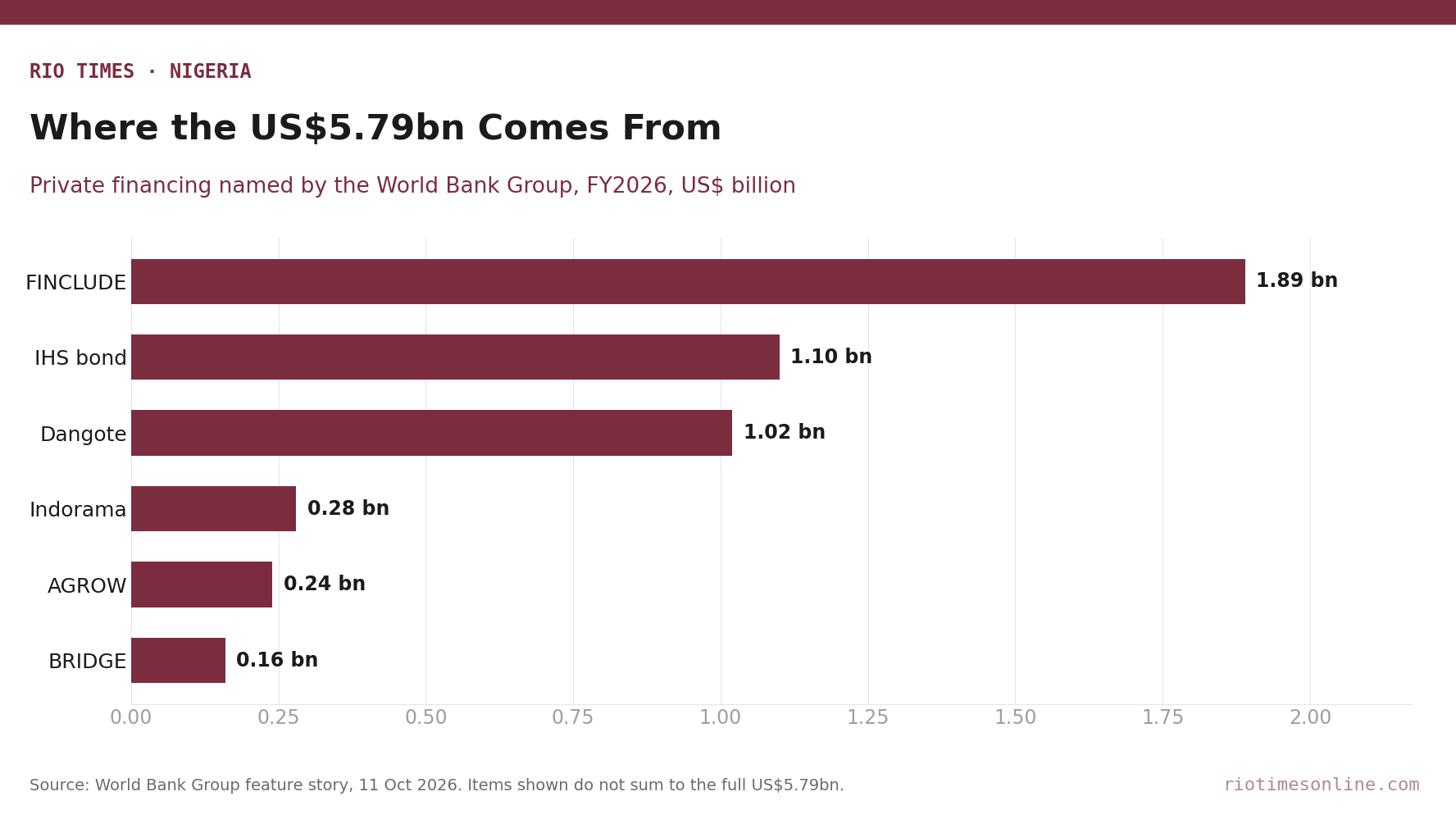
- —The numbers Nearly US$1.89 billion and about 850,000 jobs from the FINCLUDE small-business programme; US$1.02 billion for Dangote, US$282.5 million for Indorama and over US$1.1 billion through an IHS Towers bond.
- —What it means for US readers The plan runs through commercial lenders, institutional investors and guarantees, the channels foreign funds use to enter Nigerian deals. One named company, IHS Holding, reports to the US Securities and Exchange Commission.
- —Still open The Bank has not itemised the full US$5.79 billion, and several components are projections rather than money already invested.
The World Bank Group has put a number on its Nigeria private financing drive: up to US$5.79 billion in fiscal year 2026. The figure, published in a feature story on Sunday 11 October, covers broadband, farming, fertiliser and credit for small firms.
For foreign investors, the message is that Nigeria has become easier to finance since its reforms began in mid-2023. The Bank cites changes to foreign-exchange management, public finances and fuel subsidies as the source of more predictable conditions.
The Nigeria private financing figure is not a World Bank loan or grant to the government in Abuja. It is private capital that the Group’s reforms, deals and guarantees are designed to bring into Nigerian projects.
What the World Bank Group Announced
The Bank describes a sequence that starts with policy reforms and public projects that create investable opportunities. The International Finance Corporation (IFC), the Group’s private-sector arm, then structures deals and brings in commercial lenders and institutional investors.
The Multilateral Investment Guarantee Agency (MIGA), the Group’s guarantee arm, offers cover that lowers risks for investors. The Bank says its RESET and NAIJA development policy financing programmes have supported Nigeria’s reforms.
The Building Resilient Digital Infrastructure for Growth (BRIDGE) project will build a national open-access fibre network through a public-private partnership. Its first investor round is expected to raise at least US$156 million in private equity.
Later rounds could bring in up to US$1.1 billion by 2030, according to the Bank. It says broadband coverage would rise from 92 million people in 2025 to 150 million by 2030.
The network is meant to connect 38,800 public schools, 16,900 health facilities and 3,400 local government offices. The Bank counts 42 million additional young people and 15 million women among the new users.
Farms, Fertiliser and Small Firms
The Agricultural Value Chains for Growth (AGROW) project targets one million smallholder farmers through better seed, fertiliser and market links. It is expected to draw about US$220 million from agribusiness firms and US$22 million from certified seed producers.
The IFC helped mobilise US$1.02 billion for Dangote Industries Limited, the conglomerate founded by Aliko Dangote, through refinancing and lender financing. It also helped raise US$282.5 million for Indorama Fertilizer through syndicated financing.
The two fertiliser projects have a combined capacity of 6.8 million metric tons a year, the Bank says. It expects them to cut reliance on imported inputs and reach more than 10 million smallholder farmers.
The largest item named is the Fostering Inclusive Finance for MSMEs in Nigeria (FINCLUDE) programme, aimed at more than 250,000 small firms. A US$500 million package from the Bank’s IBRD and IDA lending arms backs it with financing and risk-sharing tools.
FINCLUDE is expected to mobilise nearly US$1.89 billion in private financing and support about 850,000 direct and indirect jobs. Thirty percent of its financing is aimed at businesses led by women.
In telecoms, the IFC acted as anchor investor in a US$1.2 billion bond issued by IHS Towers, a mobile-tower operator. The deal drew more than US$1.1 billion from private investors, according to the Bank.
What It Means for US Readers
For US investors, the plan shows where the World Bank Group thinks risk-sharing can make Nigerian deals bankable. Guarantees and anchor stakes are meant to attract institutional money that would otherwise stay away from a frontier market.
IHS Holding, the company behind IHS Towers, files annual reports with the US Securities and Exchange Commission. Its bond shows that Nigerian telecoms infrastructure already draws on international capital markets.
The United States is the World Bank’s largest shareholder, so these programmes rest partly on capital Washington helped provide. For American companies, cheaper broadband and stronger small firms would widen access to a market of more than 200 million people.
Why the Timing Matters
On Monday 12 October, Finance Minister Taiwo Oyedele and central bank governor Olayemi Cardoso met World Bank chief Ajay Banga in Bangkok. The talks took place on the sidelines of the 2026 IMF and World Bank Annual Meetings, according to a finance ministry statement.
Oyedele, who is also Coordinating Minister of the Economy, leads Nigeria‘s delegation, while Cardoso heads the Central Bank of Nigeria. The statement said both sides discussed using World Bank guarantee instruments to finance infrastructure and attract private capital.
Oyedele told the meeting that Nigeria’s tax-to-GDP ratio had risen from about 7% to 12.5%, according to the statement. He said better revenue collection lets the government fund public investment without printing money to cover deficits.
President Bola Tinubu, of the governing All Progressives Congress, cites World Bank findings as proof that his reforms are working. The Bank itself says success will be judged by jobs, connectivity and farm output, not by capital mobilised.
The World Bank Group is only one of several outside actors shaping Nigeria’s investment climate. Related reading: Nigeria’s Tinubu Cites World Bank Report on 4.2% Growth and Foreign Powers and Investors in Nigeria 2026.
What Is Not Known
The Bank has not itemised its US$5.79 billion Nigeria private financing total, and its named amounts fall short of it. It is unclear which deals account for the rest or how much money has already reached Nigeria.
Several components carry the phrase “expected to mobilise”, including BRIDGE, AGROW and FINCLUDE, so they remain targets. The terms of any new guarantees discussed in Bangkok were not given in the statements reviewed.
The Bank’s fiscal year 2026 ran from July 2025 to June 2026, so part of the figure describes deals already in motion. Nigeria’s general election in 2027 could also test investor appetite if policy continuity comes into doubt.
Frequently Asked Questions
How much private financing is the World Bank Group mobilising for Nigeria?
The World Bank Group says it is helping mobilise up to US$5.79 billion in private financing for Nigeria in its fiscal year 2026. It set out the figure in a feature story published on Sunday 11 October 2026.
Is the Nigeria private financing figure a World Bank loan?
No. The figure refers to private capital that World Bank reforms, IFC investments and MIGA guarantees are designed to attract, not to a loan or grant to the Nigerian government.
Which projects are included?
The Bank names the BRIDGE fibre network, the AGROW farm project, the FINCLUDE small-business programme, IFC financing for Dangote and Indorama fertiliser plants, and an IHS Towers bond. The amounts it names do not add up to the full total.
How many jobs could the plan create?
The FINCLUDE programme alone is expected to support about 850,000 direct and indirect jobs, according to the World Bank. It targets more than 250,000 micro, small and medium enterprises.
Why does this matter to US investors?
The plan relies on guarantees and anchor investments that make Nigerian deals easier for institutional investors to join. IHS Holding, one of the companies named, files annual reports with the US Securities and Exchange Commission.
Sources: World Bank Group feature, 11 October 2026; New Telegraph, finance ministry statement on the Bangkok meeting; BusinessDay; Nigerian Tribune (News Agency of Nigeria); US SEC filings, IHS Holding.
This article was produced by The Rio Times’ automated newsroom system. How we use AI · Report an error · Editorial responsibility: Matthias Camenzind, Editor-in-Chief