Nigeria’s Broadband Speed Jumps 155% as Fibre Connections Triple

Nigeria · TECHNOLOGY
Key Facts
—Median download speed: Nigeria’s fixed broadband median download speed rose from 13.50 Mbps in 2023 to 34.47 Mbps in the first half of 2026, a 155% increase.
—Fibre connections: Fibre-to-the-premises subscribers roughly tripled between end-2024 and June 2026, according to Ookla data reported by Nairametrics.
—Broadband penetration: Nigeria’s broadband penetration passed 50% in 2025, reaching about 50.58% by November 2025, up from 45.61% at the start of that year.
—Subsea capacity: Nigeria is a landing point for eight major submarine cables carrying over 95% of the country’s international Internet traffic, including Google’s Equiano and the Meta-led 2Africa, whose published design capacities alone reach 144 Tbps and 180 Tbps respectively.
—Internet traffic milestone: Nigeria achieved 1 Tbps of Internet traffic in the first quarter of 2025, a level the Internet Exchange Point of Nigeria described as a game changer.
—Economic projection: The 2Africa cable is expected to add about $9 billion to Nigeria’s gross domestic product by 2025, according to the Nigerian Communications Commission.
Nigeria broadband speed has jumped 155% since 2023, with median fixed download speeds reaching 34.47 Mbps in the first half of 2026 as fibre-to-the-premises connections roughly tripled between end-2024 and mid-2026.
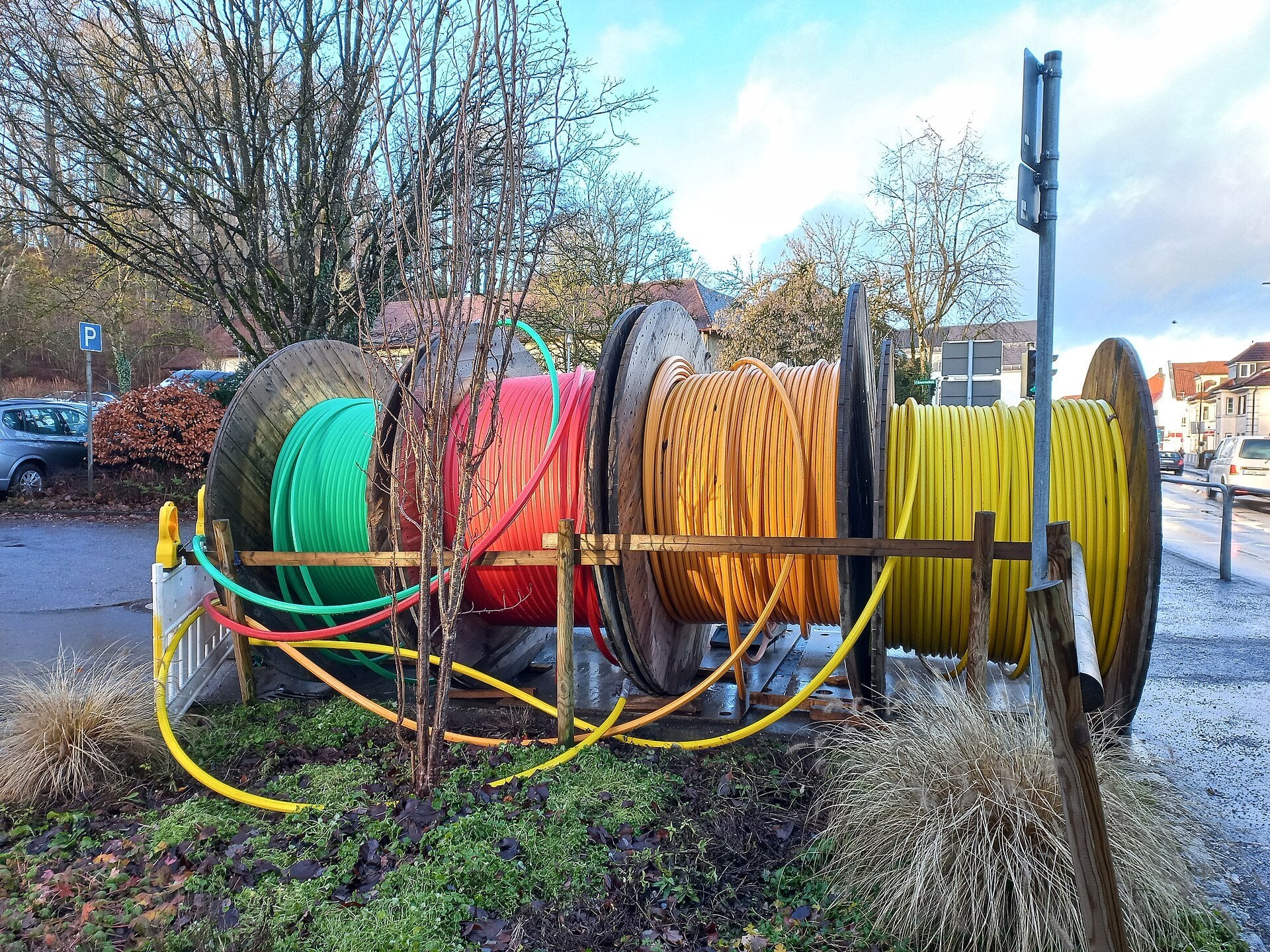
What the Nigeria broadband speed data shows
Ookla data reported by Nairametrics on 17 August 2026 shows Nigeria recorded the most consistent improvement in fixed broadband performance among major West African markets over the past three years. Median fixed broadband download speed, excluding satellite connections, climbed from 13.50 Mbps in 2023 to 34.47 Mbps in the first half of 2026.
Median upload speed also improved, rising from about 11 Mbps in 2023 to 25.17 Mbps in the first half of 2026. The gains were not confined to the fastest connections: the 10th percentile download speed nearly tripled from 2.24 Mbps to 6.04 Mbps over the same period.
At the higher end, the 90th percentile download speed rose from 74.37 Mbps in 2023 to 90.04 Mbps in the first half of 2026. This suggests slower connections improved markedly while premium connections saw more modest but still notable gains.
Fibre adoption triples as the bottleneck eases
The speed surge coincides with a threefold increase in fibre-to-the-premises subscribers between end-2024 and June 2026, according to Ookla. A separate report linked to the Nigerian Communications Commission shows fibre-to-the-home subscriptions rising from 84,141 in the fourth quarter of 2025 to 210,065 in early 2026.
That single-quarter jump of roughly 150% is consistent with the broader tripling over the longer period. Mobile broadband has also strengthened, with average 4G download speeds reaching 33 Mbps by end-2025, supported by 2,800 new sites deployed that year.
Broadband penetration passed 50% in 2025, reaching about 50.58% by November 2025, up from 45.61% at the start of the year. Data consumption hit around 1.24 million terabytes in November 2025 alone, reflecting heavy use of streaming, social media, cloud services and enterprise connectivity.
Cheap under the sea, expensive on land
Nigeria has become one of Africa’s key submarine cable landing hubs, sitting at the centre of West Africa’s international connectivity. By 2025, the country was a landing point for eight major submarine cables carrying over 95% of its international Internet and communications traffic.
These systems include SAT-3/WASC, MainOne, Glo-1 and Glo-2, Africa Coast to Europe, West Africa Cable System, Google’s Equiano and the Meta-led 2Africa cable. Newer systems carry vast bandwidth: Google’s Equiano has a published design capacity of 144 Tbps and the Meta-led 2Africa reaches 180 Tbps, though no official figure aggregates the total capacity of all cables landing in Nigeria.
Yet domestic fibre distribution remains the constraint. TechCabal describes a paradox: international bandwidth is plentiful and relatively cheap, but spreading that capacity inland from coastal landing points to homes and businesses is expensive, complex and unpredictable.
The West Africa Cable System, a roughly 14,500 to 15,000 km subsea cable, cost about $650 million, or $40,000 to $45,000 per kilometre. By contrast, the federal government estimates expanding Nigeria’s terrestrial fibre backbone to about 90,000 km could require $1.5 billion to $2 billion, with on-land costs often higher due to right-of-way fees, state-level charges, security risks and permitting delays.
US tech giants and the power map
Hyperscale technology companies, notably Google and Meta, are now prime financiers and owners of many new African subsea systems. Google’s Equiano and Meta-led 2Africa both land in Nigeria, anchoring global platforms closer to Nigerian users and entrenching these firms’ ecosystems in the country’s digital economy.
Telecom Review Africa notes that 77 active or planned subsea cable systems serve Africa as of 2025, yet more than half of international bandwidth is concentrated in just five countries: Nigeria, South Africa, Egypt, Algeria and Kenya. This concentration amplifies Nigeria’s strategic importance but also its dependency on foreign corporate infrastructure.
The ownership structure raises sovereignty concerns. Telecom Review Africa highlights that infrastructure carrying African data is increasingly owned by a small number of US technology companies, whose governance structures reflect commercial priorities rather than African national interests.
This places Nigeria inside a wider competition over data routes, standards and surveillance capabilities, a theme explored in Africa: The New Scramble. The West Africa cable outage of 13 March 2024, which disrupted Internet connectivity in at least 13 countries, showed how dependent the region is on a narrow set of routes and landing points.
Regulatory politics and regional ambition
The Nigerian Communications Commission uses infrastructure metrics and outage events to build support for regulatory and fiscal changes. Its leadership has publicly stressed the need for fibre expansion to relieve pressure on mobile networks and avoid congestion as data demand rises.
The commission links new capacity to gross domestic product gains and e-commerce growth, strengthening its case for treating telecom infrastructure as a driver of economic policy rather than a narrow sectoral issue. This gives the regulator more leverage over right-of-way fee harmonisation, open-access fibre models and security standards for landing stations.
Nigeria and Equatorial Guinea have signed a cooperation agreement to deploy a new submarine fibre-optic link, aimed at boosting bandwidth, digital connectivity and regional cybersecurity. Nigerian officials frame such projects as part of a broader effort to integrate African markets under frameworks like the African Continental Free Trade Area.
The result is a patchwork map of power and connectivity. Lagos and selected urban corridors enjoy world-class speeds, while many rural and peri-urban areas still rely on slower, congested mobile networks.
What to watch next
Global subsea cable investments rose from about $0.8 billion in 2015 to $9.7 billion in 2025, with hyperscale technology firms now leading many new projects. The 2Africa cable, launched in 2023, is expected to increase data capacity across Africa by up to 200% and potentially add about $9 billion to Nigeria’s gross domestic product by 2025.
Nigeria achieved 1 Tbps of Internet traffic in the first quarter of 2025, a milestone the Internet Exchange Point of Nigeria’s chief executive Muhammed Rudman described as a game changer for broadband usage and data centre growth. Nigeria’s e-commerce market was estimated at around US$9 billion in 2025 and is projected to approach US$16 billion by 2030, buoyed by wider broadband access and faster connections, according to Mordor Intelligence.
The key question is whether Nigeria can translate foreign-owned subsea capacity into broad-based, sovereign digital development. Stable right-of-way rules, security guarantees in conflict-affected regions and long-term financing will determine whether higher speeds become widely affordable rather than a premium urban service.
Frequently Asked Questions
How much has Nigeria broadband speed increased?
Nigeria’s median fixed broadband download speed rose 155% from 13.50 Mbps in 2023 to 34.47 Mbps in the first half of 2026, according to Ookla data reported by Nairametrics.
What caused the fibre connection growth in Nigeria?
Fibre-to-the-premises subscribers roughly tripled between end-2024 and June 2026, driven by massive undersea cable investment, rising domestic fibre rollout and growing involvement of US tech giants like Google and Meta.
Which companies own Nigeria’s submarine cables?
Nigeria’s submarine cables are owned by a mix of US technology firms, African telecom operators and consortia, including Google’s Equiano, Meta-led 2Africa, MainOne, Glo-1 and the West Africa Cable System.
Connected Coverage
For more on how subsea cables and data infrastructure are reshaping power dynamics across the continent, read Africa: The New Scramble.
Sources
This article was produced by The Rio Times’ automated newsroom system. How we use AI · Report an error · Editorial responsibility: Matthias Camenzind, Editor-in-Chief
LatAm Markets: Live Signals → — real-time movers, turnover leaders and FX across Latin America.
Read More from The Rio Times