
ECONOMY · MOROCCO
Key Facts
- —The country Morocco is a North African kingdom that sells cars, phosphates and holidays abroad and buys most of its energy from overseas.
- —Why it matters A wider external gap means Morocco needs more foreign money. That matters to holders of its international bonds and to US exporters.
- —Why now The IMF published its October World Economic Outlook on Tuesday 13 October, during its annual meetings in Bangkok.
- —What happened The IMF projects Morocco’s economy to grow 4.5% in 2026 and 4.2% in 2027, after 4.9% in 2025.
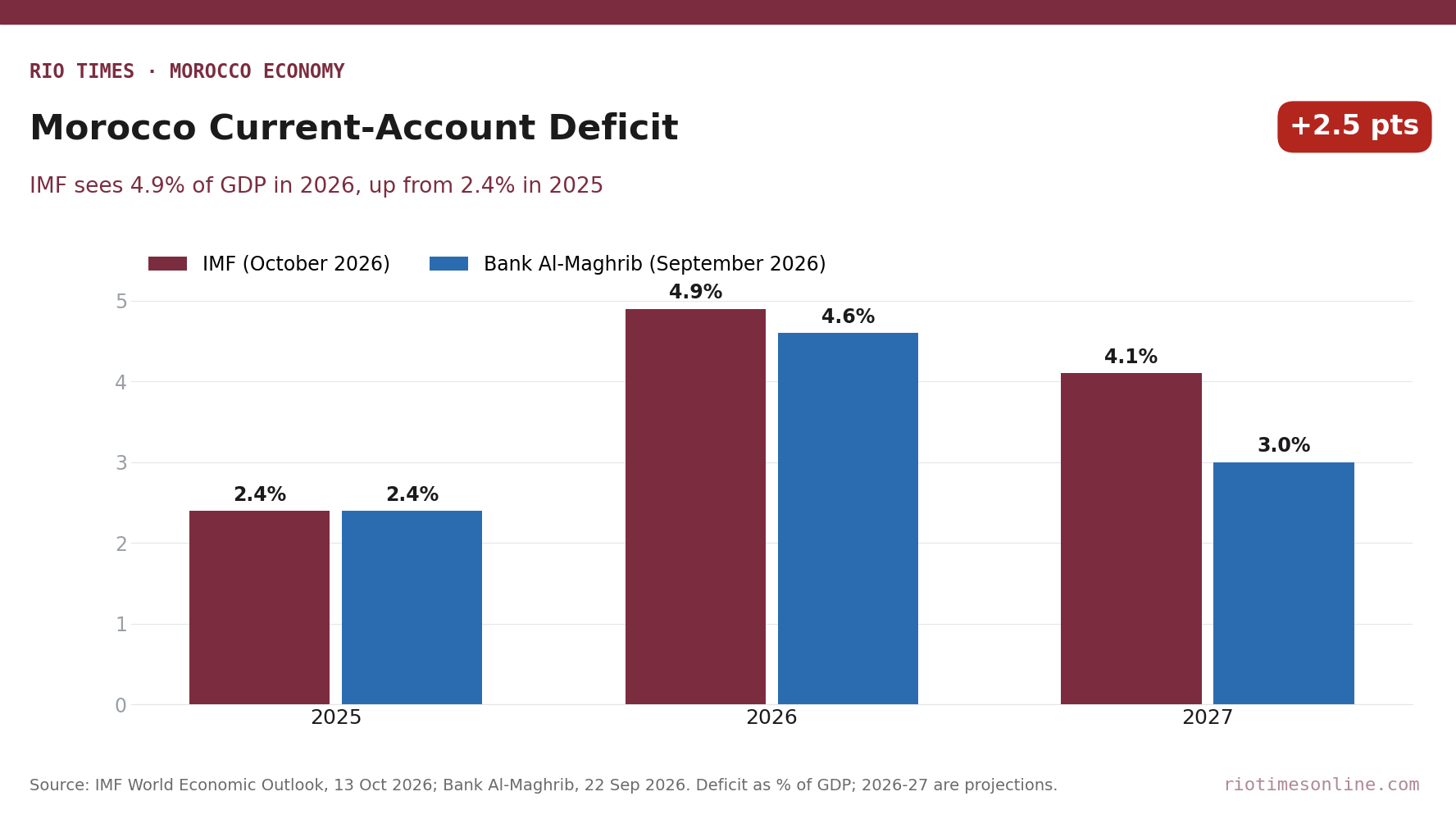
- —The numbers The current-account deficit is seen at 4.9% of GDP in 2026, about US$9.6 billion, up from 2.4% in 2025.
- —What it means for you Growth stays well above the 3.1% world rate, but a costlier energy bill leaves the dirham and external finances more exposed.
- —Still open Whether energy import costs fall enough in 2027 for the deficit to narrow, as both the IMF and the central bank expect.
Morocco growth will slow to 4.5% in 2026 from 4.9% last year, the International Monetary Fund projects in its new World Economic Outlook. The Fund, the Washington-based lender to 191 member countries, published the forecasts on Tuesday 13 October in Bangkok.
The same tables show Morocco’s current-account deficit more than doubling to 4.9% of GDP this year, from 2.4% in 2025. For US investors and exporters, that means a fast-growing partner that now needs more foreign money to pay its bills.
What the IMF Projects for Morocco Growth
The IMF expects Morocco growth to ease further to 4.2% in 2027, still well above its 3.1% forecast for the world economy this year. It puts world growth at 3.4% in 2027, so Morocco would keep outpacing the global average.
Inflation is the bright spot, with consumer prices seen rising just 0.9% in 2026 and 1.4% in 2027. That compares with 4.7% inflation forecast for the world as a whole this year.
The Fund also sees unemployment falling to 12.2% this year from 13% in 2025, and to 11.3% in 2027. Joblessness remains one of the main pressures on the kingdom’s government.
Gross public debt is projected at 66.6% of GDP in 2026, unchanged from last year, before edging down to 66.2% in 2027. That leaves the debt burden stable rather than falling quickly.
Why the Current-Account Deficit Is Widening
The current account tracks trade in goods and services, income and transfers between Morocco and the rest of the world. A deficit of 4.9% of GDP equals about US$9.6 billion, based on the IMF’s estimate of a US$195.6 billion economy.
Bank Al-Maghrib, Morocco’s central bank, pointed to dearer oil and imported inputs at its board meeting on Tuesday 22 September. It expects the energy import bill to jump 28.4% this year to 138.1 billion dirhams (about US$14 billion).
Purchases of equipment goods are also set to rise 15.6% this year as large investment projects continue. The central bank projected the current-account deficit at 4.6% of GDP in 2026, close to the IMF figure.
Exports offer a partial offset, with sales of phosphates and derived fertilisers seen up 9.7% this year on high fertiliser prices. Tourism receipts and money sent home by Moroccans living abroad are also expected to keep rising.
Bank Al-Maghrib kept its policy rate unchanged at 2.25% at the September meeting. It expects inflation of just 0.7% this year, helped by transport subsidies and frozen prices for butane gas and electricity.
Reserves Cushion the Wider Gap
The wider deficit does not yet point to a funding squeeze, because foreign direct investment and Treasury borrowing abroad are expected to cover it. Bank Al-Maghrib projects official reserves rising to 502.8 billion dirhams (about US$51 billion) by the end of 2026.
By the end of 2027 it sees reserves at 515.3 billion dirhams (about US$52 billion). The bank says that would cover about five and a half months of imports of goods and services.
The dirham is expected to weaken, with the central bank projecting a 4.1% fall this year in its real effective exchange rate. That measure tracks the currency against trading partners after adjusting for differences in inflation.
All dollar figures in this article use Bank Al-Maghrib’s reference rate of 9.8519 dirhams per US dollar on Wednesday 14 October. The IMF’s own dollar estimates are used for the size of the economy.
What It Means for US Readers
Morocco is the only African country with a free trade agreement with the United States, in force since 2006. Morocco growth near 4.5% supports demand for imported equipment, though a weaker dirham makes those imports dearer.
For bond investors, the doubling deficit is a reason to watch Morocco’s external borrowing and reserves over the next year. The IMF and the central bank both expect the gap to narrow in 2027, which would ease that pressure.
For travellers, a softer dirham stretches US dollars further in Marrakech and Casablanca. For the people and institutions behind the economy, see Who Runs Morocco’s Economy, the Key Players in 2026.
Foreign ties are covered in Foreign Powers and Investors in Morocco 2026. The recent currency slide is detailed in Morocco’s Dirham Drops 6.5% Against Dollar Since August, and daily life in the Casablanca city guide.
What Is Not Known
The IMF figures come from its global forecast tables, which do not set out the drivers of Morocco’s deficit. A full country review, known as an Article IV consultation, would give more detail on the Fund’s reasoning.
Both forecasts assume a smaller energy bill next year, with Bank Al-Maghrib expecting it to fall to 116 billion dirhams (about US$11.8 billion) in 2027. Renewed hostilities in the Middle East, which the central bank flagged in September, could keep that bill high.
The 2027 finance bill will show how the government plans to fund itself next year. Bank Al-Maghrib expects a budget deficit of 3.4% of GDP this year and 3.5% in 2027.
Frequently Asked Questions
What growth does the IMF expect for Morocco?
The IMF projects Morocco growth of 4.5% in 2026 and 4.2% in 2027, after 4.9% in 2025. Both rates are above its 3.1% forecast for the world economy this year.
How large is Morocco’s current-account deficit?
The IMF sees it at 4.9% of GDP in 2026, about US$9.6 billion, up from 2.4% in 2025. It expects the gap to narrow to 4.1% of GDP in 2027.
Why is the deficit widening?
Higher oil prices and strong imports of equipment and raw materials are lifting the import bill. Bank Al-Maghrib expects energy imports to rise 28.4% this year to about US$14 billion.
Does Morocco have enough reserves?
Bank Al-Maghrib expects official reserves to keep rising, to about US$51 billion by the end of 2026. By the end of 2027 they would cover about five and a half months of imports.
What does this mean for US investors?
Morocco growth stays well above the world rate, and the kingdom is the only African country with a US free trade agreement. Investors should watch its external borrowing and the dirham while the deficit stays wide.
Sources: IMF World Economic Outlook data, October 2026; IMF World Economic Outlook, October 2026; Bank Al-Maghrib board statement, 22 September 2026; Bank Al-Maghrib reference exchange rates; LesEco.ma.
Editorial responsibility: Matthias Camenzind, Editor-in-Chief · Editorial standards · Report an error
Part of our ongoing coverage
Africa: The New Scramble — the great-power contest over the continent.