Key Facts
- The S&P/BMV IPC, Mexico’s main stock index, added 0.39% to close at 66,615, with the 52-week high of 71,601 still a distant target
- The peso strengthened 0.15% to 17.5103 per US dollar putting the currency 7% below its own 52-week high and comfortably inside its recent steady range
- Industrias Peñoles surged 3.5% on the session leading a broader rally in mining names as precious-metals prices provided a tailwind
- Heavyweight América Móvil rose 1.0% giving the IPC a meaningful lift from one of the market’s largest and most liquid stocks
- The S&P 500 shed 1.01% to 7,458 yet Mexican equities held their ground, a rare decoupling that pointed to local catalysts at work
Today’s Focus
Mexican equities shook off a weak lead from New York to close firmly higher on Friday. The S&P/BMV IPC added 0.39% to reach 66,615, while the peso appreciated modestly to 17.51 per US dollar. The session stood out because the US benchmark S&P 500 fell more than 1%, yet Mexican stocks not only held steady but advanced — a signal that domestic buyers found value after a recent soft patch.
The rally was narrow but potent. Mining names did the heavy lifting: Industrias Peñoles jumped 3.5% and Grupo México’s transport arm climbed 3.4%. The country’s corporate heavyweight, América Móvil, contributed a 1.0% gain, which matters enormously for an index where a handful of giant stocks sway the whole tape.
The peso’s 0.15% gain to 17.51 reflected a US dollar that weakened broadly against emerging-market currencies. At 17.51, the peso sits roughly in the middle of its 52-week range, a zone that has held for weeks and suggests neither extreme optimism nor alarm about Mexico’s macro story.
What matters today. Mexico’s market found its own footing on a day when US stocks slid, with miners and América Móvil doing the work — a pattern worth watching if global risk appetite cools further.

https://www.flickr.com/photos/eneas/, CC BY 2.0, via Wikimedia Commons)
01 The session in one read
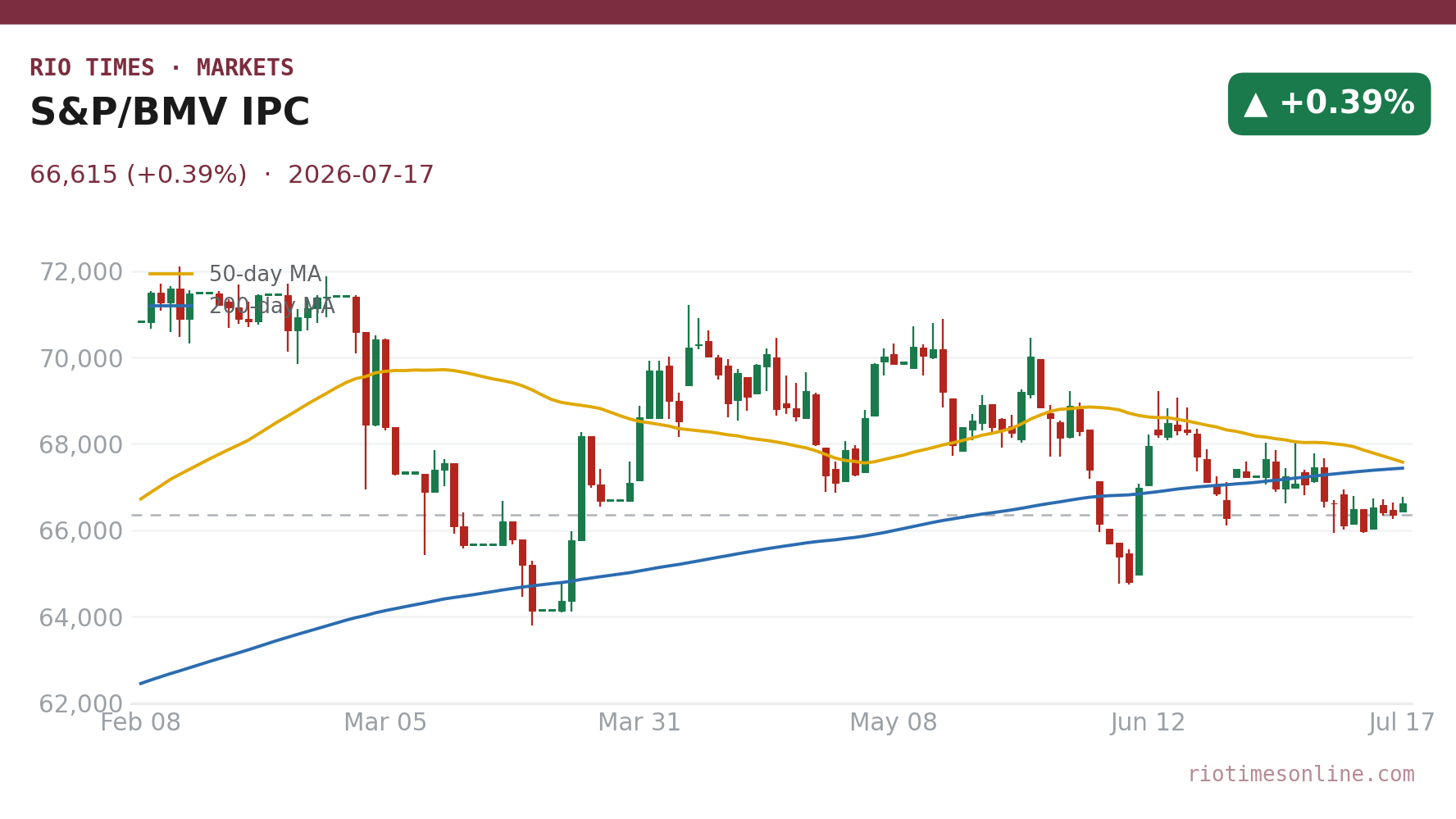
Mexico’s S&P/BMV IPC — the benchmark index that tracks the 35-or-so largest and most traded companies on the Mexican stock exchange — rose 0.39% on Friday, closing at 66,615 points. The gain looked modest on the screen but carried weight because it came against a backdrop of falling US equities, where the S&P 500 shed a full 1.01%.
The peso quietly strengthened to 17.5103 per US dollar, a 0.15% move that kept the currency inside the tight band it has occupied for most of the month. At that level, the peso is 7% below its 52-week high, reflecting a market that has dialled back some of the exuberance from earlier in the year without panicking.
What made the session tick was a sharp rally in Mexico’s mining shares. Industrias Peñoles, the precious-metals miner, surged 3.5% — the best performance on the domestic board. Grupo Carso, Carlos Slim’s industrial and retail conglomerate, followed with a 3.4% advance, giving the IPC two powerful engines on a day when most global markets were struggling for direction.
América Móvil, the telecommunications giant that is often the single most influential stock on the index, added 1.0%. That is a meaningful contribution from a name whose sheer size — it is one of the largest listed companies in Latin America — means even a 1% move can tilt the whole index. Together, the miners and América Móvil explained much of the day’s positive finish.
The session’s gains were real but concentrated: just a handful of large-caps — mainly in mining and telecoms — did the lifting, while consumer staples and airports sagged. That kind of selective rotation suggests traders are repositioning around commodity prices and defensive yield rather than betting on a broad economic acceleration. The peso’s stability reinforces the view that the market is consolidating after its earlier pullback from the 71,601 high. The key variable to watch is whether the mining bid persists into the new week, or whether Friday’s narrow advance fades without broader participation from financials and industrials.
02 The day’s numbers
| Measure | Level | Change | Read |
|---|---|---|---|
| S&P/BMV IPC | 66,615 | +0.39% | 7% below 52-week high of 71,601 |
| Session range | — | — | — |
| USD/MXN (US dollar/peso) | 17.5103 | −0.15% | Peso stronger; 7% below 52-week high |
| 52-week IPC range | 60,216 – 71,601 | — | Mid-range, closer to support than resistance |
| 52-week peso range | 17.13 – 18.83 | — | Firmly in the lower half, near the strong end |
| S&P 500 (US) | 7,458 | −1.01% | 2% below its own 52-week peak |
| Key technical level (IPC) | 66,000–66,600 zone | — | A consolidation band that has held for several sessions |
The closing level of 66,615 puts the IPC squarely in a no-man’s land between its 52-week low of 60,216 and its high of 71,601. The index is closer to the bottom of that range than the top, which suggests the market has priced in a fair amount of caution already.
The peso at 17.51 is a different story: it is trading closer to its strong end, having touched 17.13 at its most muscular point over the past year. That relative strength says the currency market is still giving Mexico the benefit of the doubt on macro stability, even as equities trade more cautiously. Rio Times · Live Market Intelligence
Live Market IntelligenceMexico — Live Market Board
Mexico — Live Market Board
Instrument Last Change YoY Prev. High Low Volume
IPC MEX
69,010.67
+0.12%
+12.17%
68,929.72
66,121
65,405
108,886,187
USD/MXN
17.06
-0.24%
-8.58%
17.10
17.08
17.01
—
WALMEX
48.07
-0.62%
-14.38%
48.37
48.65
48.02
10,781,446
GMEXICO
223.28
+0.35%
+73.59%
222.50
226.18
222.17
1,325,556
FEMSA
201.19
-0.24%
+25.67%
201.67
206.71
199.56
750,706
CEMEX
19.32
+0.89%
+19.10%
19.15
19.35
19.04
14,327,054
GFNORTE
193.98
+1.18%
+14.36%
191.71
195.79
191.83
1,579,115
BIMBO
60.98
-0.96%
+11.89%
61.57
61.46
60.29
1,048,115
TELEVISA
9.71
+0.21%
+12.78%
9.69
9.75
9.60
577,851
AMX
19.80
-0.95%
+12.53%
19.99
20.05
19.70
58,058,525
GAP
366.23
+0.43%
-21.21%
364.68
370.85
362.82
226,946
ASUR
275.04
+1.25%
-15.28%
271.64
275.08
271.31
15,451
OMA
233.50
+0.62%
-6.48%
232.06
235.00
230.62
555,693
KOF
188.04
+0.86%
+18.94%
186.44
188.56
185.52
425,273
GRUMA
252.90
+0.11%
-21.85%
252.61
254.74
250.36
90,048
KIMBER
39.74
+0.43%
+8.85%
39.57
40.09
39.33
490,551
AMX ADR
23.38
-0.23%
+22.25%
23.43
23.49
23.06
1,347,445
03 Why it moved — a mining and telecoms-led rotation
The session’s gains had a clear sectoral signature. Mining stocks caught a bid that looked tied to precious-metals prices, with Industrias Peñoles up 3.5% and Grupo México’s transport arm not far behind. That kind of concentrated buying in extractives often signals a view that global inflation or uncertainty will support gold and silver — or simply that these beaten-down names were due for a bounce.
América Móvil’s 1.0% rise was equally significant. The company carries enormous weight in the IPC because of its market capitalisation, so when it moves, the index moves. The gain came with solid turnover of $44 million, suggesting institutional rather than retail buying.
Consumer-facing and infrastructure names had a rougher day. Walmex — Walmart’s Mexican unit and a staple of many foreign portfolios — edged down 0.2%. Airport operators fell more sharply: GAP, the Guadalajara-based airport group, dropped 1.5%, and low-cost carrier Volaris declined 1.8%. That split between rising miners and falling consumer and travel stocks points to a market that was rotating, not rallying across the board.
The peso’s gentle appreciation was the mirror image of dollar weakness. With the US S&P 500 down more than 1%, capital was flowing out of dollar assets and into a range of emerging-market currencies, the peso among them. A 0.15% move is not dramatic, but it confirmed that the peso’s recent stability has not cracked.
04 The day’s movers
| Driver | Level / Move | Change | Note |
|---|---|---|---|
| Cemex (CX) | Most traded: $1,401m | −1.3% | Heavy volume but price slipped; US-listed ADR proxy |
| Femsa (FR) | $442m turnover | +0.5% | Steady bid in the bottling and retail group |
| IVV (iShares S&P 500 ETF) | $79m turnover | −0.2% | Cross-listed tracker reflecting US tape |
| Walmex (WALMEX) | $75m turnover | −0.2% | Consumer staple under gentle pressure |
| VOO (Vanguard S&P 500 ETF) | $71m turnover | −0.0% | Cross-listed US index fund; essentially flat |
| Grupo México (GMEXICOB) | $65m turnover | +0.9% | Mining bid lifted the name |
| Banorte (GFNORTEO) | $62m turnover | +0.3% | Mexico’s largest locally owned bank |
| América Móvil (AMXB) | $44m turnover | +1.0% | Telecoms heavyweight gave the index meaningful support |
| Industrias Peñoles | Biggest domestic gainer | +3.5% | Precious metals miner led the board |
| Grupo Carso (GCARSOA1) | Runner-up gainer | +3.4% | Slim’s industrial conglomerate surged |
| Volaris (VOLARA) | Biggest domestic loser | −1.8% | Low-cost airline under selling pressure |
| GAP (GAPB) | Airport operator | −1.5% | Guadalajara airport group among the weakest |
The volume board told a story of its own. Cemex, the cement giant that is one of Mexico’s most globally recognised stocks, saw a massive $1.4 billion in turnover — but its price fell 1.3%. That combination of heavy volume and a declining price often suggests large investors were trimming positions rather than adding to them.
Femsa, the Coca-Cola bottler and Oxxo convenience-store operator, was the session’s second most-traded domestic name and managed a 0.5% gain. Banorte edged up 0.3% with decent volume, but the financial sector as a whole did not provide the broad lift that would signal a more durable advance. The star performers were concentrated in mining, while airports and the low-cost carrier Volaris brought up the rear — a possible sign that traders are growing cautious on Mexico’s consumer and travel recovery.
05 The regional scoreboard
| Index | Country | Change |
|---|---|---|
| S&P/BMV IPC | Mexico | +0.39% |
| Ibovespa | Brazil | −0.06% |
| IPSA | Chile | −0.56% |
| Merval | Argentina | +0.46% |
| COLCAP | Colombia | +0.58% |
Mexico’s 0.39% gain put it in the middle of a mixed regional pack. Colombia’s COLCAP led the region with a 0.58% advance, while Argentina’s Merval — a market heavily influenced by the country’s complex inflation and currency dynamics — rose 0.46%. Brazil’s Ibovespa, the heavyweight of Latin American equities, was essentially flat, slipping 0.06%.
Chile’s IPSA was the regional laggard, falling 0.56%. The divergence across the region suggests country-specific factors — rather than a single Latin American macro story — were driving each market, with Mexico drawing support from its mining sector and peso stability.
06 The technical picture
The IPC at 66,615 is sitting in a technical zone that traders have been watching for weeks. The index has been consolidating in a band roughly between 66,000 and 66,600, unable to break decisively higher but also refusing to slide back towards the 60,216 low set during the past year.
The 7% gap to the 52-week high of 71,601 is significant — it means the market would need a powerful catalyst to reclaim that peak. For now, the daily moves are small and the index is choosing direction day by day. The peso is technically in a stronger position: at 17.51, it is closer to the 17.13 strong end of its range than to the 18.83 weak end, which will comfort foreign investors who monitor the currency as a barometer of Mexican risk.
07 What to watch
- Mining momentum: Whether Peñoles and Grupo México can extend Friday’s rally, or whether the bid fades quickly — a sector that leads on one day without follow-through is a head-fake, not a trend
- América Móvil volume: Sustained buying in the telecoms heavyweight would signal institutional conviction; a reversal would call Friday’s IPC gain into question
- Peso holds 17.50: If the peso can cling to levels stronger than 17.60, it reinforces the stability narrative; a quick move back above 17.70 would raise eyebrows
- US tape direction: Friday’s decoupling from the S&P 500 was rare — if US equities slide again, the IPC’s resilience will face a much harder test
Background: Mexico’s Banorte Bank Raises $1.35B in Capital Notes.
Background: Ten Tax Breaks Cost Mexico 2.1% of GDP, a New Fiscal Study Finds.
More: Mexico news in English, every day from The Rio Times.
Frequently Asked Questions
What is the S&P/BMV IPC?
It is Mexico’s main stock index, tracking the 35-or-so largest and most liquid companies listed on the Mexican Stock Exchange, known as the Bolsa Mexicana de Valores. Think of it as Mexico’s answer to the US Dow Jones or the UK FTSE 100 — a single number that tells you whether Mexican shares rose or fell on the day.
How is the value of the peso quoted?
The peso is quoted as USD/MXN — the number of pesos one US dollar buys. When the number goes down, as it did on Friday (to 17.5103 from a higher level), the peso has strengthened because it takes fewer pesos to buy a dollar.
Why does América Móvil matter so much?
América Móvil is one of the largest companies in Latin America by market value, controlled by the Slim family. Because of its sheer size, a 1% move in its share price can shift the entire IPC index, even if most other stocks barely move.
Are the IVV and VOO tickers Mexican companies?
No. IVV and VOO are exchange-traded funds that track the US S&P 500 index. They are cross-listed in Mexico so local investors can buy US exposure in pesos. Their moves mainly reflect what happened on Wall Street, not in Mexico.
This article was produced by The Rio Times’ automated newsroom system. How we use AI · Report an error · Editorial responsibility: Matthias Camenzind, Editor-in-Chief
In depth
LatAm Markets: Live Signals → — real-time movers, turnover leaders and FX across Latin America.