Mexico Investment Rises 6.6% in July on Machine Imports

ECONOMY · MEXICO
Key Facts
- —The country Mexico is one of the largest trading partners of the United States and a leading destination for factories moving closer to the US market.
- —Why it matters Gross fixed investment counts spending on buildings, machinery and equipment. It shows whether companies and the state are adding capacity, not just using what exists.
- —Why now INEGI, the national statistics office, published the July figures on Monday 5 October, the latest hard data on Mexico’s capital spending.
- —What happened Investment rose 6.6% from July 2025 in raw terms and 6.0% after seasonal adjustment. It grew 1.4% from June.
- —The numbers Imported machinery rose 9.9% year on year, adjusted. Mexican-made machinery fell 3.1%. From January to July, investment is up only 1.7%.
- —What it means for you Stronger demand for imported capital goods matters for US equipment exporters and for investors betting on nearshoring.
- —Still open Whether the July rebound lasts, and how the USMCA trade review and interest rates shape company plans into 2027.
- —Prediction markets Polymarket gives Banxico a 95% chance of holding rates at its November meeting (6 October, 3:05 a.m. ET).
Mexico’s gross fixed investment rose 6.6% in July from a year earlier, the national statistics office INEGI reported on Monday 5 October. Construction and machinery both grew, and imported capital goods rose fastest.
For US readers, the figure is a direct read on whether Mexico is still building the plants, warehouses and homes that nearshoring promised. Because INEGI tracks imported machinery separately, the data also show demand for foreign equipment.
INEGI, the Instituto Nacional de Estadística y Geografía, is Mexico’s autonomous statistics agency. Its monthly indicator of gross fixed capital formation measures real spending on assets used in production for more than a year.
Machinery Drove the Monthly Gain
After adjusting for seasonal and calendar effects, investment grew 1.4% from June and 6.0% from July 2025. The unadjusted series, which several Mexican outlets quoted, rose 6.6% year on year.
Machinery and equipment drove the monthly gain, rising 4.5% from June. Construction spending fell 1.5% over the same period, with non-residential building down 3.9%.
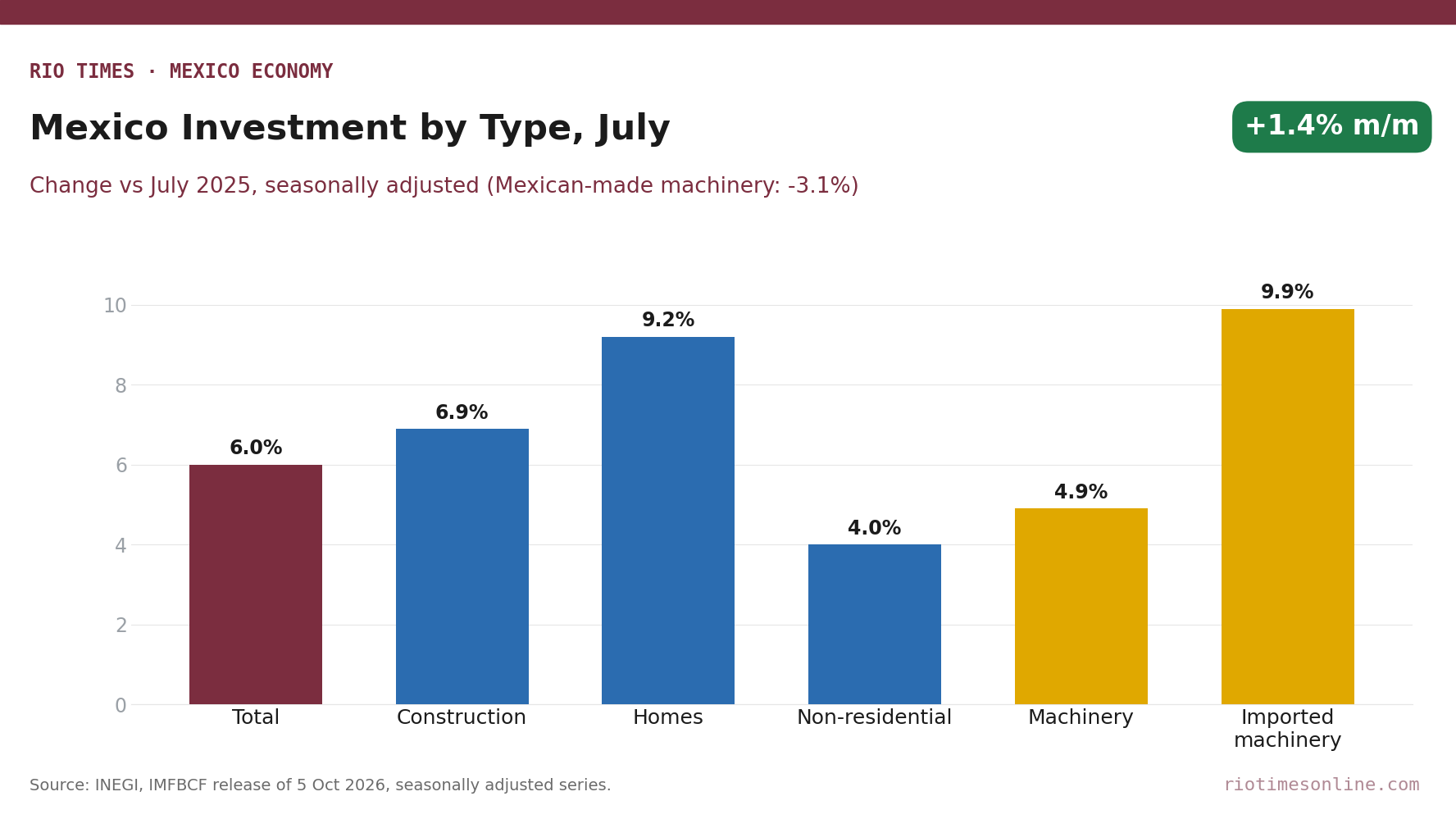
Over twelve months the picture is firmer. Adjusted construction spending rose 6.9%, with residential building up 9.2% and non-residential up 4.0%. Machinery and equipment rose 4.9%.
The split inside machinery is the striking part. Imported machinery and equipment rose 9.9% year on year, adjusted, while Mexican-made machinery fell 3.1%. In raw terms, imported machinery, equipment and other goods jumped 14.9%.
Both private and public buyers spent more. In unadjusted terms, private investment rose 6.7% and public investment 6.2% from July 2025, INEGI said.
A Weak Year Is Still Catching Up
The July jump comes from a low base. From January to July, gross fixed investment is up only 1.7% on the same months of 2025, unadjusted.
Private investment has grown just 0.4% in that period. Public investment is up 10.2%, carried by construction, where public spending rose 12.9%. Mexican-made machinery is down 8.0% for the year so far.
That gap matters. The government has led the recovery, while private companies have been slower to commit. Regional outlets such as Milenio also noted that construction and machinery moved in opposite directions in July.
The release fits a wider pattern in Mexico: record foreign investment announcements alongside slow growth, as covered in Mexico Gets Record US$35 Billion, but Growth Is 1.2%. Private forecasters have also lifted their outlook, as reported in Mexico Analysts Lift 2026 GDP Forecast to 1.4%.
What It Means for You
For US exporters of industrial equipment, a 9.9% rise in imported machinery points to steady orders from Mexican plants. It is one month of data, so it is a signal, not a trend.
For investors in Mexican stocks, peso assets and US companies with Mexican factories, higher capital spending supports the nearshoring story explained in Mexico Nearshoring Explained: Record FDI, the USMCA Review and What Could Stop It. It also suggests firms are still adding capacity despite trade uncertainty.
For travellers and residents, the construction numbers show continued building of homes, with residential spending up 9.2% on the year. That supports jobs, but it does not by itself say anything about rents or prices.
What Is Not Known
INEGI calls the figures preliminary, and monthly data are often revised as more surveys arrive. The next release, for August, is due on 5 November.
The bulletin does not say which countries supplied the imported machinery, or which industries bought it. It also gives no reason for the drop in non-residential construction in July.
It is not yet clear whether private investment will keep pace with public spending in the second half. The outcome of the USMCA review with the United States and Canada remains a key unknown for company plans.
What Prediction Markets Say
Banco de México, known as Banxico, is the country’s autonomous central bank and sets the benchmark interest rate. Its rate decisions shape the cost of borrowing for new investment.
On Polymarket, bets on no change at Banxico’s November meeting stood at 95% at 3:05 a.m. ET on 6 October. That is up about 20 points in a week, on roughly US$25,600 traded in that contract.
A 25-basis-point cut is priced at about 2%, and a 25-basis-point hike at about 4%. Total volume across the November event is about US$36,700. These are real-money bets, not polls or forecasts by Banxico.
Why we show this: prediction markets turn real-money bets into a live probability that moves within minutes of the news, which is why investors, campaigns and newsrooms in the United States now follow them closely. We show them next to polls and official results, never instead of them.
What is gross fixed investment?
It is real spending on assets used in production for more than a year, such as buildings, machinery and equipment. INEGI publishes it monthly for Mexico.
How much did Mexico’s investment grow in July 2026?
It rose 6.6% from July 2025 in raw terms and 6.0% after seasonal adjustment. Compared with June, it grew 1.4%.
When is the next release?
INEGI will publish the August figures on 5 November 2026.
Sources: INEGI, IMFBCF bulletin 615/26, 5 October 2026 · INEGI, IMFBCF bulletin, 4 September 2026 · Milenio
This article was produced by The Rio Times’ automated newsroom system. How we use AI · Report an error · Editorial responsibility: Matthias Camenzind, Editor-in-Chief
In depth
LatAm Markets: Live Signals → — real-time movers, turnover leaders and FX across Latin America.