Merval Slides for Sixth Straight Session as INDEC Crisis and Global Selloff Weigh on Argentina
Argentine equities extended their losing streak to six consecutive sessions on Wednesday as the S&P Merval closed 0.7% lower at 3,015,927 points, accumulating a 7% decline since January 27.
The selloff unfolded against a backdrop of persistent global volatility driven by fears surrounding artificial intelligence stocks and the resignation of INDEC chief Marco Lavagna, which rattled confidence in the country’s statistical integrity amid a dispute over inflation measurement methodology.
Key Market Data
| Indicator | Value | Change |
|---|---|---|
| S&P Merval (ARS) | 3,015,927 pts | -0.7% (daily) / -7% from Jan 27 |
| Merval (USD CCL) | ~2,060 pts | -4% February MTD |
| Country Risk (EMBI) | 502 bps | Stable (from 503) |
| Dollar Official (BNA) | $1,465 / $1,415 | Stable |
| Dollar Blue | $1,455 / $1,435 | +$5 |
| Dollar MEP | $1,458 | -0.1% |
| Dollar CCL | $1,465 | -1.9% (daily) |
| Dollar Mayorista | $1,447.50 | +$1.50 |
| BCRA Reserves | USD 45,417 M | -$256 M |
| BCRA Purchases 2026 | USD 1,297 M | +$44 M (daily) |
Performance Analysis
The Buenos Aires stock exchange recorded its sixth straight decline on Wednesday, though the pace of losses moderated significantly compared to the previous two sessions, when the Merval shed 2.9% and 2.2% respectively.
The index closed at 3,015,927 points, defending the critical 3-million-point psychological floor in pesos and maintaining the 2,000-point level in dollar terms.

The Merval now carries a 1.2% loss for the year, having surrendered all of January’s gains in the opening days of February.
Sovereign bonds showed signs of stabilization, recovering from Tuesday’s selloff to finish with a marginal 0.1% gain on the day. The country risk index held virtually unchanged at 502 basis points, having receded from Tuesday’s intraday peak of 506.
This level remains well below the 1,456-point crisis peak registered in September 2025, but sits above the recent trough of 474 points touched just last week — a level not seen since June 2018.
The exchange rate picture remained remarkably contained despite equity weakness. The blue dollar edged up five pesos to $1,455, recovering modestly from Tuesday’s level of $1,450 — its lowest since December 12.
The CCL dollar actually compressed sharply, falling 1.9% to $1,465, pulling the financial spread to barely 1.2% above the official rate.
Economy Minister Luis Caputo remarked that without the BCRA‘s intervention program, the peso would have appreciated toward the 1,300 pesos per dollar zone — an extraordinary statement highlighting the market’s underlying dollar supply dynamics.
Live Market IntelligenceArgentina — Live Market Board
Rio Times · Live Market Intelligence
Argentina — Live Market Board
+0.00%
206,505.98
-0.18%
66,790.35
-0.26%
10,940.53
-0.23%
2,835,843
+0.00%
2,582.29
+0.46%
60,511.74
-1.60%
| Instrument | Last | Change | YoY | Prev. | High | Low | Volume |
|---|---|---|---|---|---|---|---|
| MERVAL | 2,835,843 | +0.00% | +30.51% | 3,022,485 | 3,042,365 | 2,991,150 | — |
| USD/ARS | 1,493 | +0.10% | +12.96% | 1,491 | 1,494 | 1,480 | — |
| YPF | 7,810 | +0.26% | +72.84% | 7,790 | 7,850 | 7,600 | 1,763,858 |
| GGAL | 6,980 | -0.78% | +1.82% | 7,035 | 7,115 | 6,920 | 1,564,062 |
| PAMPA | 5,115 | +0.69% | +26.70% | 5,080 | 5,140 | 5,000 | 721,190 |
| TXAR | 747.50 | -2.35% | +18.67% | 765.50 | 770.00 | 742.50 | 771,892 |
| ALUAR | 938.00 | -1.21% | +29.83% | 949.50 | 951.00 | 932.50 | 135,426 |
| TGS | 8,870 | -0.17% | +15.05% | 8,885 | 9,075 | 8,720 | 143,546 |
| CEPU | 2,156 | +1.84% | +28.36% | 2,117 | 2,165 | 2,086 | 404,146 |
| MIRGOR | 1,650 | -1.20% | -92.90% | 1,670 | 1,670 | 1,635 | 20,877 |
| COME | 40.93 | -0.73% | -30.47% | 41.23 | 41.60 | 40.50 | 4,258,884 |
| LOMA NEGRA | 3,130 | +0.08% | +5.80% | 3,128 | 3,205 | 3,090 | 182,992 |
| BYMA | 275.00 | -1.70% | +35.14% | 279.75 | 282.50 | 272.00 | 1,409,575 |
| TELECOM ARG | 4,233 | -0.70% | +55.19% | 4,263 | 4,335 | 4,160 | 31,896 |
| GLOBANT | 38.10 | -2.26% | -49.65% | 38.98 | 38.70 | 36.77 | 793,552 |
| MERCADOLIBRE | 1,870 | -3.59% | -20.71% | 1,940 | 1,927 | 1,870 | 329,640 |
Key Drivers
Three interlocking forces shaped Wednesday’s session. The global technology rout continued to reverberate, with the Nasdaq shedding 1.8% as fears mounted over the artificial intelligence investment cycle.
Nvidia fell over 3% on reports of stalled negotiations with OpenAI, while broader risk aversion pushed Bitcoin below $78,000 for the first time since April 2025.
The nomination of economist Kevin Warsh to chair the Federal Reserve by President Trump added another layer of complexity, triggering sharp moves in commodities — gold and silver plunged 9% and 28% from recent all-time highs as markets recalibrated rate cut expectations.
Domestically, the resignation of INDEC director Marco Lavagna dominated headlines and injected a fresh source of uncertainty.
Lavagna departed after the Milei administration delayed implementation of an updated Consumer Price Index methodology that reportedly produces higher inflation readings than the current formula based on 2004 weights.
Analysts flagged the episode as politically sensitive, with market participants questioning whether statistical credibility could be compromised ahead of key policy decisions.
The Milei government’s decision not to return to international debt markets in the short term, confirmed by Minister Caputo on Monday, also tempered enthusiasm, though it sparked speculation about potential local-law bond issuance.
On the positive side, the BCRA continued its relentless reserve accumulation, purchasing USD 44 million on Wednesday to extend its buying streak to 23 consecutive sessions.
Total 2026 purchases now stand at an impressive $1,297 million, with gross reserves at $45,417 million despite a $256 million mark-to-market decline driven by global asset price movements rather than debt payments.
Technical Outlook
| Indicator | Support | Resistance | Signal |
|---|---|---|---|
| S&P Merval (ARS) | 2,985,204 / 2,866,931 | 3,078,281 / 3,195,428 (ATH) | Bearish short-term |
| USD/ARS Mayorista | 1,441 / 1,438 | 1,451 / 1,580 (band ceiling) | Range-bound, 8.5% from ceiling |
| Country Risk | 474 bps (Jan 27 low) | 550-560 bps | Consolidation above 500 |
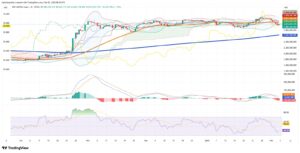
The Merval’s daily chart shows the index testing the critical 3,013,045-point zone, which corresponds to the 50-day moving average.
A break below the 2,985,000 support level could open the door toward 2,866,931, where the 100-day average and Ichimoku cloud base converge. The RSI on the daily timeframe sits at 45-54, in neutral territory with a mild bearish bias.
On the 4-hour chart, the index found support near 2,961,378 during Wednesday’s intraday lows before recovering into the close — a constructive sign suggesting buyers remain willing to step in at lower levels.
The wholesale dollar rate at $1,447.50 sits comfortably 8.5% below the BCRA’s band ceiling of $1,579.95 for February, leaving ample room before any intervention triggers are reached.
The floating band system continues to anchor expectations, with February futures contracts settling at $1,472.50, barely above spot.
Analyst Perspectives
Ian Colombo, financial advisor at Cocos Gold, framed the correction in global terms: “Argentina is not exempt from what’s happening in the world, with the S&P 500 dropping half a point, the Nasdaq and particularly technology stocks suffering heavy selling because investors fear that AI could even hurt technology and software companies.
The world is moving out of stocks and risky bonds.” Colombo also warned that carry trade investors should not underestimate exchange rate risk, noting that the official rate is just 8% from the band ceiling — a gap that could evaporate if conditions shift.
Analysts at IEB described the outlook for February as “an action movie” compared to January’s calmer picture, citing the convergence of political reactivation — including pending labor and glacier reform bills — alongside the start of Q4 2025 earnings season, which they expect to show strong results for banks and continued dynamism in the Vaca Muerta shale basin.
Looking Ahead
Several catalysts loom over the coming sessions. The Argentine Congress opens extraordinary sessions this week, with the Milei administration looking to push through transformative legislation including labor reform and the contentious Glaciers Law.
The Senate is expected to take up key bills around February 11. The BCRA’s reserve accumulation program — having already exceeded $1.2 billion in just over a month — will remain under close scrutiny as a key determinant of country risk trajectory.
Meanwhile, Q4 2025 corporate earnings begin filtering through, with banking sector results expected to provide a positive catalyst given improved credit growth and lower funding costs.
With the Merval testing the 3-million-point floor and the blue dollar trading at near-parity with the official rate, Argentina’s markets stand at a pivotal juncture where domestic political momentum and global risk sentiment will determine whether the six-session losing streak gives way to a recovery or deepens into a more significant correction.
This is part of The Rio Times’ daily coverage of Argentine markets and Latin American financial news.
For regional context, see the Brazil’s Ibovespa report for the same date: Brazil’s Ibovespa.
For regional context, see the Chile’s IPSA report for the same date: Chile’s IPSA.
Key Facts
— Deep Dive
— For the complete picture, read our in-depth guide: Latin America Stock Markets 2026: Ibovespa, Merval, COLCAP, IPSA and IPC Guide
This article was produced by The Rio Times’ automated newsroom system. How we use AI · Report an error · Editorial responsibility: Matthias Camenzind, Editor-in-Chief
In depth
Read More from The Rio Times