ECONOMY · LATIN AMERICA
Key Facts
- —The country Latin America and the Caribbean, the region covered by ECLAC, the UN Economic Commission for Latin America and the Caribbean, based in Santiago.
- —What happened ECLAC’s Special Report No. 3 (21 Sep 2026) warns an extreme El Niño could add up to 4.8 million people to poverty by decade’s end. UNICEF added a child-exposure estimate on 30 Sep.
- —The numbers A cumulative regional GDP loss of at least 2% over three years, half in year one. Ecuador (4.4 points) and Peru (4.1) face the largest growth cuts (ECLAC, 21 Sep 2026).
- —What it means for you Expect pressure on food prices, power supply and fishing in exposed countries. ECLAC says cash transfers and early planning can limit the damage.
- —Still open Whether the event reaches historic strength, and which governments fund the ten measures ECLAC recommends before the peak this northern winter.
The El Niño poverty warning issued by the United Nations’ regional economic body on 21 September has gained weight this week. ECLAC estimates that an extreme event could push up to 4.8 million more people in Latin America and the Caribbean into poverty by the end of the decade.
The figure compares a scenario with El Niño against one without it, and rests on lost household income. The same report, published on 21 September 2026, puts the cumulative regional GDP loss at at least 2% over three years.
On 30 September UNICEF, the UN children’s agency, added its own estimate. At least 25.8 million children in the region, about one in seven, are exposed to El Niño droughts and floods.
What ECLAC Found
ECLAC, known in Spanish as CEPAL, released the study as its Special Report No. 3. It was led by Executive Secretary José Manuel Salazar-Xirinachs.
Half of the 2% GDP loss would arrive in the first year after the event, the commission says. The rest would spread over the following two years, so the damage outlasts the weather.
The report cites projections from NOAA, the US ocean and weather agency. They give a more than 90% chance of a very strong El Niño this northern autumn and winter, and a 69% chance of a historic “Super El Niño”.
Which Countries Are Most Exposed
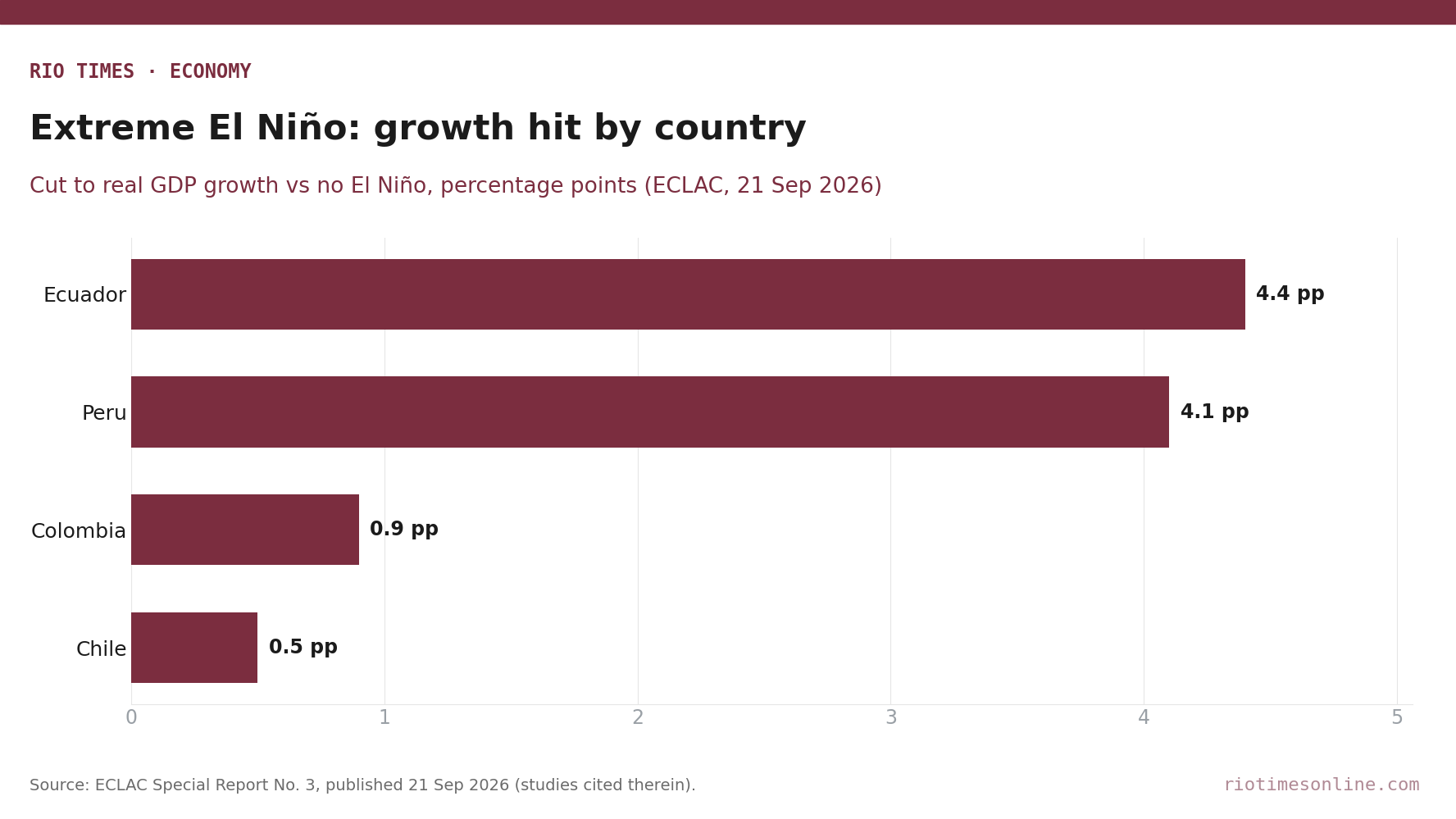
Losses are uneven. Citing earlier studies, ECLAC says an extreme event would cut real GDP growth by 4.4 percentage points in Ecuador and 4.1 points in Peru.
Colombia would lose about 0.9 points and Chile around 0.5, compared with a scenario without El Niño. Panama’s La Estrella and Peru Retail reported the same figures from the report.
Peru has already had to plan around thin margins, as covered in Peru Meets El Niño With Its Smallest Buffer in 25 Years. A separate debate in Lima has centred on decree powers covering security and El Niño.
Food, Power and Fishing Under Pressure
ECLAC flags energy as a weak point, because hydropower supplies more than 70% of electricity in several countries. Heat in Lima, São Paulo and Mexico City could lift power demand just as reservoirs run lower.
Citing FAO, the UN food agency, the report puts drought risk above 70% in Central America’s Dry Corridor, Colombia, Venezuela, Cuba, the Dominican Republic and Haiti. Staple crops and rural incomes are most exposed.
UNICEF’s 30 September analysis, reported by AFP and El País, names the same Dry Corridor of Guatemala, El Salvador, Honduras and Nicaragua. It requested US$53.8 million for regional emergencies in 2026, with 55% unfunded as of 30 June.
Fishing is the other pressure point. In past Super El Niño events, regional catches fell by 52.7% in 1972–1973 and by 26.9% in 1997–1998, the report notes.
What Governments Can Do
The El Niño poverty estimate is a risk scenario, not a forecast of certain losses. ECLAC lists ten measures, from early warning systems and climate insurance to targeted cash transfers for vulnerable households.
Salazar-Xirinachs argued that prevention costs less than emergency response. “It is imperative that we shift from a response after losses to anticipatory management of climate risk,” he said.
What Is Not Yet Known
ECLAC’s release gives no country-by-country split of the 4.8 million figure. It is also unclear how fast households would recover once rains return to normal.
The final strength of the event will only be clear in the coming months. Governments have yet to say how much of the recommended spending they will fund.
Sources: ECLAC press release, 21 Sep 2026; ECLAC Special Report No. 3; La Estrella de Panamá, 28 Sep 2026; Peru Retail, 23 Sep 2026; UNICEF press release, 30 Sep 2026; El País, 30 Sep 2026.
This article was produced by The Rio Times’ automated newsroom system. How we use AI · Report an error · Editorial responsibility: Matthias Camenzind, Editor-in-Chief