Key Facts
- US futures point lower with Nasdaq futures down about 1.3% and S&P 500 futures off roughly 0.8% after a weak chip tape, keeping risk appetite cautious across emerging markets.
- Brent crude settled at US$91.02 a barrel on Tuesday, its highest close since 24 July, on Middle East tension, supporting oil-linked boards in Colombia and Brazil even as global tech wobbles.
- The dollar is broadly flat with the DXY index at 99.66, essentially flat on the day, leaving Latin American currencies to trade their own domestic stories rather than a single global dollar move.
- Brazil’s real slipped to 5.2186 per dollar in the last session, compounding pressure from heavy foreign outflows on B3, the São Paulo exchange.
- Chile edged higher with the IPSA up 0.34% and Colombia’s COLCAP up 0.36% in the prior session, while Argentina’s Merval fell 1.89%.
Today’s Focus
Latin America opens Wednesday with a mixed global backdrop. The overnight tape shows US futures under pressure, led lower by chipmakers, while oil prices are holding firmer on Middle East worries.
That split matters for the region. Oil exporters such as Colombia and Brazil can lean on crude strength, while Mexico’s tech-linked listings and Argentina’s generally defensive mood face a more cautious open.
Brazil’s own story is dominated by flow. Foreign investors have pulled billions from B3 in recent weeks, and the real has weakened toward 5.22 per dollar, which raises the stakes for today’s central bank monetary council meeting.
The board shows the real little changed from its last close, but the pressure from local politics and global tech makes the currency the key tell for the session.
What matters today. Whether steady oil and a flat dollar can cushion Latin American risk appetite against weaker US futures and ongoing foreign outflows from Brazil.
| Instrument | Level | Session |
|---|---|---|
| Ibovespa (Brazil) | 166,335 | -0.27% |
| S&P 500 (US) | 7,692 | -0.69% |
| USD/BRL | 5.2186 | +0.33% |
| USD/MXN | 17.0656 | +0.16% |
| USD/CLP | 927.5 | +1.21% |
| USD/COP | 3,133 | +0.09% |
| USD/ARS | 1,495 | +0.48% |
Latin American markets — Source: RT close, 2026-08-18. Figures rendered directly from the feed.
01 The overnight tape in one read
Global markets are trading with a defensive tilt. The Edge Malaysia reported that Nasdaq futures fell about 1.3% and S&P 500 futures around 0.8%, with weaker chipmakers the main drag.
Europe was softer too, with the STOXX 600 down roughly 0.5%. Britain’s FTSE 100 was off about 0.28% in a snapshot, while Japan’s Nikkei dropped 2.54%.
The commodity leg is the bright spot. Brent crude has risen toward US$91 a barrel, supported by Middle East tensions, while gold and silver pulled back sharply in the last session.
US Treasury yields are little changed to slightly lower, with the 10-year around 4.73%, suggesting bond markets are not yet pricing a much sharper global slowdown.
The evidence is mixed. Oil is firmer and the dollar is flat, which usually helps Latin American carry trades and exporters, but US futures are down hard on the chip selloff and that tends to spill into risk-sensitive currencies and equities.
Brazil’s ongoing foreign outflows add a local negative, while Chilean and Colombian boards looked steadier in the last session. The variable to watch is whether the real stabilises near 5.22 or slides further, because that will set the tone for foreign positioning across the region.
02 The board before the open
| Instrument | Level | Change | Read |
|---|---|---|---|
| S&P 500 | 7,692 | −0.69% | US benchmark retreats on chip weakness |
| VIX | 15.84 | +4.28% | Volatility gauge lifts from low base |
| USD/BRL | 5.2186 | +0.33% | Real under pressure from outflows |
| USD/MXN | 17.0656 | +0.16% | Peso soft but contained |
| Brent crude | — | — | Firmer on Middle East supply worry |
The board shows US equities closed lower, with the S&P 500 down 0.69% and the Nasdaq off more than 1.3%, while the VIX volatility index jumped more than 4%.
For Latin America, the currency board is modestly negative. The real’s 0.33% slip and the Chilean peso’s much larger 1.21% fall stand out, while the Mexican peso moved only slightly. Rio Times · Live Market Intelligence
Live Market IntelligenceLatin America — Cross-Market Board
Latin America — Cross-Market Board
Instrument Last Change YoY Prev. High Low Volume
IBOV
192,114.55
+2.63%
+21.85%
187,197.46
168,310
167,142
—
IPSA
10,916.57
+0.08%
—
10,908.18
11,210
10,984
1,513,213,483
IPC MEX
64,531.68
+1.10%
+12.17%
63,828.60
66,121
65,405
108,886,187
MERVAL
2,767,663
+0.32%
+30.51%
3,022,485
3,042,365
2,991,150
—
COLCAP
2,515.02
-0.59%
—
9.04
9.05
9.02
4,133
BVL PERÚ
59,751.67
+0.18%
—
—
—
—
—
USD/BRL
5.16
+0.01%
-5.13%
5.16
5.18
5.14
—
EUR/BRL
5.95
+1.01%
-5.83%
5.89
5.98
5.94
—
USD/MXN
17.06
-0.24%
-8.58%
17.10
17.08
17.01
—
USD/CLP
913.98
+0.04%
-5.67%
913.65
915.11
906.68
—
USD/COP
3,140
+0.03%
-22.04%
3,139
3,141
3,105
—
USD/PEN
3.36
-0.66%
-4.82%
3.38
3.38
3.35
—
USD/ARS
1,493
+0.10%
+12.96%
1,491
1,494
1,480
—
USD/UYU
40.27
+1.24%
+1.80%
39.77
40.27
40.23
—
USD/PYG
5,939
+1.68%
-19.54%
5,841
5,939
5,925
—
USD/BOB
11.64
-0.76%
+72.04%
11.73
11.72
11.64
—
USD/DOP
58.34
+1.25%
-3.44%
57.62
58.34
58.04
—
USD/CRC
445.92
+0.89%
-9.71%
441.97
448.50
445.92
—
03 What the data shows — B3’s most-traded names split by oil and rates
| Stock | Move | Turnover | Note |
|---|---|---|---|
| PETR4 | — | R$1.57bn (about US$301 million) | Petrobras preferred, top turnover on oil strength |
| VALE3 | — | R$890m (about US$171 million) | Vale common, biggest mining name on board |
| EQTL3 | — | R$675m (about US$130 million) | Equatorial Energia, utilities draw defensive flow |
| AXIA3 | — | R$629m (about US$121 million) | Axia, retailer among volume leaders |
| ITUB4 | — | R$560m (about US$107 million) | Itaú Unibanco preferred, rates in focus |
Turnover data from B3 shows money concentrating in the most liquid commodity and bank names. Petrobras preferred shares led with R$1.57 billion (about US$301 million) traded, reflecting oil’s firm tone.
The presence of Itaú Unibanco and Equatorial among the volume leaders tells a story of investors seeking cash flow and regulated returns while Brazil’s interest rate stays high.
The biggest gainers were led by Oncoclínicas, up 10% on modest turnover, while retailers and homebuilders such as C&A, Cyrela and Cury dominated the losers’ side, a classic signal of domestic rate anxiety.
04 Brazil and the currencies
Brazil’s real is the region’s focal point. It slipped to 5.2186 per dollar in the last session, and foreign exchange flows have been closely watched after foreign investors pulled R$4.7 billion (about US$902 million) from B3 in a single day in mid-August.
August outflows from the stock exchange were around R$11.9 billion (about US$2.3 billion) by mid-month, though year-to-date flows are still net positive at roughly R$24.4 billion (about US$4.7 billion).
The central bank’s benchmark Selic rate is at 14.00%, and the National Monetary Council meets today, which could keep rate-sensitive assets busy.
Mexico’s peso is steadier, moving only 0.16% against the dollar, while Chile’s peso weakened more than 1% and Argentina’s peso continued its gradual slide as the board shows.
05 The regional setup
| Index | Country | Change |
|---|---|---|
| COLCAP | Colombia | +0.36% |
| IPSA | Chile | +0.34% |
| IPC | Mexico | +0.07% |
| Ibovespa | Brazil | −0.27% |
| Merval | Argentina | −1.89% |
The prior session’s regional board was split. Colombia and Chile rose modestly, likely supported by their commodity and defensive sectors, while Mexico was essentially flat.
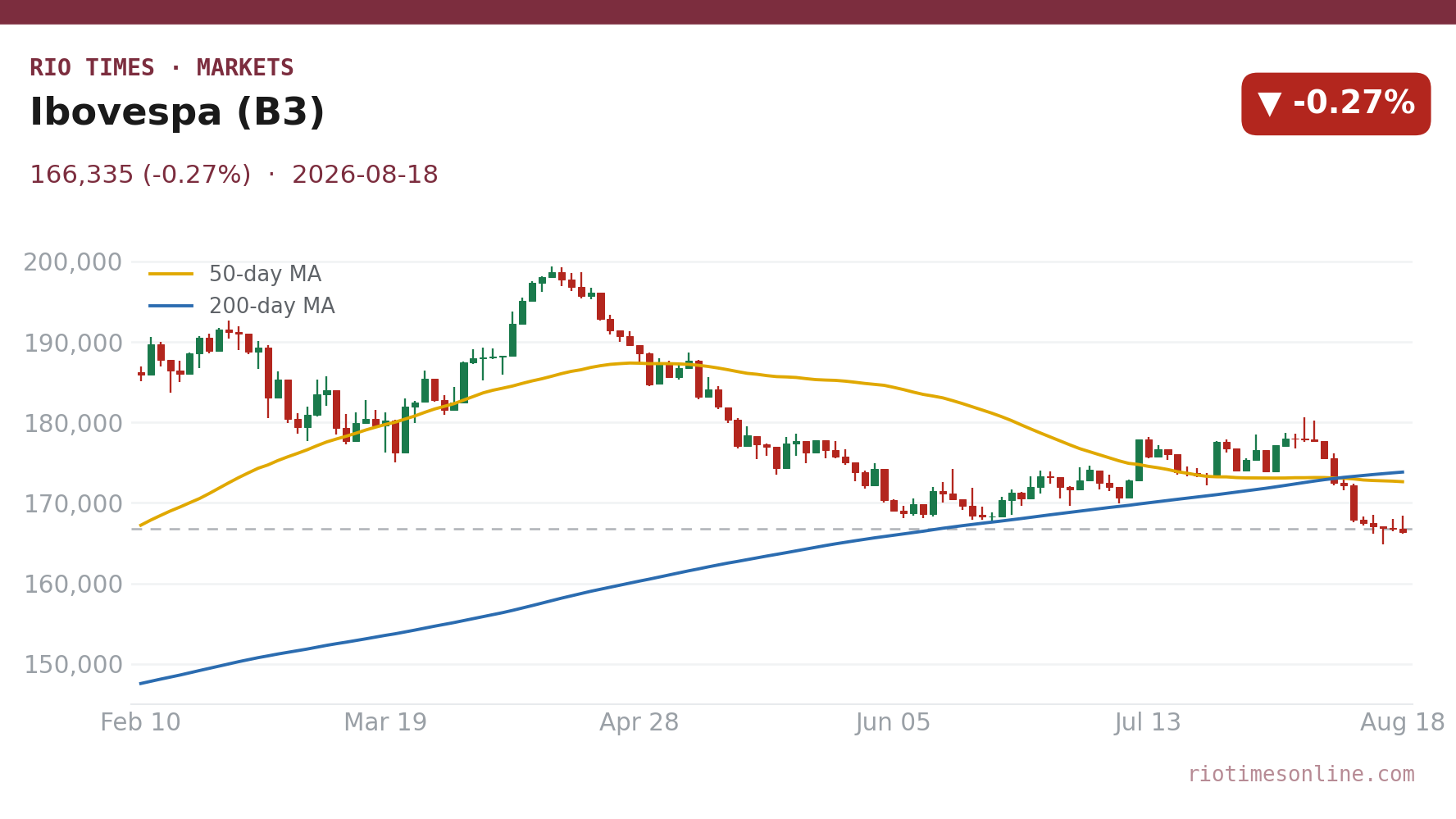
Brazil fell for an eleventh straight session, a streak that shows genuine fatigue from domestic politics and foreign outflows rather than a simple global swoon.
Argentina’s Merval dropped nearly 1.9%, the weakest of the five, as the country’s long-running adjustment story keeps investors nervous ahead of trade and activity data due later.
06 The technical picture
Brazil’s Ibovespa sits about 16.3% below its 52-week high, with an 11-session losing streak that has pushed it deep into technically oversold territory.
Mexico’s IPC is around 10% off its high, a shallower pullback, while the S&P 500 remains within 1.4% of its own peak despite Tuesday’s dip.
The dollar index is flat near 99.65, and the real’s range between 4.89 and 5.59 over the past year leaves plenty of room for volatility.
The regional technical picture depends on oil and the dollar. If crude holds near US$91 and the real does not break decisively above 5.25, the worse of the squeeze may be over.
07 What to watch
- Brazil’s National Monetary Council: Any signal on rates or credit policy could shift the real and B3 liquidity quickly.
- Argentina activity and trade data: Due at 19:00 local time, they set the tone for Merval and Argentine assets into Thursday.
- US jobless claims and Philly Fed: The 12:30 releases will test whether the US soft-landing story still holds.
- Chipmaker futures: Nasdaq’s 1.7% slide means any further weakness could drag Mexico and Brazil tech proxies lower.
Frequently Asked Questions
Why is Brazil falling while Colombia and Chile rise?
Brazil is suffering heavy foreign outflows and a long losing streak, while Chile and Colombia are smaller markets with more commodity and defensive support.
What does oil’s rise mean for Latin America?
Firmer crude helps exporters like Petrobras, Colombia’s Ecopetrol and the broader trade balance, cushioning the impact of weaker US tech.
Is the dollar strong today?
Not especially. The dollar index is flat, so Latin American currencies are moving on their own domestic stories rather than a global dollar shock.
What should I watch most closely today?
The real’s behaviour near 5.22 and whether the US data keep futures weak or offer relief into the New York open.
This article was produced by The Rio Times’ automated newsroom system. How we use AI · Report an error · Editorial responsibility: Matthias Camenzind, Editor-in-Chief
LatAm Markets: Live Signals → — real-time movers, turnover leaders and FX across Latin America.