Key Facts
- The dollar eased against the Mexican peso and Chilean peso overnight, but crept higher against the real and Colombian peso, leaving Latin American currencies split ahead of the US retail sales print.
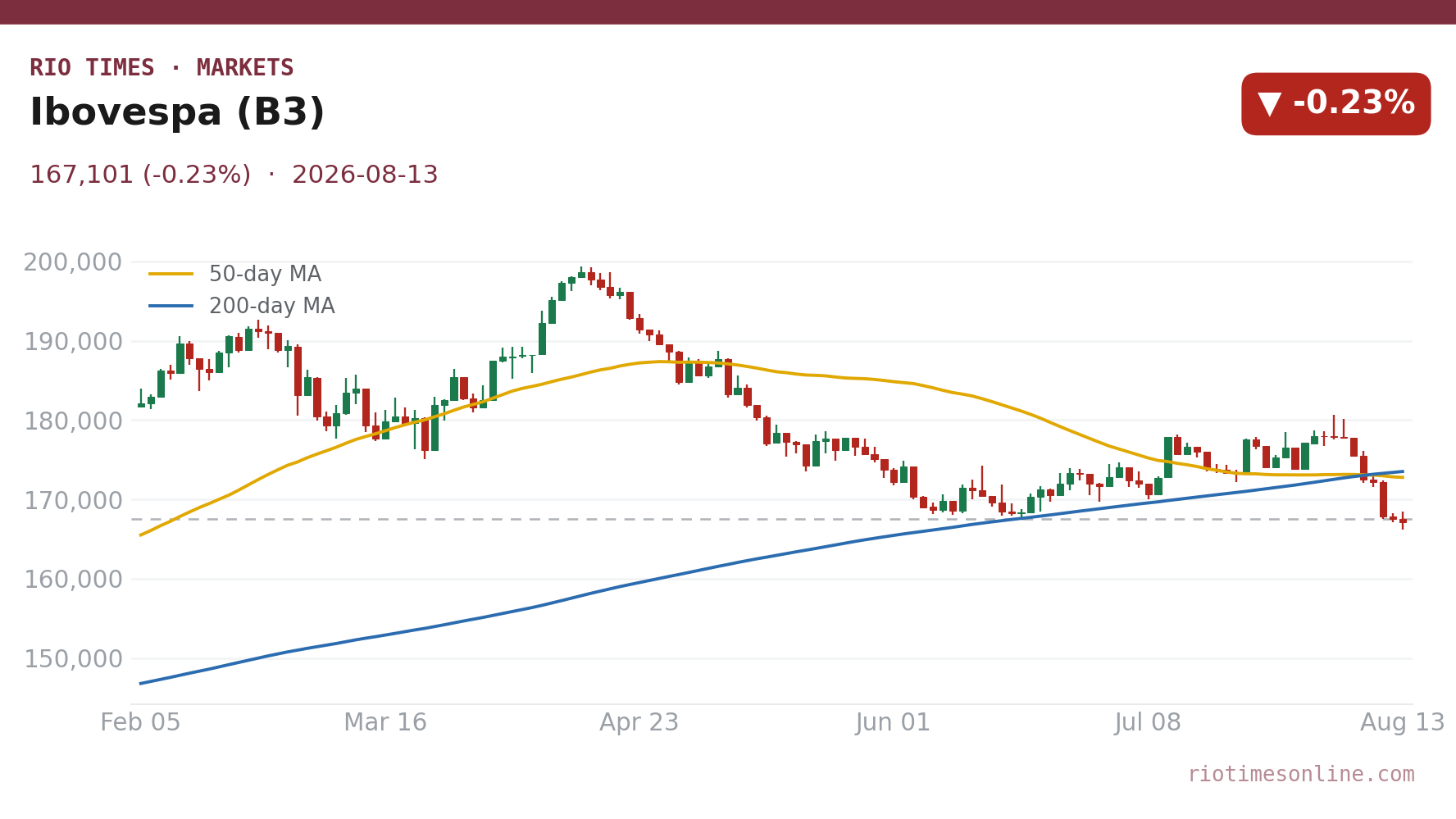
- Brazil’s Ibovespa fell for an eighth straight session closing at 167,101, a drop of 0.23% that leaves the main stock index 15.9% below its 52-week high and firmly decoupled from a firmer Wall Street.
- The S&P 500 rose 0.65% to 7,799 matching its 52-week high, while the Nasdaq added 0.81% and the VIX fear gauge ticked up only slightly, a US tape that offers little comfort to a defensive Latin American open.
- Turnover concentrated in Brazilian defensives and utilities with Sabesp, Petrobras, and Vale seeing the heaviest trading as investors repositioned after the central bank’s Selic cut to 14.00% at its August meeting.
- Gold and silver fell sharply with bullion down 1.29% to $4,357 an ounce, pressuring the outlook for mining-heavy exchanges in Mexico and Peru while the 10-year US Treasury yield eased to 4.647%.
Today’s Focus
Latin America walks into Friday’s session with a split personality: a weaker dollar is helping the peso and Chilean peso, but Brazil’s stock market is in its longest losing streak of the year and the real is edging the wrong way. The Ibovespa, Brazil’s main share index, closed at 167,101, down 0.23% and now 15.9% below its 52-week high.
The pain is not evenly spread. Mexico’s IPC index fell 0.64% to 64,826, while Chile’s IPSA rose a modest 0.16% and Argentina’s Merval was flat. The board shows the dollar mixed against regional currencies — firmer against the real at 5.1887, softer against the Mexican peso at 17.0293.
Today’s US retail sales report, due at 17.03:17.03 Brasília time, is the swing factor. Economists expect a muted 0.1% headline rise, and any surprise will ripple straight into Latin American risk pricing before the weekend.
Traders will also watch the CFTC speculative positioning data out tonight, which covers bets on the real, the peso, and a range of commodities that matter to Chile, Peru, and Colombia.
What matters today. Whether US consumption data confirms a soft landing or fans stagflation fears, setting the tone for Latin American risk into the close.

| Instrument | Level | Session |
|---|---|---|
| Ibovespa (Brazil) | 167,101 | -0.23% |
| S&P 500 (US) | 7,799 | +0.65% |
| USD/BRL | 5.1887 | +0.20% |
| USD/MXN | 17.0293 | -0.17% |
| USD/CLP | 914.67 | -0.02% |
| USD/COP | 3,146 | +0.35% |
| USD/ARS | 1,492 | -0.05% |
Latin American markets — Source: RT close, 2026-08-13. Figures rendered directly from the feed.
01 The overnight tape in one read
The overnight world tape offers a fragile calm. The S&P 500 rose 0.65% to 7,799, exactly its 52-week high, and the Nasdaq gained 0.81%, but the VIX — Wall Street’s fear gauge — still inched up to 14.63, suggesting traders are hedging rather than celebrating.
Bond markets signalled caution. The 10-year US Treasury yield fell to 4.647%, a decline that usually reflects buyers seeking safety ahead of today’s US retail sales data.
Commodities were the clear pain point. Gold slumped 1.29% to $4,357 an ounce and silver fell 1.14%, a headwind for mining-heavy bourses in Mexico, Peru, and Chile that often track precious metals closely.
The dollar index slipped to 99.884, but that broad softness did not translate uniformly across Latin America. The Mexican peso and Chilean peso firmed slightly, while the Brazilian real and Colombian peso weakened.
The evidence points to a defensive regional open. Brazil’s eight-session slide, concentrated selling in utilities and healthcare, and a real that cannot rally even as the dollar index eases all signal domestic fatigue. Mexico’s IPC is also slipping. The variable to watch is the US retail sales print — a beat could stabilise sentiment, while a miss would likely extend the defensive rotation already visible in Thursday’s turnover leaders.
02 The board before the open
| Instrument | Level | Change | Read |
|---|---|---|---|
| US Dollar Index (DXY) | 99.884 | −0.13% | Broad dollar soft, helping Mexico and Chile, not Brazil |
| USD/BRL | 5.1887 | +0.20% | Real weaker despite soft dollar — domestic drag |
| USD/MXN | 17.0293 | −0.17% | Peso firming with risk appetite |
| Gold (oz) | $4,357 | −1.29% | Precious metals slide hits Peru and Mexican miners |
| US 10Y yield | 4.647% | −1.15% | Bond buying signals caution before retail data |
The currency board splits Latin America into two camps. The dollar’s modest retreat helped the Mexican peso and Chilean peso, but the Brazilian real went the other way, weakening to 5.1887 per dollar.
Gold’s 1.29% drop is the most striking overnight move. It directly pressures miners in Peru, where the BVL Peru index fell 1.21% on Thursday, and it complicates the picture for Mexico’s materials-heavy IPC. Rio Times · Live Market Intelligence
Live Market IntelligenceLatin America — Cross-Market Board
Latin America — Cross-Market Board
Instrument Last Change YoY Prev. High Low Volume
IBOV
184,853.65
+0.56%
+21.85%
183,827.59
168,310
167,142
—
IPSA
11,097.87
+0.38%
—
11,055.91
11,210
10,984
1,513,213,483
IPC MEX
65,110.57
+0.26%
+12.17%
64,944.41
66,121
65,405
108,886,187
MERVAL
2,785,510
+0.11%
+30.51%
3,022,485
3,042,365
2,991,150
—
COLCAP
2,549.57
-0.37%
—
9.04
9.05
9.02
4,133
BVL PERÚ
60,410.88
+0.33%
—
—
—
—
—
USD/BRL
5.16
+0.01%
-5.13%
5.16
5.18
5.14
—
EUR/BRL
5.95
+1.01%
-5.83%
5.89
5.98
5.94
—
USD/MXN
17.06
-0.24%
-8.58%
17.10
17.08
17.01
—
USD/CLP
913.98
+0.04%
-5.67%
913.65
915.11
906.68
—
USD/COP
3,140
+0.03%
-22.04%
3,139
3,141
3,105
—
USD/PEN
3.36
-0.66%
-4.82%
3.38
3.38
3.35
—
USD/ARS
1,493
+0.10%
+12.96%
1,491
1,494
1,480
—
USD/UYU
40.27
+1.24%
+1.80%
39.77
40.27
40.23
—
USD/PYG
5,939
+1.68%
-19.54%
5,841
5,939
5,925
—
USD/BOB
11.64
-0.76%
+72.04%
11.73
11.72
11.64
—
USD/DOP
58.34
+1.25%
-3.44%
57.62
58.34
58.04
—
USD/CRC
445.92
+0.89%
-9.71%
441.97
448.50
445.92
—
03 What the data shows — Brazil decouples from Wall Street
| Stock | Move | Turnover | Note |
|---|---|---|---|
| Hapvida (HAPV3) | −33.1% | R$294m | Healthcare plan provider crushed — likely margin shock |
| MRV (MRVE3) | +14.3% | R$121m | Homebuilder surged — bargain hunting after deep slump |
| Sabesp (SBSP3) | −7.0% | R$1,882m | Water utility hit hard in heavy turnover |
| RD Saúde (RDOR3) | +6.3% | R$743m | Drugstore chain rallied on defensive rotation |
| Petrobras (PETR4) | — | R$1,550m | Oil major led turnover without a clear directional push |
The B3 scan shows a market in distress under the surface. Hapvida, a health plan operator, lost a third of its value in one session on R$294 million of turnover — a move that smells like an operational or regulatory shock rather than routine volatility.
Yet there is selective optimism. Builder MRV jumped 14.3% and drugstore chain RD Saúde rose 6.3%, the latter on R$743 million of turnover, suggesting some investors are rotating into beaten-down consumer and healthcare names.
Sabesp, the São Paulo water utility, fell 7% on the heaviest turnover of the day at R$1.88 billion. That is a defensive name being sold aggressively, which fits the broader defensive-to-risk rotation seen across emerging markets.
04 Brazil and the currencies
Brazil’s central bank has now cut the Selic, its benchmark interest rate, to 14.00% after a fourth straight reduction at the August meeting. The bank left the door open for more easing but stressed that inflation uncertainty remains high.
The inflation picture has improved, with the July reading at 4.44% year over year, down from 4.64% in June, but it is still above the 4.5% upper limit of the central bank’s tolerance band around its 3% target.
The real’s refusal to rally as the dollar softened tells you the market is now pricing Brazil’s domestic story more than the US dollar cycle. Foreigners are watching whether the Selic can keep real yields attractive enough to defend the currency.
The CFTC positioning data out tonight will show how speculative accounts are betting on the real. The previous reading showed a modest net long position, and any swing toward net short would confirm the souring mood.
05 The regional setup
| Index | Country | Change |
|---|---|---|
| Ibovespa | Brazil | −0.23% |
| IPC | Mexico | −0.64% |
| IPSA | Chile | +0.16% |
| Merval | Argentina | +0.04% |
| COLCAP | Colombia | +0.07% |
| BVL Perú | Peru | −1.21% |
The regional board is a patchwork. Brazil and Mexico are weak, Chile and Colombia are flat-to-positive, and Peru is the clear laggard after gold and silver slid.
Peru’s 1.21% drop reflects heavy mining exposure. With bullion down 1.29% and silver off 1.14%, Lima’s miners will likely open under pressure again today.
Colombia’s COLCAP held steady at 2,432, but today brings retail sales and industrial production data. Economists expect retail sales growth of 13.6% year over year, a number that, if confirmed, would support the peso.
06 The technical picture
The Ibovespa’s eight straight down days have pushed it to 15.9% below its 52-week high, with the index now trading near the lower end of its one-year range. Momentum indicators are oversold, but oversold can stay oversold in a trend like this.
The US S&P 500 sitting exactly at its 52-week high of 7,799 is the opposite signal. This divergence is unusual and reflects the very different earnings and rate cycles in the two markets.
For the real, the 5.1887 level against the dollar matters. It is roughly 7% stronger than the 52-week low, but the failure to rally on dollar weakness today is a warning that local sellers are still in charge.
Watch the 4.647% level on the 10-year Treasury. If yields keep falling, emerging market currencies often catch a bid — but the real is not cooperating, which suggests investors want Brazil-specific good news rather than just a softer dollar.
07 What to watch
- US retail sales at 12:30: A weak print would hit risk appetite across Latin America; a beat could stabilise Brazil and Mexico
- Michigan consumer sentiment at 14:00: Inflation expectations matter as much as the headline, especially for rate-sensitive currencies
- CFTC positioning at 19:30: Shows speculative bets on the real, peso, and commodities — confirms or challenges the current mood
- Colombia retail sales at 15:00: The 13.6% expected surge would be the strongest regional data point of the day if confirmed
Frequently Asked Questions
Why is Brazil falling while Wall Street rallies?
Brazil’s central bank is cutting rates and inflation is still above target, so foreign investors are demanding higher returns to hold Brazilian assets. The Ibovespa’s eight-day slide reflects that domestic repricing, not a global sell-off.
What does the Selic cut to 14.00% mean for investors?
Lower rates make Brazilian bonds less attractive to foreign money, which can weaken the real. But they also eventually support local stocks and housing, which is why builders like MRV rallied even as the index fell.
Why did Hapvida collapse 33%?
The move came on unusually heavy turnover and is likely tied to a specific operational or regulatory event, not the broad market. Such single-stock shocks are common in Brazilian healthcare after earnings disappointments or government contract changes.
Which Latin American market looks strongest today?
Chile and Colombia are holding up best, with flat-to-positive moves and resilient currencies. Peru is the weakest after gold and silver slid sharply, pressuring its mining-heavy index.
This article was produced by The Rio Times’ automated newsroom system. How we use AI · Report an error
LatAm Markets: Live Signals → — real-time movers, turnover leaders and FX across Latin America.
Read More from The Rio Times