
PUBLIC FINANCES · JAMAICA
Key Facts
- —The country Jamaica, an English-speaking Caribbean island of under three million people whose economy leans on tourism, remittances and bauxite. Its fiscal year runs from April to March.
- —Why it matters Jamaica sells US dollar bonds to foreign investors, who watch its budget discipline. A revenue gap tests that discipline while the island recovers from Hurricane Melissa.
- —Why now The Ministry of Finance has published its provisional April to August accounts, and RJR News reported the budget comparison on Monday 5 October.
- —What happened Revenue and grants reached J$428.6 billion (about US$2.7 billion) in April to August, J$31.3 billion (about US$197 million) below budget.
- —The numbers Spending came in J$34.5 billion (about US$217 million) under budget. The fiscal deficit for the five months was J$58.4 billion (about US$367 million).
- —What it means for you Bondholders get a government that cuts spending rather than overshooting. Residents and visitors may feel it in slower public works and tight public-sector pay talks.
- —Still open Whether the government will revise its budget, add tax measures or borrow more before March. No new measure has been announced.
Jamaica’s government collected J$31.3 billion (about US$197 million) less in revenue and grants than it budgeted for the first five months of its fiscal year. The Jamaica revenue shortfall covers April to August 2026 and comes from the Ministry of Finance and the Public Service’s own accounts. It matters to foreigners because Jamaica borrows in US dollars, and American investors watch its fiscal discipline closely.
The government’s answer so far has been to spend less than planned, although its borrowing also ran well ahead of budget. Total spending ran J$34.5 billion (about US$217 million) below the budget for the period, the ministry’s fiscal monitoring table shows. RJR News first reported the figures on Monday 5 October.
That keeps the deficit in check for now. It also means fewer public works on an island still repairing damage from Hurricane Melissa, which struck in October 2025.
What the Finance Ministry’s Accounts Show
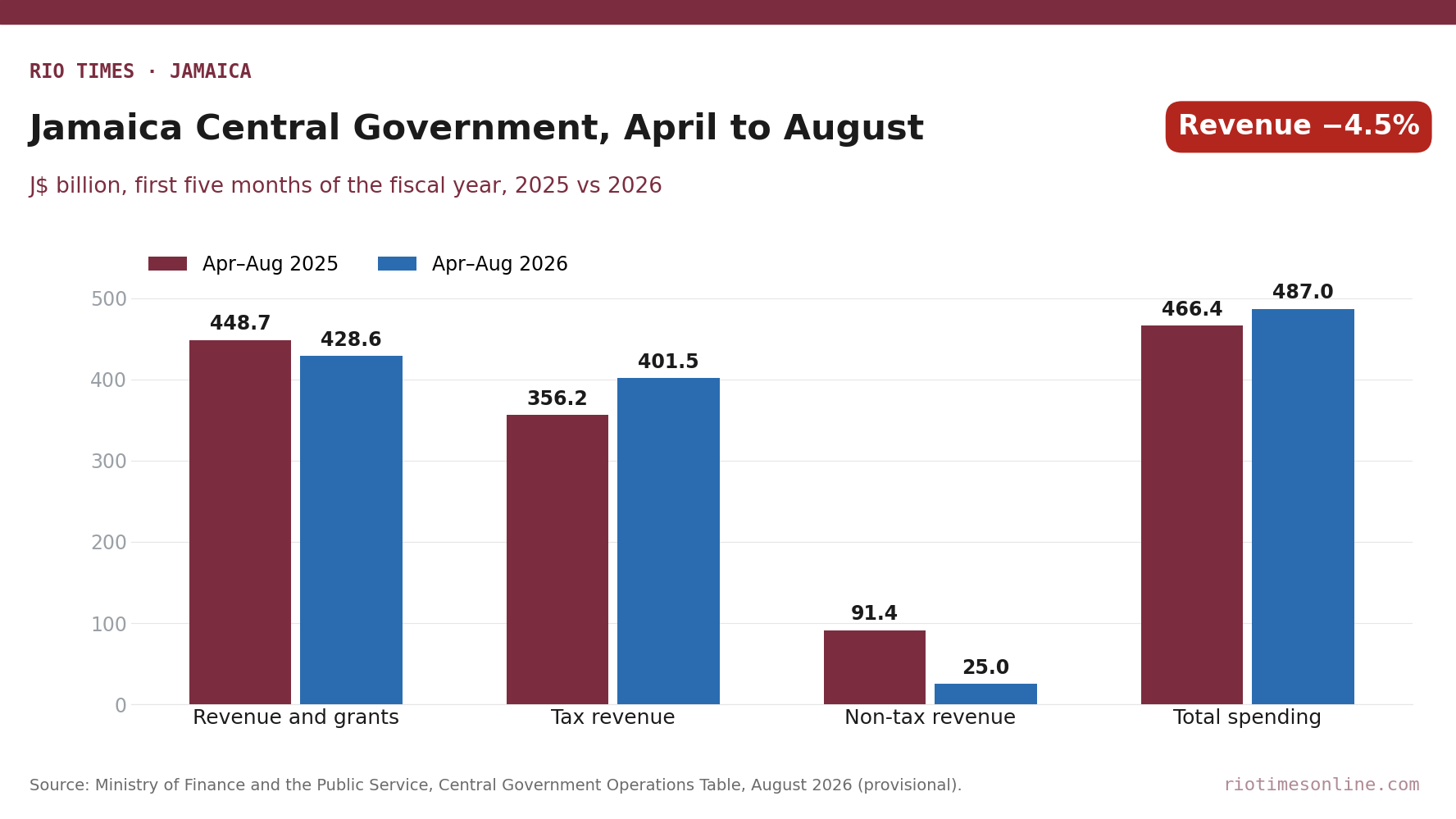
The ministry’s provisional Central Government Operations Table for August 2026 puts revenue and grants at J$428.6 billion (about US$2.7 billion) for April to August. That is down from J$448.7 billion (about US$2.8 billion) in the same five months of 2025, a fall of about 4.5 percent.
Tax revenue is not the part that shrank. It rose to J$401.5 billion (about US$2.5 billion), from J$356.2 billion (about US$2.2 billion) a year earlier. The Jamaica Observer has reported J$18.04 billion (about US$113 million) in new taxes for this fiscal year.
The drop came from non-tax revenue. It fell to J$25.0 billion (about US$157 million), from J$91.4 billion (about US$575 million) in April to August 2025. The ministry’s table does not itemise which one-off receipts boosted last year’s figure.
Even so, taxes missed the government’s own plan. The ministry’s fiscal monitoring table shows tax collections J$21.7 billion (about US$136 million) below budget. Corporate income tax brought in J$45.7 billion (about US$287 million), short of a J$59.1 billion (about US$372 million) target.
The ministry, as quoted by RJR News, said the weaker revenue reflects the impact of the economic downturn on consumer demand and corporate profits.
How the Government Is Absorbing the Gap
Spending reached J$487.0 billion (about US$3.1 billion) in the five months, the ministry’s table shows. Day-to-day recurrent spending took J$460.2 billion (about US$2.9 billion) of that.
Capital spending, which pays for roads, schools and other projects, was J$26.7 billion (about US$168 million). That was J$4.6 billion (about US$29 million) below budget.
Interest payments alone took J$74.9 billion (about US$471 million). That leaves the government with a fiscal deficit of J$58.4 billion (about US$367 million) for April to August, against J$17.8 billion (about US$112 million) a year earlier. The budget had allowed for J$61.6 billion (about US$387 million).
Before interest, the government still ran a primary surplus of J$16.5 billion (about US$104 million). A year earlier that surplus was J$50.5 billion (about US$318 million). The primary surplus is the money left to reduce debt.
The trend was already visible a month ago. The Jamaica Observer reported in September that the April to July deficit was J$33.43 billion (about US$210 million), wider than the J$30.89 billion (about US$194 million) budgeted.
In September the government also returned to international markets with a US$1 billion bond. Most of it went to a buyback of older debt, as covered in Jamaica’s US$1 Billion Bond Mostly Funds a Buyback.
What It Means for You
For US investors in Jamaican government bonds, the message is mixed. Revenue is weak, but the government is cutting spending to match rather than letting the deficit run.
The primary surplus has shrunk but remains positive. That surplus is what allows Jamaica to keep paying down its public debt.
For residents and visitors, lower capital spending can mean slower road and building repairs after Hurricane Melissa. Pressure on the wage bill is also rising, as seen in Jamaica Doctors Walk Out for 24 Hours in Overtime Row.
The Bank of Jamaica’s policy rate stands at 6.00 percent after its 28 September decision. Its weighted average selling rate was about J$159.04 per US dollar on Monday 5 October. Visitors who pay in US dollars face no direct change from these accounts.
The centre-left opposition People’s National Party (PNP) has made the shortfall a political issue. Its finance spokesman, Julian Robinson, told a party conference in September that weak revenues had forced new borrowing, the Jamaica Gleaner reported.
What Is Not Known
The ministry’s fiscal monitoring table gives the budget comparisons but not the reasons behind them. Its explanation of the gap, quoted by RJR News, does not say how much each factor contributed.
It is not known whether the Jamaica revenue shortfall will lead the government to table a supplementary budget, add new tax measures or raise more debt before the fiscal year ends in March 2027.
The August figures are provisional and can be revised. It is also unclear how much of the corporate tax gap is timing rather than lost revenue. The ministry has not said.
The longer squeeze on public pay is explored in Jamaica Wage Bill Is Heading for More Than Half of Every Tax Dollar Collected.
How big is the Jamaica revenue shortfall?
Revenue and grants for April to August 2026 were J$31.3 billion (about US$197 million) below budget, according to Finance Ministry data reported by RJR News.
Did Jamaica’s tax collections fall?
No. Tax revenue rose year on year to J$401.5 billion (about US$2.5 billion), but it was still about J$21.7 billion (about US$136 million) below target. The total fell because non-tax revenue dropped.
How is the government responding?
By spending less. Total spending was J$34.5 billion (about US$217 million) below budget for the five months, including lower capital spending. No new tax measure has been announced.
Sources: Ministry of Finance and the Public Service, Central Government Summary Accounts (Fiscal Monitoring Table) April to August 2026 · Ministry of Finance and the Public Service, Central Government Operations Table August 2026 · RJR News, 5 October 2026 · Jamaica Observer, 4 September 2026 · Jamaica Gleaner, 21 September 2026 · Bank of Jamaica
This article was produced by The Rio Times’ automated newsroom system. How we use AI · Report an error · Editorial responsibility: Matthias Camenzind, Editor-in-Chief
LatAm Markets: Live Signals → — real-time movers, turnover leaders and FX across Latin America.
Read More from The Rio Times