Hormuz Traffic Slows, Oil Proxies Jump 2.7%: LatAm Oil Wrap

Key Facts
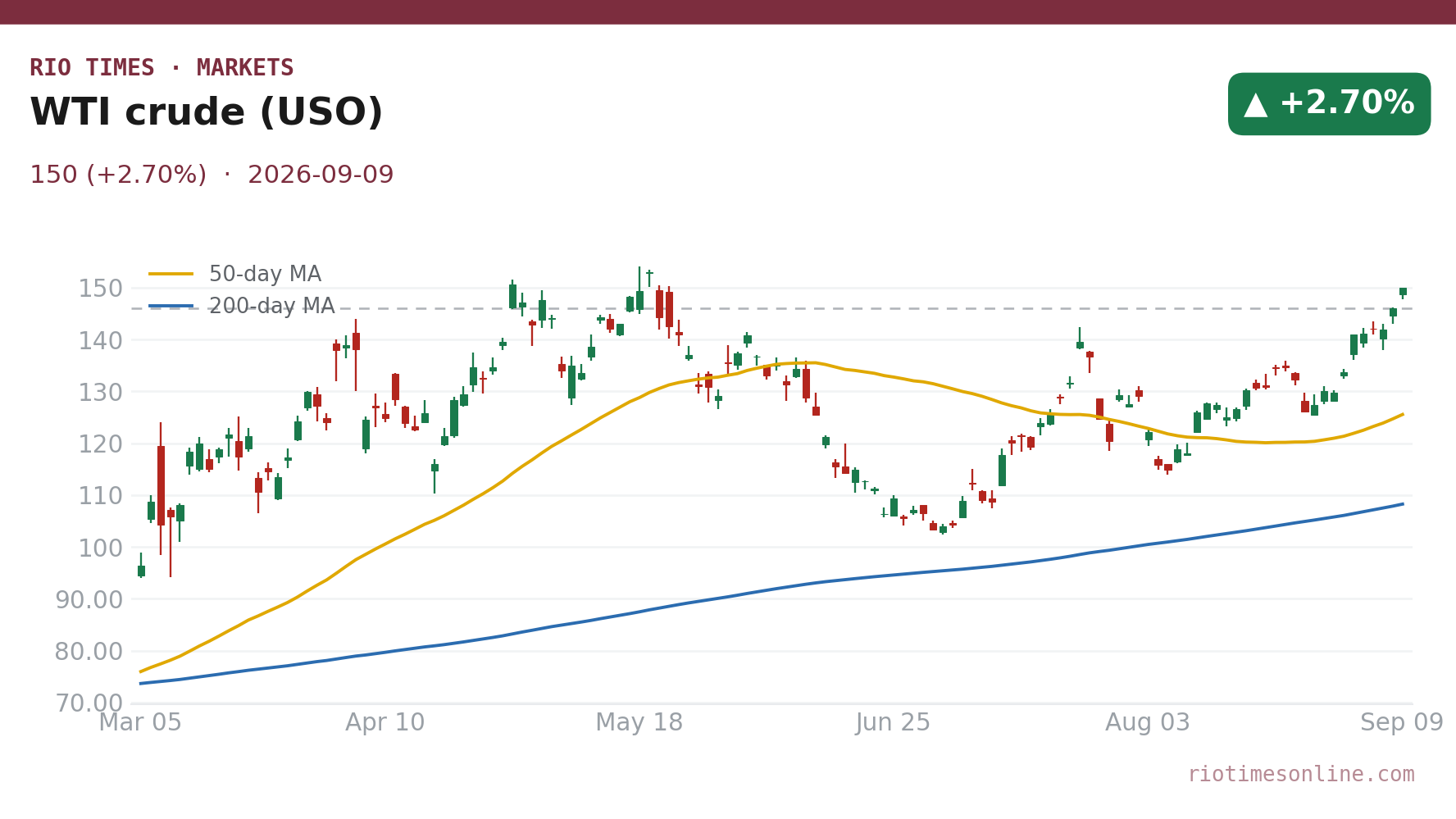
- WTI crude proxy the United States Oil Fund closed at US$149.97, up 2.70% on Wednesday, September 9, 2026, tracking near-month WTI futures.
- Petrobras New York shares rose 0.48% to US$20.93 as firmer benchmark prices supported Brazil’s deepwater pre-salt economics.
- YPF jumped 2.86% to US$54.61 as investors weighed Vaca Muerta drilling against Argentina’s country risk.
- Ecopetrol edged up 0.28% to US$17.83, a modest move that lagged the broader LatAm oil equity rally.
- Hormuz supply scare tanker traffic through the Strait of Hormuz slowed sharply, breaking the higher flows seen after the June Iran-US ceasefire collapsed.
- Guyana capacity the Errea Wittu production ship arrived on 24 August and is designed to add 250,000 barrels per day.
Today’s Focus
Crude oil proxies surged on Wednesday, September 9, 2026, after fresh evidence that tanker traffic through the Strait of Hormuz had slowed, reversing months of improving flows. The United States Oil Fund, which tracks near-month WTI futures, closed at US$149.97, a gain of 2.70%. Front-month WTI itself settled at US$96.05 a barrel.
Latin American oil equities followed the benchmark higher. Petrobras rose 0.48% to US$20.93, YPF added 2.86% to US$54.61, and Ecopetrol ticked up 0.28% to US$17.83.
The move reflected genuine supply anxiety rather than a demand story. A US administration push into Venezuela’s oilfields and Chevron’s pledge to more than double drilling rigs there added a longer-term geopolitical overlay.
What matters today. A renewed Strait of Hormuz supply scare is lifting crude and LatAm oil equities, with Brazil, Argentina and Guyana the main beneficiaries.
01 The session in one read
Oil proxies climbed sharply on Wednesday, September 9, 2026, after the market finally accepted that traffic through the Strait of Hormuz is no longer improving. For months, tanker movement in and out of Hormuz had run above spring levels, even after the June Iran-US ceasefire broke down; the latest tracking shows that pattern has now reversed.
The United States Oil Fund, the New York-listed vehicle tracking near-month WTI futures, settled at US$149.97, a rise of 2.70%. That is a futures-linked proxy, not the physical barrel price, but it captures the direction of the raw commodity unambiguously.
The rally is built on a single, fragile input: the latest evidence that Hormuz tanker traffic has slowed after months of elevated flows. If that slowdown proves temporary, the crude spike and the LatAm equity gains could unwind quickly. Watch the next US inventory report and any confirmation of Hormuz transit counts.
02 The board
Latin American producers rode the crude spike higher, though not at equal speed. Petrobras, Brazil’s state-controlled pre-salt operator, closed at US$20.93, up 0.48% on its New York shares.
YPF delivered the strongest session among the region’s majors, gaining 2.86% to US$54.61. Colombia’s Ecopetrol managed only a 0.28% rise to US$17.83, a thin move that suggests traders were not chasing every producer equally.
| Asset | Level | Change |
|---|---|---|
| Oil proxy (USO) | US$149.97 | +2.70% |
| Petrobras | US$20.93 | +0.48% |
| Ecopetrol | US$17.83 | +0.28% |
| YPF | US$54.61 | +2.86% |
Trade date: Wednesday 9 September 2026. Source: RT close, 2026-09-09. Where a commodity has no spot feed, an exchange-traded tracker or leading producer is shown as a labelled proxy.
Live Market IntelligenceThe live market board
Rio Times · Live Market Intelligence
Latin America — Cross-Market Board
| Instrument | Last | Change | YoY | Prev. | High | Low | Volume |
|---|---|---|---|---|---|---|---|
| IBOV | 205,082.56 | +0.47% | +21.85% | 204,120.12 | 168,310 | 167,142 | — |
| IPSA | 10,746.36 | -0.31% | — | 10,780.31 | 11,210 | 10,984 | 1,513,213,483 |
| IPC MEX | 69,879.62 | -0.01% | +12.17% | 69,889.73 | 66,121 | 65,405 | 108,886,187 |
| MERVAL | 3,017,221 | — | +30.51% | 3,022,485 | 3,042,365 | 2,991,150 | — |
| COLCAP | 2,540.10 | +0.46% | — | 9.04 | 9.05 | 9.02 | 4,133 |
| BVL PERÚ | 57,021.19 | +0.13% | — | — | — | — | — |
| USD/BRL | 5.16 | +0.01% | -5.13% | 5.16 | 5.18 | 5.14 | — |
| EUR/BRL | 5.95 | +1.01% | -5.83% | 5.89 | 5.98 | 5.94 | — |
| USD/MXN | 17.06 | -0.24% | -8.58% | 17.10 | 17.08 | 17.01 | — |
| USD/CLP | 913.98 | +0.04% | -5.67% | 913.65 | 915.11 | 906.68 | — |
| USD/COP | 3,140 | +0.03% | -22.04% | 3,139 | 3,141 | 3,105 | — |
| USD/PEN | 3.36 | -0.66% | -4.82% | 3.38 | 3.38 | 3.35 | — |
| USD/ARS | 1,493 | +0.10% | +12.96% | 1,491 | 1,494 | 1,480 | — |
| USD/UYU | 40.27 | +1.24% | +1.80% | 39.77 | 40.27 | 40.23 | — |
| USD/PYG | 5,939 | +1.68% | -19.54% | 5,841 | 5,939 | 5,925 | — |
| USD/BOB | 11.64 | -0.76% | +72.04% | 11.73 | 11.72 | 11.64 | — |
| USD/DOP | 58.34 | +1.25% | -3.44% | 57.62 | 58.34 | 58.04 | — |
| USD/CRC | 445.92 | +0.89% | -9.71% | 441.97 | 448.50 | 445.92 | — |
Live Company IntelligencePetroleo Brasileiro Petrobras SA ADR — the full investor dossier
Wall Street view
Valuation & profitability
Price & risk
$10.7852-wk high
$26.39
Revenue trend · 6y
Ownership
Dividend
03 What moved it
The driver was a Middle East supply scare: the slowdown in Hormuz tanker traffic marked the first time in months that flows were not running above spring levels. That removed the market’s comfort blanket and forced crude proxies to reprice the risk of disruption to the world’s most important oil transit chokepoint.
US inventory data reinforced the move. The American Petroleum Institute estimated commercial crude stocks fell 300,000 barrels in the week ending September 4, after a 2.6 million barrel draw the prior week, leaving commercial inventories down just over 48 million barrels overall.
A parallel Canadian supply narrative added depth: Canadian crude is pushing deeper into the US Gulf Coast, absorbing roughly 90% of Canada’s exported crude thanks to integrated pipeline and refining infrastructure built over decades.
04 The Latin American read
Brazil’s pre-salt is the cleanest beneficiary of higher benchmark prices. Petrobras, as the main operator of those deepwater fields, sees its project economics improve whenever WTI-linked proxies rally, and Wednesday’s 0.48% gain to US$20.93 reflects that link.
Argentina’s YPF is the most sensitive to the Vaca Muerta story. Its 2.86% jump to US$54.61 suggests investors are focusing on drilling activity rather than Argentina’s country risk, at least for one session.
Guyana’s Stabroek block, operated by ExxonMobil with Hess and CNOOC, remains the region’s fastest-growing new source of light sweet crude. Output slipped from a February peak of 918,000 barrels per day to 869,000 in June, but the Errea Wittu production ship arrived on 24 August. Guyanese reporting expects a September start, though ExxonMobil guidance still points to first oil in the fourth quarter.
Venezuela sits behind the moves as a longer-term subplot. Chevron said it would more than double its drilling rigs in the country under new terms signed the previous week, backed by more than US$7 billion of investment, while a US-linked deal took over 17 oil fields on September 1, 2026, replacing Chinese and Russian operators.
05 The names to watch
The United States Oil Fund is the session’s headline mover, up 2.70% to US$149.97 on near-month WTI futures. Petrobras added 0.48% to US$20.93, a laggard relative to the crude proxy but still positive.
YPF outperformed, rising 2.86% to US$54.61, while Ecopetrol settled at US$17.83, up just 0.28%. Mexico’s Pemex, typically watched for output disputes, had no session-specific move in the material, but traders linked earlier Petrobras softness to caution about Pemex production rows.
06 The outlook
The question now is whether the Hormuz traffic slowdown becomes a trend or a blip. The United States Oil Fund at US$149.97 suggests traders are paying for disruption risk, not just tight inventories.
Watch for confirmation of the next US inventory draw and any fresh tracking of tanker movements through Hormuz; those two signals will determine whether Wednesday’s rally sticks or fades into Thursday.
07 What to watch
- Hormuz traffic: any new evidence on tanker flows through the Strait will confirm or break the supply scare that drove the crude spike.
- US inventories: the next weekly crude stock report will test the API’s estimate of a 300,000-barrel draw.
- Guyana output: Errea Wittu is designed to add 250,000 barrels per day, which would take national output beyond one million. ExxonMobil guidance points to the fourth quarter.
- Venezuela policy: Chevron’s ramp-up under the new contract could shift global light sweet supply and OPEC dynamics.
Frequently Asked Questions
What is the United States Oil Fund?
It is a New York-listed exchange-traded vehicle that tracks near-month WTI crude futures, not physical oil, and is used as a proxy for the benchmark price.
Why did oil rise on Wednesday, September 9?
Because tanker traffic through the Strait of Hormuz slowed sharply after months of elevated flows, and US commercial crude inventories fell by 300,000 barrels in the latest week.
Which Latin American producer gained the most?
YPF, Argentina’s flagship Vaca Muerta producer, rose 2.86% to US$54.61, outperforming Petrobras and Ecopetrol.
What happened to Petrobras?
The Brazilian state-controlled pre-salt operator rose 0.48% to US$20.93 on higher benchmark crude prices, improving deepwater project economics.
Market data: RT
This article was produced by The Rio Times’ automated newsroom system. How we use AI · Report an error · Editorial responsibility: Matthias Camenzind, Editor-in-Chief
LatAm Markets: Live Signals → — real-time movers, turnover leaders and FX across Latin America.