Iron Ore: Vale Rises 0.8% as CSN Mineração Rebounds Before China Holiday
Key Facts
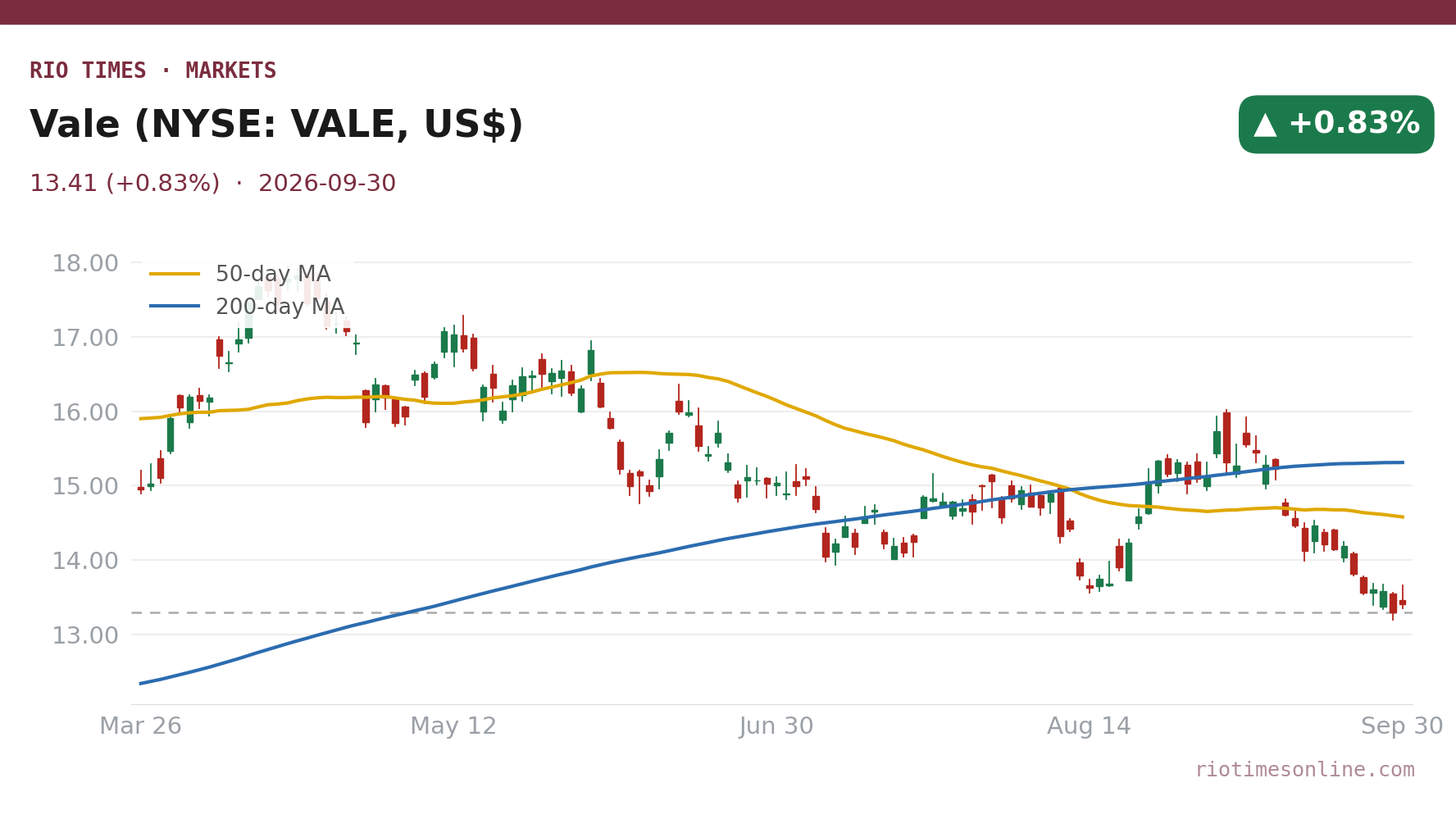
- Vale’s New York shares rose 0.83% to US$13.41 on Wednesday, 30 September 2026, recovering part of Tuesday’s 2.13% fall. In São Paulo, Vale gained 0.43% to R$69.91 (about US$13.51).
- CSN Mineração rebounded 5.25% to R$5.01 (about US$0.97) a day after cutting its 2026 output target; parent CSN rose 6.85% to R$5.77 (about US$1.12).
- Dalian barely moved. The most-traded January contract rose 0.14% to 702.5 yuan (about US$104.78) a tonne in the last Chinese session before the 1–7 October National Day holiday.
- China’s factory PMI returned to growth at 50.1 in September from 49.8, in line with forecasts, but steel output and mill margins remain weak.
- Brazil’s markets helped. The Ibovespa rose 1.37% to 186,340 and the real firmed 0.53% to 5.1743 per US dollar.
- Rio Tinto and BHP were flat at US$94.17 (+0.01%) and US$84.84 (+0.02%).
Today’s Focus
Iron-ore shares recovered part of Tuesday’s losses on Wednesday, 30 September 2026. Vale’s New York shares rose 0.83% to US$13.41, and CSN Mineração jumped 5.25% to R$5.01 (about US$0.97), a day after it cut its 2026 production target because of high freight costs.
The metal itself gave little help. In the last session before China’s week-long National Day holiday, the most-traded Dalian contract edged up 0.14% to 702.5 yuan (about US$104.78) a tonne. China’s official factory PMI rose to 50.1 in September, back above the 50 line that separates growth from contraction, but it matched forecasts.
Underlying steel demand is still soft. Chinese crude-steel output fell 3.7% year on year in August, according to the World Steel Association, and only 7.8% of blast-furnace mills were profitable in a mid-September Mysteel survey.
A stronger Brazilian market did the rest. The Ibovespa rose 1.37% and the real firmed 0.53% to 5.1743 per US dollar.
What matters today. Dalian is shut until 8 October, so Singapore futures are the only live iron-ore price this week. Wednesday’s bounce in Brazil was a relief rally after CSN’s cut, not a turn in the ore market.

01 The session in one read
Iron-ore equities bounced on Wednesday, 30 September 2026. Vale’s New York shares rose 0.83% to US$13.41, after a 2.13% fall on Tuesday. In São Paulo, Vale added 0.43% to R$69.91 (about US$13.51).
The Australian majors barely moved. Rio Tinto rose 0.01% to US$94.17 and BHP 0.02% to US$84.84. In China, the most-traded Dalian contract gained 0.14% to 702.5 yuan (about US$104.78) a tonne.
The biggest moves were in São Paulo. CSN Mineração rose 5.25% to R$5.01 (about US$0.97), and parent CSN climbed 6.85% to R$5.77 (about US$1.12), recovering part of Tuesday’s slide after the guidance cut.
Wednesday’s gains were a rebound from Tuesday’s sell-off, not a change in fundamentals. Dalian barely moved, Chinese steel output is falling and mill margins are thin. Brazilian producers also face high freight costs to China. The variable to watch is Chinese mill buying after the 1–7 October holiday.
02 The board
Vale’s New York shares, the most widely watched proxy for one of the world’s two largest iron-ore exporters, closed at US$13.41, up 0.83%. They remain well below their 52-week high of US$17.94, set on 17 April 2026.
CSN Mineração and its parent led the board after Tuesday’s sell-off. The Australian majors were flat, which shows the move in Brazil was about local stock-specific recovery rather than the ore price. Real-denominated prices are converted at 5.1743 reais per US dollar.
| Asset | Level | Change |
|---|---|---|
| Iron ore (Vale, NYSE) | US$13.41 | +0.83% |
| Vale (B3) | R$69.91 (US$13.51) | +0.43% |
| CSN Mineração (B3) | R$5.01 (US$0.97) | +5.25% |
| CSN (B3) | R$5.77 (US$1.12) | +6.85% |
| Rio Tinto (NYSE) | US$94.17 | +0.01% |
| BHP (NYSE) | US$84.84 | +0.02% |
| Iron ore, Dalian January (per tonne) | 702.5 yuan (US$104.78) | +0.14% |
Source: RT live market data, close of Wednesday 30 September 2026; Dalian: Dalian Commodity Exchange, most-traded contract. Where a commodity has no spot feed, an exchange-traded tracker or leading producer is shown as a labelled proxy.
Live Market IntelligenceThe live market board
Rio Times · Live Market Intelligence
Latin America — Cross-Market Board
| Instrument | Last | Change | YoY | Prev. | High | Low | Volume |
|---|---|---|---|---|---|---|---|
| IBOV | 186,340.46 | +1.37% | +21.85% | 183,827.59 | 168,310 | 167,142 | — |
| IPSA | 10,969.49 | -0.78% | — | 11,055.94 | 11,210 | 10,984 | 1,513,213,483 |
| IPC MEX | 64,951.10 | -0.24% | +12.17% | 65,110.57 | 66,121 | 65,405 | 108,886,187 |
| MERVAL | 2,819,323 | +1.32% | +30.51% | 3,022,485 | 3,042,365 | 2,991,150 | — |
| COLCAP | 2,549.16 | -0.38% | — | 9.04 | 9.05 | 9.02 | 4,133 |
| BVL PERÚ | 60,410.88 | -0.96% | — | — | — | — | — |
| USD/BRL | 5.16 | +0.01% | -5.13% | 5.16 | 5.18 | 5.14 | — |
| EUR/BRL | 5.95 | +1.01% | -5.83% | 5.89 | 5.98 | 5.94 | — |
| USD/MXN | 17.06 | -0.24% | -8.58% | 17.10 | 17.08 | 17.01 | — |
| USD/CLP | 913.98 | +0.04% | -5.67% | 913.65 | 915.11 | 906.68 | — |
| USD/COP | 3,140 | +0.03% | -22.04% | 3,139 | 3,141 | 3,105 | — |
| USD/PEN | 3.36 | -0.66% | -4.82% | 3.38 | 3.38 | 3.35 | — |
| USD/ARS | 1,493 | +0.10% | +12.96% | 1,491 | 1,494 | 1,480 | — |
| USD/UYU | 40.27 | +1.24% | +1.80% | 39.77 | 40.27 | 40.23 | — |
| USD/PYG | 5,939 | +1.68% | -19.54% | 5,841 | 5,939 | 5,925 | — |
| USD/BOB | 11.64 | -0.76% | +72.04% | 11.73 | 11.72 | 11.64 | — |
| USD/DOP | 58.34 | +1.25% | -3.44% | 57.62 | 58.34 | 58.04 | — |
| USD/CRC | 445.92 | +0.89% | -9.71% | 441.97 | 448.50 | 445.92 | — |
Live Company IntelligenceVale SA ADR — the full investor dossier
Wall Street view
Valuation & profitability
Price & risk
$9.8852-wk high
$17.44
Revenue trend · 6y
Ownership
Dividend
03 What moved it
The main driver was a rebound in Brazilian mining shares after Tuesday’s sell-off. CSN Mineração had cut its 2026 target for production and third-party purchases to 39–41 million tonnes from 45–47 million, citing a weaker market and higher freight costs. On Wednesday, investors bought back part of that drop.
China gave only mild support. The official manufacturing PMI rose to 50.1 from 49.8, and the non-manufacturing PMI to 50.2 from 49.0. Dalian still gained only 0.14% before the holiday.
The background is weak steel demand. China’s crude-steel output fell 3.7% year on year in August and was down 3.1% over January to August, according to the World Steel Association. The China Iron and Steel Association has urged mills to restrain output, and only 7.8% of blast-furnace mills were profitable in Mysteel’s mid-September survey.
Supply is ample. Australian shipments to China rose about 6.2% week on week to 17.2 million tonnes in the week to 20 September.
On the research side, JPMorgan kept an Overweight rating on Vale and raised its price target to US$22 from US$21, according to MarketBeat.
04 Wednesday’s data, one by one
Our 30 September edition told readers to watch five things on Wednesday. Here is how each turned out.
- China’s last session before the holiday: Dalian closed for the National Day break after Wednesday’s session, with the January contract up 0.14% at 702.5 yuan (about US$104.78) a tonne. Overnight, the official manufacturing PMI rose to 50.1 (forecast 50.1, August 49.8) and the private RatingDog PMI to 52.1 (forecast 51.6, August 51.5). Dalian barely moved.
- US ADP and PCE: Private employers added 90,000 jobs in September, according to ADP, above the 70,000 forecast. The Bureau of Economic Analysis said August PCE inflation was 3.4% year on year (forecast 3.7%) and core PCE 3.0% (forecast 3.3%). The 10-year Treasury yield still rose to 5.29%, and the dollar index edged up 0.08%. No visible effect on ore.
- Brazil’s public accounts and producer prices: The central bank reported a consolidated primary deficit of R$10.0 billion (about US$1.93 billion) for August, against a R$1.4 billion (about US$0.27 billion) surplus in July. Gross general government debt rose to 82.9% of GDP from 82.5%, just below the 83.1% forecast; net debt was 69.3%. IBGE’s producer price index rose 0.36% in August (forecast −0.4%) and 2.53% over 12 months. The Ibovespa still rose 1.37%, helping Vale and CSN.
- Chile’s August output: INE said industrial production fell 5.7% year on year (forecast −3.0%) and mining output 11.7%. Copper production dropped 12.8% to 369,500 tonnes, the lowest monthly figure since February 2011. It confirms weak Andean mining activity but has no direct iron-ore link.
- More Brazilian cuts: No new cut was reported on Wednesday. CSN Mineração remains the third Brazilian producer this month to curb output, after Mineração Usiminas and Itaminas, and its shares recovered 5.25%.
05 The Latin American read
For Brazilian miners, China is the customer that moves the needle. Vale’s earnings are tightly linked to seaborne ore prices and Chinese buying, which is why its shares trade as a commodity proxy.
Freight is the Brazilian problem. The Tubarão–Qingdao route, the benchmark for Brazil–China iron-ore shipping, stood near US$43 a tonne this week, up 75.2% from a year earlier, according to SteelOrbis. That hits low-grade Brazilian ore hardest, which is why CSN Mineração, Mineração Usiminas and Itaminas have cut output.
Those cuts remove marginal supply. Over time that can support prices, but for now they show how much pressure freight and weak Chinese steel margins put on Brazilian producers.
06 The names to watch
Vale remains the bellwether. Its New York shares at US$13.41 reflect global appetite for iron-ore exposure; any sustained move in Chinese steel margins will show up here first.
CSN Mineração offers a higher-beta route. At R$5.01 (about US$0.97) after a 5.25% gain, it is back near Monday’s R$5.05 (about US$0.98) close, but its lower 2026 target and higher cost guidance still weigh on the stock.
Rio Tinto at US$94.17 and BHP at US$84.84 are the steady global counterweights. Their flat closes suggest international investors are waiting for post-holiday Chinese demand signals before committing.
07 The outlook
The World Steel Association’s April outlook projects global steel demand will rise just 0.3% in 2026 to 1.724 billion tonnes, then 2.2% in 2027 to 1.762 billion tonnes. That suggests a slow grind rather than a sharp rebound.
With Dalian shut from 1 to 7 October, trading activity will thin. Singapore futures will keep trading, but the next real signal comes after the holiday, when Chinese mills either restock or stay cautious.
08 What to watch
- China’s holiday: Dalian is shut from 1 to 7 October and reopens on 8 October; Singapore iron-ore futures keep trading and are the only live price this week.
- US data today: Weekly jobless claims at 12.30 UTC (forecast 200,000, prior 197,000) and the ISM manufacturing PMI for September at 14.00 UTC (forecast 55.0, prior 54.6).
- Brazil today: The S&P Global manufacturing PMI for September at 13.00 UTC (10.00 am in Brasília; forecast 46.5, prior 46.3), a read on Brazil’s steel-using industry.
- Chile today: The August Imacec activity index at 11.30 UTC (8.30 am in Santiago and Brasília; forecast −0.4% year on year, prior −1.5%), after Wednesday’s weak mining data.
- Vale and CSN Mineração: Whether Wednesday’s rebound holds without a Chinese price, and whether other low-grade Brazilian producers follow CSN with cuts while freight stays high.
Frequently Asked Questions
Why did iron-ore shares rise on 30 September 2026?
Brazilian miners rebounded after Tuesday’s sell-off, and China’s factory PMI returned to growth. Dalian iron ore itself rose only 0.14% before the National Day holiday.
Why did CSN Mineração gain more than Vale?
CSN Mineração had fallen 5.74% on Tuesday after cutting its 2026 output target. Wednesday’s 5.25% gain recovered most of that drop.
Is China’s steel demand recovering?
No, it is still weak. Crude-steel output fell 3.7% year on year in August and only 7.8% of mills were profitable in mid-September.
What happens next for iron ore?
Dalian is shut from 1 to 7 October, so trading will be thin and Singapore futures will set the price. The key test is whether Chinese mills restock after the holiday.
Source: RT live market data, close of Wednesday 30 September 2026.
This article was produced by The Rio Times’ automated newsroom system. How we use AI · Report an error
LatAm Markets: Live Signals → — real-time movers, turnover leaders and FX across Latin America.
Read More from The Rio Times