Vale ADR Edges Up 0.47% to US$15.06 as China Steel Signals Shift
Key Facts
- Vale ADR moved 0.47% to US$15.06 as investors repriced expectations for Chinese steel demand and imported ore volumes.
- Rio Tinto shares eased 0.34% to US$96.85 mirroring the cautious tone across global mining equities tied to Chinese construction.
- CSN Mineração fell -0.17% to R$5.71 in São Paulo trading, reflecting Brazilian domestic sensitivity to the iron ore demand outlook.
- China is the dominant buyer of seaborne iron ore and changes in its mill margins and infrastructure spending directly pull on Vale’s realised prices.
- Vale is the world’s second-largest iron ore exporter shipping high-grade Brazilian fines and pellets primarily to Asian and European steel mills.
- The iron ore spot price is not on our live board so we infer the commodity’s direction through listed producers whose revenues track iron ore.
Today’s Focus
Vale’s NYSE-listed ADR, a liquid proxy for iron ore, settled at US$15.06 for a 0.47% session move on Monday. The shift came as investors absorbed fresh signals on Chinese steel demand and the broader Asian construction cycle. China remains the gravitational centre of the seaborne iron ore market, buying the bulk of Vale’s high-grade Brazilian exports to blend with domestic and Australian ore. When Chinese blast furnace utilisation rises, mills restock imported ore, lifting Vale’s expected cash flows and typically its ADR price. Today’s modest move suggests a market digesting conflicting signals on Chinese infrastructure stimulus and property sector health without a definitive new catalyst. For Latin America-focused investors, the Vale ADR is a real-time barometer of Brazil’s commodity terms of trade and global risk appetite for iron ore-linked assets.
What matters today. Whether a durable recovery in Chinese steel mill margins can sustain a bid for seaborne iron ore and Vale’s shares.

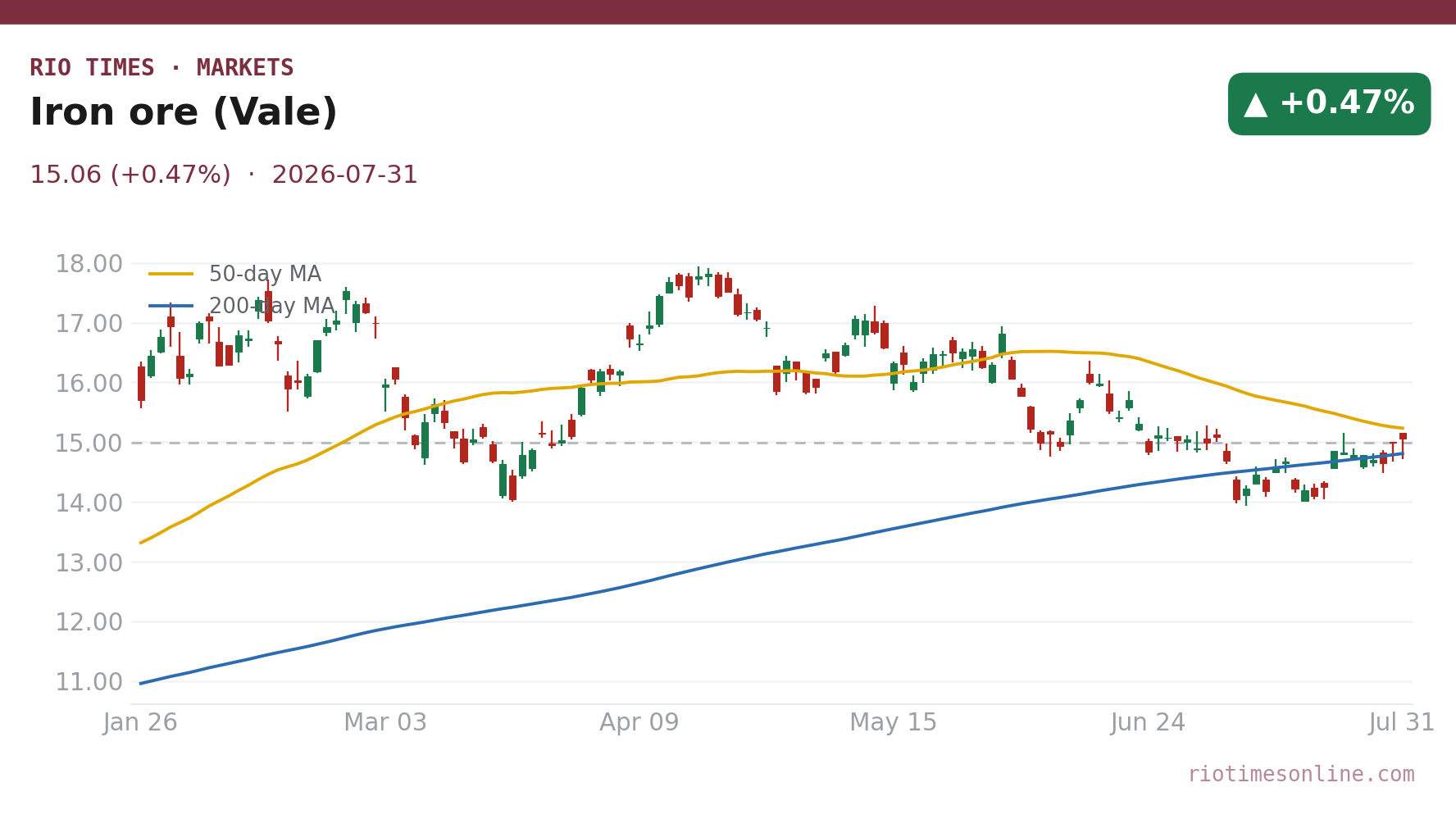
” alt=”Iron Ore daily market wrap.” />
01 The session in one read
Shares of the world’s top iron ore exporters shifted modestly on Monday as investors recalibrated expectations for Chinese steel consumption. Vale’s New York-traded ADR, the primary liquid proxy for iron ore, edged 0.47% to US$15.06.
The move reflected a market weighing fragile Chinese property data against the potential for fresh infrastructure stimulus from Beijing. Rio Tinto, the largest iron ore shipper, slipped 0.34% to US$96.85, while Brazil’s CSN Mineração fell -0.17% to R$5.71.
Monday’s trading in iron ore proxies signals a market holding its breath on Chinese demand rather than reacting to a clear fundamental shift. With Vale ADRs moving 0.47% to US$15.06 and Rio Tinto slipping 0.34% to US$96.85, global miners were marked slightly lower against a backdrop of persistent uncertainty about Beijing’s next infrastructure push. CSN Mineração’s -0.17% decline to R$5.71 added a distinctly Brazilian caution, reflecting the local market’s sensitivity to the China iron ore trade. The variable to watch is any concrete announcement on Chinese steel output quotas or new infrastructure spending.
02 The board
The three mining names on our board are treated by global investors as exchange-traded proxies for the seaborne iron ore market, because their revenues are dominated by sales of the steelmaking raw material. Vale’s ADR at US$15.06 captures both iron ore price expectations and company-specific Brazilian risk into a single US-dollar quote.
Rio Tinto at US$96.85 offers a London-and-Sydney-listed counterpoint, heavily exposed to Australian ore shipped to Asia. CSN Mineração at R$5.71 provides a pure-play Brazilian read in reais, often moving in sympathy with Vale but adding a local-currency layer for investors watching Brazil’s domestic equity market.
| Asset | Level | Change |
|---|---|---|
| Iron ore (Vale) | US$15.06 | +0.47% |
| CSN Mineração | R$5.71 | -0.17% |
| Rio Tinto | US$96.85 | -0.34% |
Source: RT close, 2026-07-31. Where a commodity has no spot feed, an exchange-traded tracker or leading producer is shown as a labelled proxy.
Live Market IntelligenceThe live market board
Rio Times · Live Market Intelligence
Latin America — Cross-Market Board
| Instrument | Last | Change | YoY | Prev. | High | Low | Volume |
|---|---|---|---|---|---|---|---|
| IBOV | 183,476.86 | -0.27% | +21.85% | 183,965.91 | 168,310 | 167,142 | — |
| IPSA | 11,255.90 | -0.39% | — | 11,299.82 | 11,210 | 10,984 | 1,513,213,483 |
| IPC MEX | 64,651.92 | +0.60% | +12.17% | 64,264.16 | 66,121 | 65,405 | 108,886,187 |
| MERVAL | 2,893,751 | -1.57% | +30.51% | 3,022,485 | 3,042,365 | 2,991,150 | — |
| COLCAP | 2,584.72 | -0.95% | — | 9.04 | 9.05 | 9.02 | 4,133 |
| BVL PERÚ | 59,934.37 | +1.27% | — | — | — | — | — |
| USD/BRL | 5.16 | +0.01% | -5.13% | 5.16 | 5.18 | 5.14 | — |
| EUR/BRL | 5.95 | +1.01% | -5.83% | 5.89 | 5.98 | 5.94 | — |
| USD/MXN | 17.06 | -0.24% | -8.58% | 17.10 | 17.08 | 17.01 | — |
| USD/CLP | 913.98 | +0.04% | -5.67% | 913.65 | 915.11 | 906.68 | — |
| USD/COP | 3,140 | +0.03% | -22.04% | 3,139 | 3,141 | 3,105 | — |
| USD/PEN | 3.36 | -0.66% | -4.82% | 3.38 | 3.38 | 3.35 | — |
| USD/ARS | 1,493 | +0.10% | +12.96% | 1,491 | 1,494 | 1,480 | — |
| USD/UYU | 40.27 | +1.24% | +1.80% | 39.77 | 40.27 | 40.23 | — |
| USD/PYG | 5,939 | +1.68% | -19.54% | 5,841 | 5,939 | 5,925 | — |
| USD/BOB | 11.64 | -0.76% | +72.04% | 11.73 | 11.72 | 11.64 | — |
| USD/DOP | 58.34 | +1.25% | -3.44% | 57.62 | 58.34 | 58.04 | — |
| USD/CRC | 445.92 | +0.89% | -9.71% | 441.97 | 448.50 | 445.92 | — |
Live Company IntelligenceVale SA ADR — the full investor dossier
Wall Street view
Valuation & profitability
Price & risk
$9.8852-wk high
$17.44
Revenue trend · 6y
Ownership
Dividend
03 What moved it
Chinese steel demand remains the master switch for all three proxies. Mills in China buy high-grade Brazilian ore from Vale to blend with lower-grade domestic and Australian feedstock, meaning changes in Chinese government infrastructure spending or property activity pull directly on Vale’s volumes.
Monday’s session lacked a single headline catalyst, but traders were digesting mixed indicators on Chinese industrial output and the pace of new construction starts. Higher blast furnace utilisation rates in China tend to prompt restocking of imported ore, which historically supports Vale’s ADR price; any softening in that data point applies the opposite pressure.
04 The Latin American read
For foreign investors in Latin America, Vale’s 0.47% move to US$15.06 is a real-time health check on Brazil’s largest single export industry. Mining royalties and corporate taxes from Vale flow directly into Brazil’s fiscal accounts, making the ADR a gauge of the country’s external balances.
CSN Mineração’s -0.17% slide to R$5.71 added a note of domestic caution, suggesting São Paulo-based investors were marginally more defensive than their New York peers. Because Vale is a heavyweight in Brazilian equity indices, any sustained move in the ADR can ripple into the broader perception of Brazilian market risk and the real’s direction.
05 The names to watch
Vale is the world’s second-largest iron ore exporter, moving seaborne fines and pellets from Brazil’s Carajás mines to Asia and Europe. Its NYSE ADR, each representing one common share, is the most liquid single-name iron ore proxy available to foreign investors.
Rio Tinto, trading at US$96.85, is Vale’s largest competitor and the benchmark Australian producer shipping ore to China’s northern ports. CSN Mineração at R$5.71 offers a smaller but focused Brazilian pure-play that often amplifies the moves in Vale’s New York quote.
06 The outlook
The path for iron ore proxies now hinges on whether Beijing translates recent policy rhetoric into concrete steel-intensive spending. Vale’s ADR at US$15.06 is pricing in a cautious, wait-and-see stance rather than an outright downturn in the commodity cycle. Investors will watch for Chinese steel output data and any government signal on property sector support as the next catalyst for repricing seaborne iron ore risk.
07 What to watch
- Chinese steel margins: Mill profitability data will signal whether restocking of imported ore accelerates or stalls in coming weeks.
- Beijing infrastructure policy: Any concrete stimulus announcement targeting construction or manufacturing would likely lift Vale and Rio Tinto shares.
- Vale shipment volumes: The company’s next quarterly production report will show whether operational momentum supports current ADR levels.
- Brazilian real trajectory: A weaker real historically boosts Vale’s local-currency revenues while influencing the ADR’s appeal to dollar-based buyers.
Frequently Asked Questions
Why is Vale’s share price a proxy for iron ore?
Vale’s earnings are dominated by iron ore sales, so its NYSE-listed ADR moves in sympathy with expected seaborne ore prices and Chinese demand.
Why isn’t the iron ore spot price on your board?
Our live board captures exchange-traded instruments; iron ore spot is a physical market price that we infer through producer equity proxies like Vale, Rio Tinto and CSN Mineração.
What drives Vale’s ADR the most?
Chinese steel output and construction activity are the primary drivers, because China is the dominant buyer of Vale’s high-grade Brazilian ore.
How does CSN Mineração relate to Vale?
CSN Mineração is a Brazilian pure-play iron ore miner whose São Paulo-listed shares often amplify the directional moves seen in Vale’s New York ADR.
This article was produced by The Rio Times’ automated newsroom system. How we use AI · Report an error
LatAm Markets: Live Signals → — real-time movers, turnover leaders and FX across Latin America.
Read More from The Rio Times