How Soccer Team Flamengo Became Source of Support for Brazil’s Far-right Politicians

RIO DE JANEIRO, BRAZIL – Although it is common for heads of state to exchange courtesies at diplomatic events, the situation caught the attention of those who followed the meeting between the presidents of Brazil and China in late October.
At the Great People’s Palace in Beijing, Jair Bolsonaro handed Xi Jinping a Flamengo jersey, explaining that it was the “best team in Brazil at the moment“. Although a fan of Palmeiras, the main opponent of Rio de Janeiro’s red-and-black team for the Brazilian Championship title, Bolsonaro also told his host that “1.3 billion Chinese will also be Flamengo supporters” in the Libertadores Cup final, against River Plate.

On the other side of the planet, the brief ceremony summarized how the country’s biggest fan club became a political tool for the president’s diplomacy.
A regular presence in stadiums, Bolsonaro has used soccer as a stepping stone to his popularity since he was elected – a card already used by many who preceded him in office, from the classic boastful nationalism inflated by the military dictatorship in the successful 1970 World Cup campaign, to the presidential lobby for the construction of the Corinthians Arena during the Lula administration, on the eve of the 2016 World Cup hosted by Brazil.
Raising the instrumentalization to its highest power, including inviting himself to major games such as the classic between rivals Santos and São Paulo, the right-wing president saw in Flamengo, which had not experienced such an exciting period since Zico’s time in the 1980s, the platform of greatest reach to seduce fans.
In April, the same week in which the team became champion in Rio de Janeiro, the President welcomed the young Yasmin Alves at the Planalto, who had allegedly refused to greet him on a visit to her school, and presented her with a Flamengo jersey.
In June, Bolsonaro made an appearance on the stands of Brasília’s Mané Garrincha Stadium alongside the Minister of Justice, Sérgio Moro, to attend the game of the red-and-black against the CSA. Both posed for photos wearing team jerseys. The appearance at the stadium took place three days after The Intercept had disclosed leaked messages from Moro, which called into question the impartiality of the former Lava Jato judge.
Last week, the president once again delighted Flamengo fans during a ceremony in Campina Grande, Paraíba, when he said Gabigol would score the Libertadores title-winning goal.
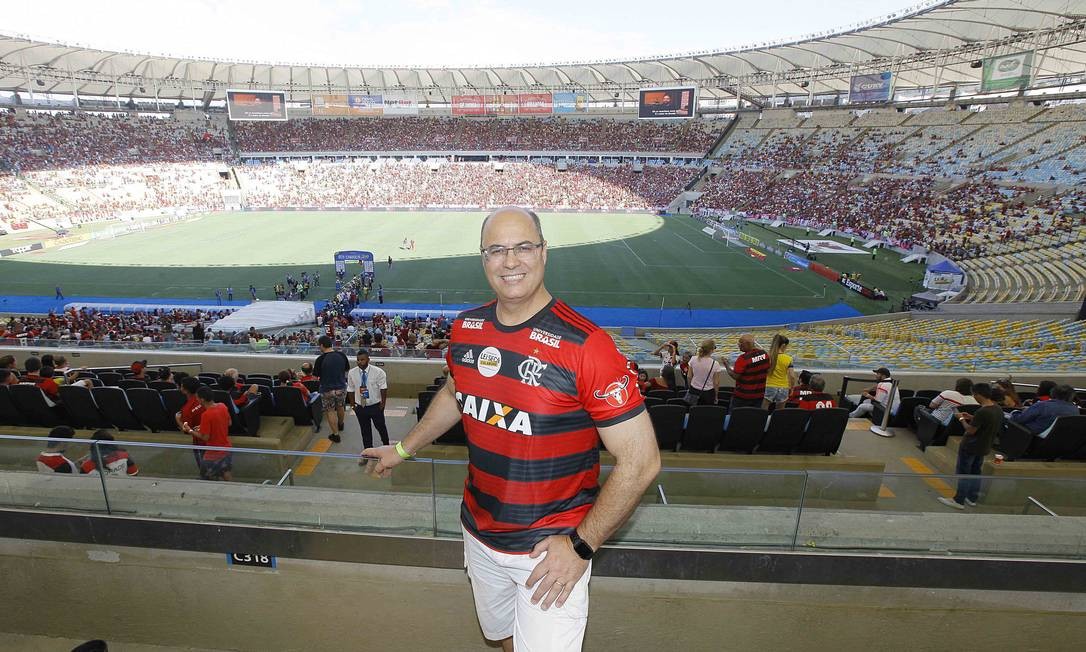
Competing politicians for the leading role in the right-wing are resorting to a similar strategy. In Rio de Janeiro, Governor Wilson Witzel, who won the election riding on Bolsonaro’s image, but now defies the president, is yet another head of government surfing on Flamengo’s wave.
One of his first official commitments as governor-elect was to welcome Rodolfo Landim, who was then a candidate for Flamengo club president, to discuss the Maracanã stadium concession. In January, Witzel was at the stadium to watch a match of the team for the Carioca Championship. Despite cheering for Corinthians, he stepped onto the pitch wearing a Flamengo jersey, asked the athletes for autographs and took selfies with fans. From then on, he dedicated himself to strengthening ties with the club.
In early April, the state government granted Flamengo and Fluminense the provisional management of Maracanã, under protests from local rival Vasco, which alleged lack of transparency in the selection process. By way of appeasment the governor announced a partnership with the Cruzmaltino club for works to improve the surroundings of its São Januário home ground.
Witzel has occasionally attended the Maracanã’s boxes during the red-and-black team’s matches, has met with members of the club’s organized fans and was even willing to convince the Portuguese coach Jorge Jesus to stay in Brazil after rumors that the manager was concerned about the violence in Rio. “He will have peace to do the best for Flamengo,” said the governor. The link between Witzel and President Landim resides within the club, endorsed by an official position.
Aleksander Santos exercises Flamengo’s public relations role in politics. A member of the state executive committee of the Solidarity political party, he has already been affiliated to MDB and PSC and headed secretariats in cities such as Itaboraí and Maricá. Initially, as an informal contributor, he handled the intermediation of Landim’s contacts with authorities even before taking over the club’s presidency.
A friend of the vice-governor Cláudio Castro, whom he met during his tie as a member of PSC, Santos established a direct connection with the Guanabara Palace. Castro was present at Landim’s inauguration in Gávea, where he received a personalized jersey and, as in two other ceremonies, he represented the governor.

But it was the advisor’s effort to obtain licenses from state and municipal bodies to remove the ban on Ninho do Urubu (Flamengo’s training ground and youth team headquarters) after the fire that killed ten boys at the training center in February, that convinced the board to appoint him to the position of director of government relations in May.
Before the position was made official, Santos had already linked the club’s image to other references from the right-wing allied to Bolsonaro, such as ex-senator Magno Malta and state deputy Rodrigo Amorim, who were given team uniforms. The pleasantry toward Amorim, however, sparked internal differences within the club.
In his office in ALERJ (Legislative Assembly of Rio de Janeiro), he has a Flamengo jersey framed between a photo of Jair Bolsonaro with the presidential band and a piece of the plaque with the name of Marielle Franco broken by the then-candidate at a rally alongside Witzel.
Early in the year, the deputy marched onto the Maracanã ground celebrating the Rio Cup’s triumph among red-and-black players. In April, he thanked the club that presented him with jersey 17, his party number. However, in the same week, Flamengo’s board of directors had issued a note emphasizing that the institution “does not take positions on political issues”.
The statement rejected the club’s involvement in a tribute by fans to former Flamengo crew racing rower Stuart Angel, tortured and killed in 1971 by the military dictatorship, a regime extolled by fans of the Bolsonarist line.
Faced with the pampering of Rodrigo Amorim, advisors and partners questioned the leadership on the political connotation of the deed, which leaders described as “a kindness”, of an unofficial nature. The deputy continues to leverage on the team’s successful stage. In October, for instance, he published two photos with red-and-black garments on social media. One of them on Family Appreciation Day and the other, where he poses with Vice Governor Cláudio Castro, on Flamengo Day, celebrated on October 28th.
Despite the controversy, Alexsander Santos gained even greater prestige with the club’s clique of “top hats”. Since he was promoted to a paid position, he has focused on bringing the club closer to the federal government. The leader states that his work is “non-partisan”, focused only on the “institutional relationship with the public powers”.
Santos expedited the bridge with Bolsonaro’s office for the delivery of autographed jerseys to members of the government in the match against the CSA team, held in Brasília. He even features in a photo reproduced by the club’s official profiles on social media alongside the president, minister Sérgio Moro, federal deputy Helio Lopes, and soccer vice-president Marcos Braz.
In his second time in the club’s high command, Braz was secretary of Sports and Leisure in the management of Eduardo Paes and ran for city councilor for the PSB in 2012 – he was not elected. Next to Senator Romario, he made sure to record a meeting with Vice President Hamilton Mourão, who is a fan of Flamengo, on his Instagram account early this year.
Helio Lopes, one of the closest deputies to the Bolsonaro family, also declares himself a Flamengo fan. He is one of eight deputies – five of them elected by the PSL – who submitted a request to celebrate the club’s 124th anniversary in a formal sitting in the Chamber of Deputies, scheduled for November 19th, with the confirmed presence of President Rodolfo Landim.
The request is also signed by Dr. Luizinho, a Flamengo counsellor and Witzel supporter, who, after an unmarked penalty in favor of the club against Athletico, summoned together with Lopes, a public hearing to question the CBF on the use of the video referee (VAR).
“They can’t stop Flamengo in the field and, now, they want to stop it through VAR,” says the deputy. The debate would be held shortly after the event to celebrate the red-and-black team’s anniversary.
Between the political game and ideological alignment
The ‘Flamengo da Gente’ (People’s Flamengo) movement, consisting of fans and members, has publicly questioned the board about the club’s relationship with officials.
When official profiles posted Moro and Bolsonaro’s picture in the stadium, amid the repercussions of Vaza Jato, the group criticized alleged proselytizing by leaders, noting the “value of maintaining institutional relations with politicians and decision-makers. But we believe there is a difference between relating to and promoting the agenda of others, particularly in times of crisis.”
At the time, the red-and-black command reiterated its “apolitical” orientation, as it viewed the closeness to a minister and the President of the Republic as normal.
To reject the argument of partisanship in favor of ultra-right leaders, the club relies on the fact that it has already linked with opposition legislators as part of its alliance strategy to accommodate their interests in the public sector.
Leftist deputies Rosângela Zeidan and André Ceciliano, president of ALERJ, were also present at Landim’s inauguration, both invited by Alexsander Santos. Red-and-black fans, they joined extreme right-wing legislators such as Rodrigo Amorim, dressed in club uniforms, to approve a project that provides for the return of popular sectors, such as the famous “Geral”, to the Maracanã (a standing-room section where bleacher rats could watch matches while engaging in “creative” forms of support or criticism).
Flamengo said it favored the measure, which requires financial feasibility studies before it can be implemented. Ceciliano also joined a PT political opponent, deputy Alexandre Knoploch, a regular supporter at Flamengo’s matches, to propose the award of the Tiradentes Medal to club manager Jorge Jesus.
However, for being the governing power in both the state and federal executive, the conservative right spectrum is the one that has most invested in leveraging off Flamengo’s good moment. A Bolsonarist dissident, federal deputy Alexandre Frota decorated his office in Brasília with red-and-black themed items and pictures courtesy of the team’s official photographer.
Despite having already been part of the water polo team and even of one of Flamengo’s organized supporter groups, the legislator became a laughing stock for fans on social media after confusing the (red-and-black) Recife Sport Club jersey with that of Flamengo, when striker Diego Souza handed out team items from Recife to his teammates in the Brazilian national team. One of the mentors of the request to honor the anniversary of the Rio de Janeiro club, Frota was appointed red-and-black ambassador to the State of São Paulo in 2010.
Currently, the club’s government relations department envisions a diplomacy that spans several ideological fields, albeit with no impact on Bolsonarism, a support regarded as essential by leaders, particularly in Rio de Janeiro.
On the government side, Bolsonaro is pleased with the signs of deference from Flamengo. In October, he invited Rodolfo Landim for lunch in the Planalto and, under the mediation of Santos, was again given a team jersey.
In the period in which he was a member of Petrobras’ board of directors, the red-and-black president developed a tactic to deal with the political formalities of the state-owned company, to the point of becoming one of the closest executives to the former leftist president and minister of Mines and Energy, Dilma Rousseff. As a “top hat” soccer boss, Landim retains the pragmatism applied to business in order to woo whoever is in power.
Source: El País
More: Brazil news in English, every day from The Rio Times.
Editorial responsibility: Matthias Camenzind, Editor-in-Chief · Editorial standards · Report an error