Soybeans, Corn, Wheat Fall on Currency and Harvest
Key Facts
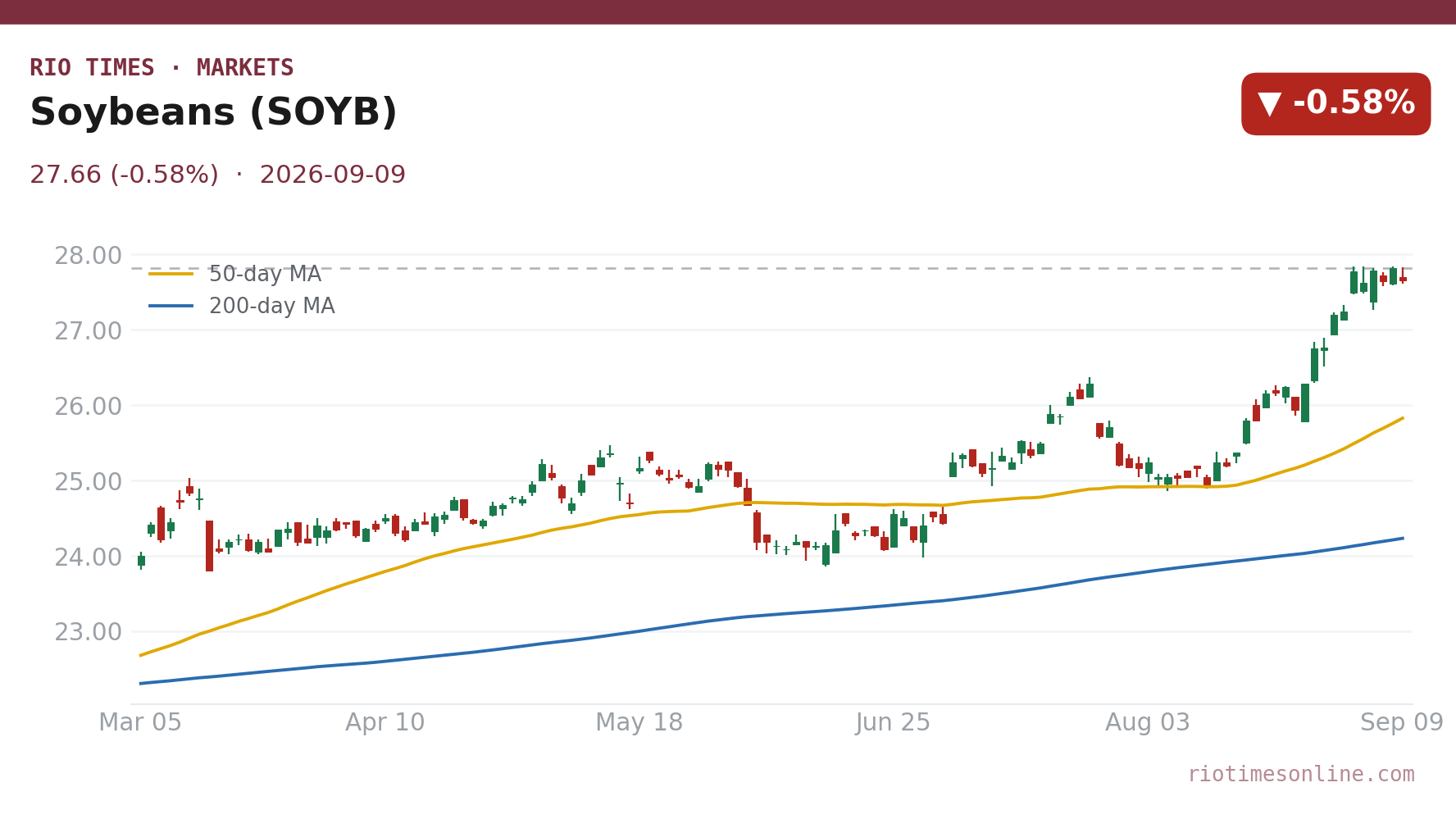
- SOYB fell 0.58% with the soybean-tracking fund settling at US$27.66 as the Chinese demand picture underwhelmed.
- CORN dropped 0.70% to US$19.83 as early U.S. harvest supplies widened cash basis levels.
- WEAT lost 2.52% settling at US$26.28 after Black Sea war headlines triggered profit-taking.
- Brazil and Argentina remain the export engine with local currency swings shaping farmer selling into the global market.
- Traders positioned ahead of WASDE bracing for a lower U.S. corn yield outlook in the next government report.
- Cash market basis widened as the U.S. harvest began, pressuring front-month grain tracker valuations.
Today’s Focus
Grain tracker funds slipped on Wednesday, September 9, 2026, with wheat leading the decline. WEAT fell 2.52% to US$26.28 as Black Sea ceasefire headlines encouraged profit-taking after a sharp rally.
Soybeans and corn had softer sessions. SOYB settled down 0.58% at US$27.66, while CORN lost 0.70% to US$19.83 as early U.S. harvest supplies widened cash basis.
For Latin American producers, the pullback coincides with a currency-sensitive window. Brazilian and Argentine farmers watch the real and peso against the dollar, since a weaker local currency makes exports more attractive and can accelerate selling.
What matters today. The grain complex is pausing as harvest supply and currency swings meet still-firm Chinese demand, with traders eyeing the next U.S. yield estimates.
01 The session in one read
Grain tracker funds slipped on Wednesday, September 9, 2026, with wheat taking the steepest cut. WEAT settled at US$26.28, down 2.52% on the day.
Soybeans and corn followed a gentler path lower. SOYB fell 0.58% to US$27.66, while CORN dropped 0.70% to US$19.83 as early U.S. harvest supplies widened cash basis levels.
The moves reflect a market digesting three forces at once: a firmer U.S. dollar, Black Sea war headlines that prompted profit-taking in wheat, and positioning ahead of Friday’s WASDE supply and demand report.
The pullback looks like a natural consolidation after strong grain rallies, amplified by widening cash basis as the U.S. harvest begins and by profit-taking in wheat on Black Sea diplomacy headlines. Brazilian and Argentine export competitiveness remains the key swing factor, since any sharp move in the real or peso could accelerate farmer selling and deepen the futures retreat. The variable to watch is Friday’s WASDE report, specifically whether the projected U.S. corn yield lands below the number traders are already bracing for.
02 The board
The three exchange-traded trackers all closed in the red. SOYB, which follows front-month CBOT soybean contracts, settled at US$27.66, a drop of 0.58%.
CORN, tracking CBOT corn futures, finished at US$19.83, down 0.70%. WEAT, the wheat-linked fund, recorded the heaviest fall at 2.52% to US$26.28.
The uniform direction but uneven magnitude tells the story: wheat carried the most speculative heat going into the session, so it had the most air to let out.
| Asset | Level | Change |
|---|---|---|
| Soybeans (SOYB) | US$27.66 | -0.58% |
| Corn (CORN) | US$19.83 | -0.70% |
| Wheat (WEAT) | US$26.28 | -2.52% |
Trade date: Wednesday 9 September 2026. Source: RT close, 2026-09-09. Where a commodity has no spot feed, an exchange-traded tracker or leading producer is shown as a labelled proxy.
Live Market IntelligenceThe live market board
Rio Times · Live Market Intelligence
Latin America — Cross-Market Board
| Instrument | Last | Change | YoY | Prev. | High | Low | Volume |
|---|---|---|---|---|---|---|---|
| IBOV | 185,629.04 | -0.93% | +21.85% | 187,366.84 | 168,310 | 167,142 | — |
| IPSA | 11,370.36 | -0.39% | — | 11,414.32 | 11,210 | 10,984 | 1,513,213,483 |
| IPC MEX | 65,025.71 | -0.06% | +12.17% | 65,065.56 | 66,121 | 65,405 | 108,886,187 |
| MERVAL | 3,110,163 | +1.11% | +30.51% | 3,022,485 | 3,042,365 | 2,991,150 | — |
| COLCAP | 2,584.02 | +0.57% | — | 9.04 | 9.05 | 9.02 | 4,133 |
| BVL PERÚ | 60,246.14 | +0.76% | — | — | — | — | — |
| USD/BRL | 5.16 | +0.01% | -5.13% | 5.16 | 5.18 | 5.14 | — |
| EUR/BRL | 5.95 | +1.01% | -5.83% | 5.89 | 5.98 | 5.94 | — |
| USD/MXN | 17.06 | -0.24% | -8.58% | 17.10 | 17.08 | 17.01 | — |
| USD/CLP | 913.98 | +0.04% | -5.67% | 913.65 | 915.11 | 906.68 | — |
| USD/COP | 3,140 | +0.03% | -22.04% | 3,139 | 3,141 | 3,105 | — |
| USD/PEN | 3.36 | -0.66% | -4.82% | 3.38 | 3.38 | 3.35 | — |
| USD/ARS | 1,493 | +0.10% | +12.96% | 1,491 | 1,494 | 1,480 | — |
| USD/UYU | 40.27 | +1.24% | +1.80% | 39.77 | 40.27 | 40.23 | — |
| USD/PYG | 5,939 | +1.68% | -19.54% | 5,841 | 5,939 | 5,925 | — |
| USD/BOB | 11.64 | -0.76% | +72.04% | 11.73 | 11.72 | 11.64 | — |
| USD/DOP | 58.34 | +1.25% | -3.44% | 57.62 | 58.34 | 58.04 | — |
| USD/CRC | 445.92 | +0.89% | -9.71% | 441.97 | 448.50 | 445.92 | — |
03 What moved it
Wheat’s drop came after Black Sea war headlines triggered profit-taking. Traders who had ridden the recent rally used the news flow as a reason to bank gains, hitting WEAT hardest.
Corn’s slide was tied to harvest mechanics. As the U.S. corn harvest began, cash basis widened, leaving futures less attractive relative to physical bushels moving through the countryside.
Soybean pressure was milder, reflecting a tug-of-war between weak U.S. export sales and fresh Chinese purchases that have kept the market anchored around the same level.
04 The Latin American read
Brazil and Argentina remain the world’s export engine for soybeans and corn, so every CBOT tick translates into local planting and selling decisions.
Currency is the hidden lever: when the Brazilian real or Argentine peso weakens against the dollar, local farmers receive more of their home currency per bushel and often accelerate sales, which then feeds back into futures pressure.
The current slip in tracker funds is a reminder that South American producer hedging can amplify moves, especially as planting progress and weather forecasts keep the export programme in focus.
05 The names to watch
SOYB is the soybean futures tracker, a synthetic way for foreign investors to hold exposure to front-month CBOT soybean contracts without opening a commodity account.
CORN tracks CBOT corn futures and is the cleanest expression of U.S. harvest pressure and WASDE positioning for outside investors.
WEAT, the wheat-linked fund, tends to move most violently on geopolitical headlines, which is why it led Wednesday’s retreat on Black Sea news.
06 The outlook
The immediate catalyst is Friday’s WASDE report, where traders expect a lower U.S. corn yield outlook to provide support.
If the report confirms a tighter U.S. corn balance sheet, the recent corn rally could regain momentum; a disappointing revision would likely extend the pullback.
For soybeans and wheat, the path depends on whether Chinese buying stays enough to offset harvest supply, and whether Black Sea ceasefire talk turns into a concrete export corridor improvement.
07 What to watch
- WASDE corn yield: A lower U.S. yield outlook could reignite the corn rally and lift CORN across the board.
- Brazilian real and Argentine peso: Any sharp depreciation would accelerate farmer selling into the export market, pressuring soybeans and corn.
- Black Sea diplomacy: Concrete export corridor news would likely push WEAT lower, while escalation would reverse the profit-taking.
- Chinese buying pace: Sustained purchases could cushion soybean losses even as U.S. export sales remain weak.
Frequently Asked Questions
Why did grain trackers fall on Wednesday?
Wheat led the decline on Black Sea profit-taking, while soybean and corn funds slipped as harvest supply widened cash basis.
What does the WASDE report mean for corn?
Traders expect the USDA to lower its U.S. corn yield outlook, which could support prices if confirmed on Friday.
How do Brazil and Argentina affect these prices?
They are major soybean and corn exporters, and currency swings influence how aggressively their farmers sell into the global market.
Are these funds the actual grain price?
No. SOYB, CORN and WEAT are exchange-traded funds that track front-month CBOT futures contracts, not spot commodity prices.
Market data: RT
This article was produced by The Rio Times’ automated newsroom system. How we use AI · Report an error
LatAm Markets: Live Signals → — real-time movers, turnover leaders and FX across Latin America.
Read More from The Rio Times