Copper Rises: CPER up 1.18% on China, Chile Supply
Key Facts
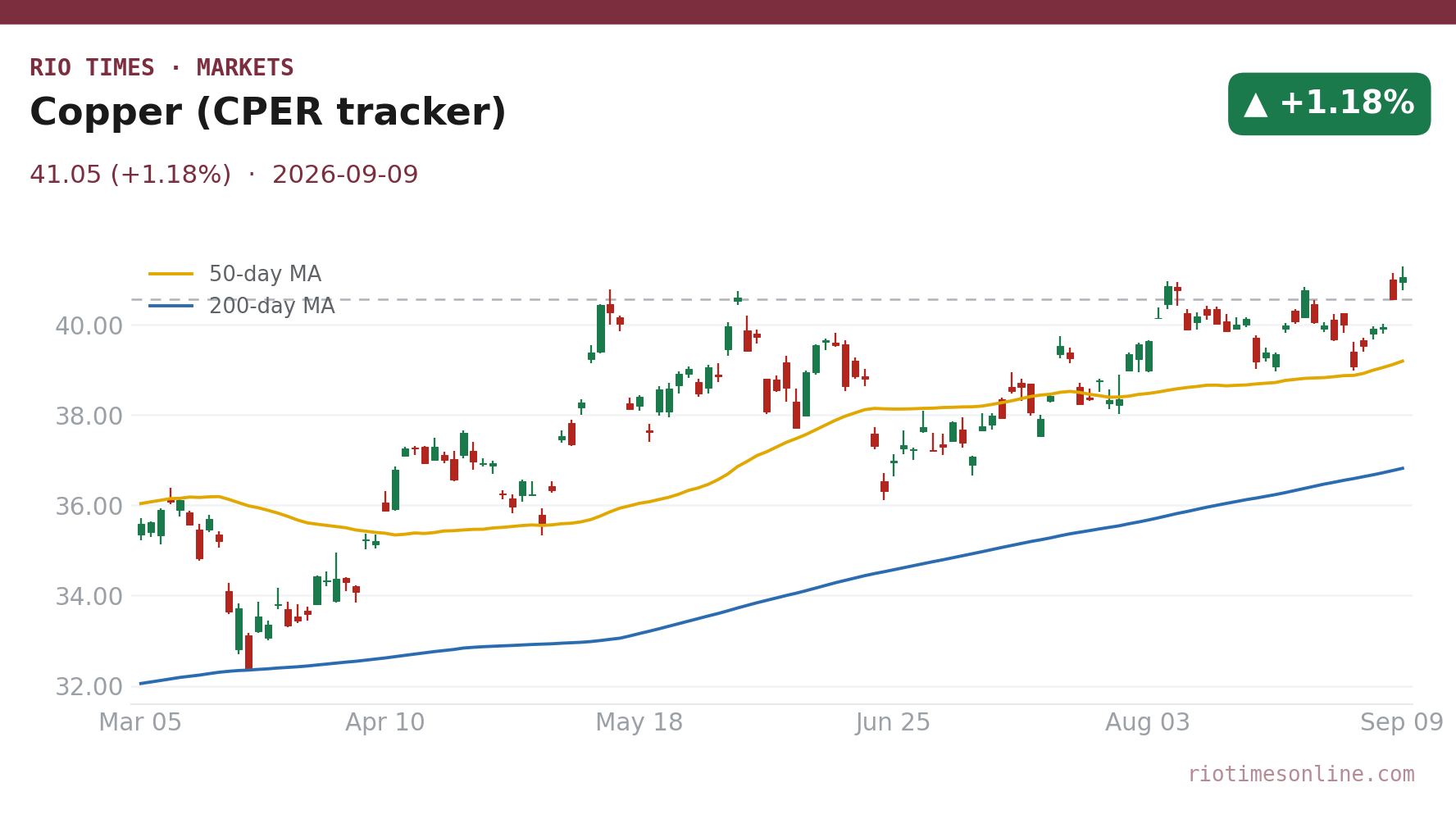
- Copper tracker gained the CPER fund rose 1.18% to US$41.05, tracking copper futures rather than physical metal.
- Futures settled higher front-month copper on NYMEX traded between US$6.6630 and US$6.8055 per pound and last traded at US$6.7760.
- Producer shares diverged Southern Copper added 0.34% to US$209.26 while Freeport-McMoRan slipped 0.51% to US$76.23.
- Chile and Peru anchor supply the world’s top two copper producers remain the reference for smelters across Asia and Europe.
- China demand is central the largest refined copper consumer is still driven by grid investment, construction and manufacturing.
- Energy transition underpins EVs, renewables and transmission upgrades are building a case for structurally higher copper demand.
Today’s Focus
Copper climbed on Wednesday, with the CPER tracker settling 1.18% higher at US$41.05. That move reflects a firmer futures curve, not a spot metal quote.
Front-month copper on NYMEX traded between US$6.6630 and US$6.8055 per pound and last changed hands at US$6.7760, an intraday gain of US$0.0370 per pound.
Equity proxies were mixed: Southern Copper rose 0.34% to US$209.26, while Freeport-McMoRan fell 0.51% to US$76.23.
The backdrop is familiar to Latin America watchers: Chile and Peru supply, Chinese industrial demand and the long-term pull of the energy transition.
What matters today. Copper’s rise is less about a single headline and more about the steady pull of China demand against Latin American supply concentration.
01 The session in one read
Copper futures firmed on Wednesday, September 9, extending a modest upward trend that has global miners watching closely. The exchange-traded CPER tracker, which follows copper futures rather than physical metal, settled at US$41.05, a rise of 1.18%.
That futures strength came with only a partial lift for the biggest producer shares. Southern Copper closed up 0.34% at US$209.26, while Freeport-McMoRan dropped 0.51% to US$76.23.
The copper futures tracker outperformed several mining equities, a sign that investors are buying the commodity exposure itself rather than producer shares. The divergence between Southern Copper’s gain and Freeport-McMoRan’s decline hints at company-specific cost or output worries, not a broad sector rethink. Watch whether CPER can hold above the US$41 level if the dollar steadies and Chinese import data disappoint.
02 The board
The price board shows a clear split between the commodity tracker and the mining equities. CPER’s 1.18% advance to US$41.05 was the standout move, confirming that investors preferred futures exposure on the day.
Southern Copper’s 0.34% gain to US$209.26 suggests some buying of Latin American output leverage, but Freeport-McMoRan’s 0.51% decline to US$76.23 shows the move was not a blanket vote for all copper miners.
Front-month NYMEX copper traded between US$6.6630 and US$6.8055 per pound, last at US$6.7760 after an intraday gain of US$0.0370. The low-high range points to a market testing resistance without a runaway breakout.
| Asset | Level | Change |
|---|---|---|
| Copper (CPER tracker) | US$41.05 | +1.18% |
| Southern Copper | US$209.26 | +0.34% |
| Freeport-McMoRan | US$76.23 | -0.51% |
Trade date: Wednesday 9 September 2026. Source: RT close, 2026-09-09. Where a commodity has no spot feed, an exchange-traded tracker or leading producer is shown as a labelled proxy.
Live Market IntelligenceThe live market board
Rio Times · Live Market Intelligence
Latin America — Cross-Market Board
| Instrument | Last | Change | YoY | Prev. | High | Low | Volume |
|---|---|---|---|---|---|---|---|
| IBOV | 185,629.04 | -0.93% | +21.85% | 187,366.84 | 168,310 | 167,142 | — |
| IPSA | 11,370.36 | -0.39% | — | 11,414.32 | 11,210 | 10,984 | 1,513,213,483 |
| IPC MEX | 65,025.71 | -0.06% | +12.17% | 65,065.56 | 66,121 | 65,405 | 108,886,187 |
| MERVAL | 3,110,163 | +1.11% | +30.51% | 3,022,485 | 3,042,365 | 2,991,150 | — |
| COLCAP | 2,584.02 | +0.57% | — | 9.04 | 9.05 | 9.02 | 4,133 |
| BVL PERÚ | 60,246.14 | +0.76% | — | — | — | — | — |
| USD/BRL | 5.16 | +0.01% | -5.13% | 5.16 | 5.18 | 5.14 | — |
| EUR/BRL | 5.95 | +1.01% | -5.83% | 5.89 | 5.98 | 5.94 | — |
| USD/MXN | 17.06 | -0.24% | -8.58% | 17.10 | 17.08 | 17.01 | — |
| USD/CLP | 913.98 | +0.04% | -5.67% | 913.65 | 915.11 | 906.68 | — |
| USD/COP | 3,140 | +0.03% | -22.04% | 3,139 | 3,141 | 3,105 | — |
| USD/PEN | 3.36 | -0.66% | -4.82% | 3.38 | 3.38 | 3.35 | — |
| USD/ARS | 1,493 | +0.10% | +12.96% | 1,491 | 1,494 | 1,480 | — |
| USD/UYU | 40.27 | +1.24% | +1.80% | 39.77 | 40.27 | 40.23 | — |
| USD/PYG | 5,939 | +1.68% | -19.54% | 5,841 | 5,939 | 5,925 | — |
| USD/BOB | 11.64 | -0.76% | +72.04% | 11.73 | 11.72 | 11.64 | — |
| USD/DOP | 58.34 | +1.25% | -3.44% | 57.62 | 58.34 | 58.04 | — |
| USD/CRC | 445.92 | +0.89% | -9.71% | 441.97 | 448.50 | 445.92 | — |
03 What moved it
China remains the anchor for copper demand. The country is the largest consumer of refined copper, with buying tied to grid investment, construction and manufacturing, and traders watch its import rhythm as the core signal for futures.
The global energy transition is reinforcing the longer-dated case. Electric vehicles, renewable power and upgraded transmission networks all require heavy copper wiring, giving investors a structural reason to hold futures beyond any single session.
Supply concentration adds a geopolitical twist. Chile is the number one mined copper producer and Peru ranks second, so any port delay, grade decline or strike threat in those two countries can tighten the futures curve quickly.
04 The Latin American read
For Chile and Peru, a firmer futures price is a mixed blessing. Higher copper tends to boost export earnings and mining tax receipts, but it also raises the stakes for labour negotiations and water or permitting disputes.
Southern Copper, with operations spanning both countries, showed the most direct equity response, rising 0.34% to US$209.26. Freeport-McMoRan’s decline despite its South American footprint suggests investors are differentiating by cost curve and project mix.
Foreign investors often treat these two producer shares as a cleaner Latin America copper play than buying futures directly. When CPER rises but miners lag, the market is often pricing operational risk in the Andes more than demand.
05 The names to watch
The Global X Copper Miners ETF gives a broad equity proxy for the sector. Its top holdings include BHP Group, Teck Resources, Hudbay Minerals, Southern Copper, First Quantum Minerals, Glencore, Antofagasta, KGHM Polska Miedz, Freeport-McMoRan and Zijin Mining Group.
Those names span Chile, Peru, North America, Europe and Asia, so the basket moves on Chinese industrial data, Latin American mine performance and energy-transition demand all at once.
The futures tracker CPER remains the purest listed way to follow the New York copper curve, and its 1.18% gain to US$41.05 shows derivatives buyers were more aggressive than equity investors on Wednesday.
06 The outlook
Copper looks set to keep trading off three signals: Chinese import appetite, Chilean and Peruvian supply news, and the pace of grid and EV investment globally. The futures curve is doing the leading, with miner shares still catching up.
The next test for CPER is whether it can hold above US$41.05 into the end of the week without a fresh supply interruption from the Andes.
07 What to watch
- China import data: any sign of weaker refined copper buying would test the futures rally quickly.
- Chilean mine output: grade declines or strike risk at major operations can tighten the curve with little warning.
- Peruvian logistics: port delays and community disputes remain the fastest path to a supply scare.
- US dollar moves: a stronger dollar tends to pressure dollar-denominated copper futures even when demand holds.
Frequently Asked Questions
Does CPER track spot copper?
No, CPER is built to follow copper futures contracts, not physical spot metal, so it reflects the futures curve.
Why are Chile and Peru so important?
Chile is the world’s number one mined copper producer and Peru is number two, anchoring global supply for Asian and European smelters.
What drives copper demand most?
China is the largest refined copper consumer, with grid investment, construction and manufacturing setting the pace.
How does the energy transition affect copper?
EVs, renewable power and upgraded transmission networks all require large amounts of copper wiring, supporting structurally higher demand.
Market data: RT
This article was produced by The Rio Times’ automated newsroom system. How we use AI · Report an error
In depth
LatAm Markets: Live Signals → — real-time movers, turnover leaders and FX across Latin America.
Read More from The Rio Times