Good growth trend in cotton to consolidate Brazil’s role as second-largest exporter
From the shuttle of harvesters on giant white carpets comes encouraging news for Brazil and the world. The country’s cotton production at the end of the year is expected to be between 13% and 19% higher than last year, returning to the pre-pandemic rhythm.
The health crisis, which caused a slump in demand from the global textile industry, interrupted the rise in national production, which had doubled in just five years.
This year’s production growth trend is expected to consolidate Brazil as the fourth-largest producer and second-largest exporter. In the 2019 crop, 3 million tons were grown. In 2017, the figure was 1.5 million. For 2022, production is estimated at 2.6 to 2.8 million tons.
The quality of Brazilian cotton is also attractive to the foreign market. The most important market is Asia, where the largest garment industries have joined forces.
Bayer has announced that it will pay the price for the “sustainable cotton” label, which will only be awarded to those who have some form of “rural ESG.” It is necessary to meet 178 quality requirements – social, economic and environmental. These include labor laws, the Forest Code, and measures to promote worker health and safety.
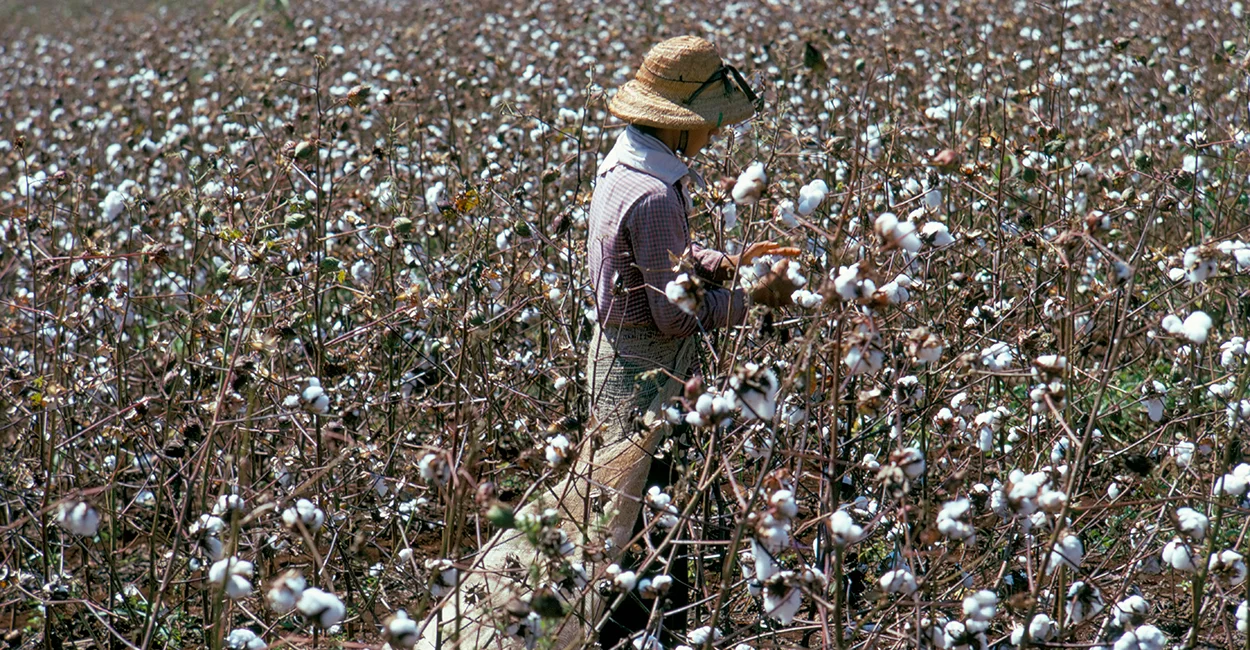
Despite the expected increase in production this year, productivity has not been the best. More than 90% of farms use technology that relies on rainwater, and this did not come in the expected time frames and quantities. The average amount of cotton per hectare this year is lower than in 2021, when the cultivated area was smaller than today.
For 2023, the Brazilian Association of Cotton Producers (Abrapa) projects an area of 1.7 million hectares, which would exceed the area of the record crop of 2019. “We shrank with the pandemic. It was a very difficult decision. We just came from the largest crop in history. The cotton was sold but left on the farm.
No one came to pick it up. And we had to determine how to grow the next crop,” says Júlio Cézar Busato, Abrapa’s president, who, just before the Covid-19 became a global emergency, opened an office in Singapore to be close to Asian industrialists.
The increase in cotton production in recent years is largely due to three factors. Although it is more difficult and costly to grow, it is more profitable than soybeans. Growers wait about a year from planting to receiving payment for the product they sell. It takes time, but the revenue is worth it. The profit from one hectare of cotton is the same as four hectares of soybeans.
Another reason for the increase is demand. It’s good that the company has been able to keep up with the growing demand for its products,” says the company’s general manager. There is also a practical reason. Cotton needs a large repellent, making the soil better prepared for the next harvest.
About 65% of cotton in Brazil is grown as a second crop between soybeans and corn. For this reason, the largest harvests are obtained in regions where these crops predominate, such as Mato Grosso, Goiás, and Bahia.
Cotton is an expensive and unattractive branch for farmers with a lower financial structure and experience. The necessary inputs became more expensive and increased production costs. Key inputs such as potassium chloride and phosphorus are three to four times more expensive.
According to the Brazilian Confederation of Agriculture and Livestock (CNA), costs in Bahia are close to R$18,000 per hectare, compared to R$15,000 in the second half of last year. Only the average expenditure on fertilizers increased from 3 thousand dollars to 5.4 thousand dollars.
EXPECTATIONS
An hour away from Brasília, in Cristalina (GO), the first cotton plantations appear along the road.
Farmer Carlos Alberto Moresco, owner of GM Algodoeira, in the city of Goias, says that he has greatly reduced the area under cultivation due to the decrease in demand in the pandemic. Still, he is pleased with productivity, which is helped by the fact that his farm is located in an area that suffers less from the lack of rain.
“I’ve reduced the cotton and increased the soybeans,” he says. “I’ve always planted about 2,000 acres. Last year it was 840. This year it’s 960. My yield is very good. It will be similar or even better than last year. The drought in Mato Grosso and Bahia did not affect our region that much. Our region will still have a reasonable production.
More: Brazil news in English, every day from The Rio Times.
This article was produced by The Rio Times’ automated newsroom system. How we use AI · Report an error · Editorial responsibility: Matthias Camenzind, Editor-in-Chief