Gabon Debt Passed 80% of GDP, World Bank Estimates

ECONOMY · GABON
Key Facts
- —The country Gabon is an oil producer on Central Africa’s Atlantic coast. It uses the CFA franc, pegged to the euro, and about a third of its people live in poverty.
- —Why it matters The World Bank puts Gabon public debt above 80% of GDP, well over the 68.91% the government announced after its own audit in September.
- —Why now Gabon Media Time reported the Bank’s figure on Thursday 8 October and says Libreville is seeking to refinance debt while IMF talks continue.
- —What happened The Bank’s Gabon Public Finance Review 2026, published Tuesday 29 September, estimates debt at more than 80% of GDP in 2025, up from 71.5% in 2023.
- —The numbers Seven big state firms owed about US$1.8 billion in 2024, nearly 8% of GDP. Gabon Oil Company alone owed about US$1.5 billion.
- —What it means for US readers Holders of Gabon’s dollar bonds face two debt figures. The lower one supports prices; the higher one points to tighter budgets and costlier borrowing.
- —Still open The full audit has not been published, and the IMF has not said which debt figure it will use.
The World Bank estimates that Gabon public debt passed 80% of gross domestic product in 2025, far above the figure the government now uses. The estimate sits in the Bank’s Gabon Public Finance Review 2026, published on Tuesday 29 September. For foreign investors it matters because Gabon borrows on international bond markets, and two very different debt numbers now compete for their attention.
The government’s own number is 68.91% of GDP. It comes from a debt audit that the Ministry of Economy and Finance summarised in a statement dated Sunday 13 September, according to Gabonreview. That figure sits just under the 70% ceiling set by CEMAC, the six-country Central African monetary union that shares Gabon’s currency.
The gap reached a wider audience this week, when the Libreville news site Gabon Media Time reported on Thursday 8 October that the Bank still sees debt at about 80% of GDP despite the audit.
Amounts in this article are converted at the fixed rate of 655.957 CFA francs per euro and the European Central Bank reference rate of US$1.1186 per euro on Thursday 8 October, or about 586 CFA francs per US dollar.
Two Debt Figures for One Country
The World Bank says Gabon public debt rose quickly from 71.5% of GDP in 2023 to more than 80% in 2025. Its main explanation is a sharp rise in public spending since 2023, especially on capital projects. Lower oil prices and output in 2025 added to the strain.
The Bank also notes a less obvious driver. Since the 2023 political transition, officials have found unpaid bills to suppliers and unpaid wages that were left out of the debt stock until 2023. Counting them pushed debt up. The report calls this a commendable transparency effort.
The government arrived at a lower ratio by two routes. According to Gabonreview, the audit launched on 17 June fixed debt and other payable sums at 9,524.643 billion CFA francs (about US$16.2 billion) at the end of 2025. That is 2,175.357 billion CFA francs (about US$3.7 billion) below the initial estimate of nearly 11,700 billion CFA francs (about US$20 billion).
The ministry also used a rebased GDP of 13,822 billion CFA francs (about US$23.6 billion) for 2025. A bigger economy on paper lowers the ratio, even if the debt does not change. Gabonreview reports that the audit report was sent to the IMF but has not been released.
The Bank itself flags the uncertainty. Its footnotes say the 2025 debt figures are preliminary and that the audit announced in May 2026 could change them.
State Companies Carry Much of the Risk
The report points to Gabon’s state-owned companies as a major source of hidden pressure. In 2024 the main state firms owed 1,064 billion CFA francs (about US$1.8 billion), nearly 8% of GDP. Their combined equity was only 382 billion CFA francs (about US$651 million).
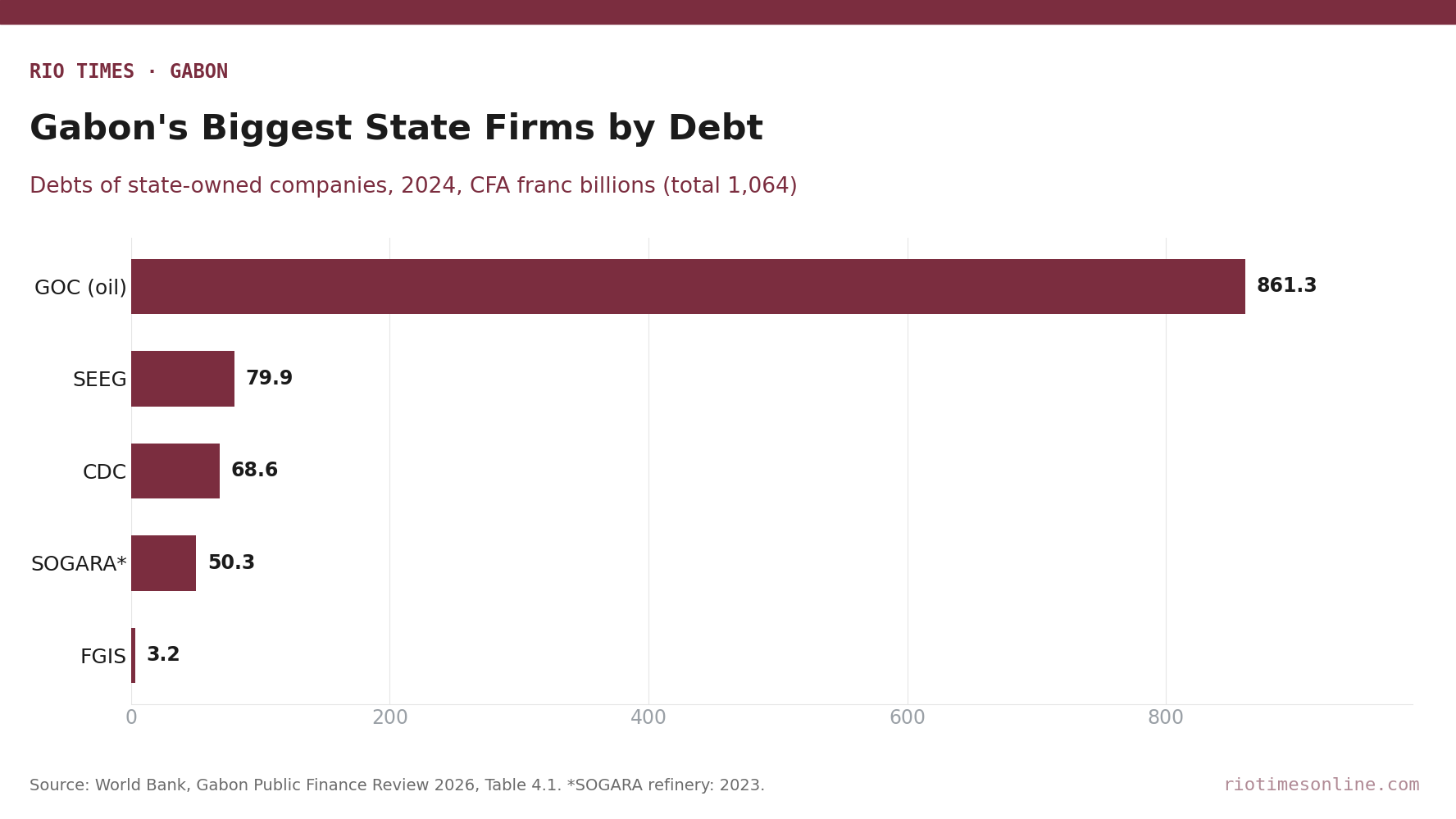
Gabon Oil Company (GOC), the national oil firm, accounts for most of it. Its debts stood at 861.3 billion CFA francs (about US$1.5 billion), or 6.8% of GDP. The Bank says GOC’s 2024 purchase of Assala and of Tullow Oil assets was financed mainly with borrowed money.
The water and power utility SEEG is in worse shape. The Bank describes it as effectively insolvent, with negative equity of 91 billion CFA francs (about US$155 million) and accumulated losses above 127 billion CFA francs (about US$217 million). It cites a tariff freeze in place since 2018 and technical losses of nearly 30%.
There is a stabiliser. GOC earned a net profit of 49.1 billion CFA francs (about US$84 million) in 2024, and its assets produce oil revenue. The Bank also counts debt arrears of 3.5% of GDP in November 2025, a stock that can shrink if the state keeps to its payment plans.
What It Means for US Readers
Gabon has borrowed in US dollars from international investors. The World Bank report lists a US$570 million private placement in February 2025 at 12.7%, a rate it calls particularly costly. In 2023 Gabon also used a US$500 million blue bond, a debt-for-nature swap, to buy back older bonds.
For bondholders, the question is which measure of Gabon public debt the IMF accepts. A ratio under 70% would ease pressure to cut spending. A ratio above 80% would point to a longer squeeze and higher borrowing costs.
Oil links Gabon to US companies too. It is sub-Saharan Africa’s fourth-largest oil producer, and the Bank notes partnerships with ExxonMobil and BP pursued in 2025. A government short of cash may push harder on tax and contract terms.
The report also offers a way out. It estimates that its proposed reforms, including fewer tax exemptions, digital VAT invoices and phasing out fuel subsidies that favour richer households, could yield net gains of 1.8% to 5.3% of GDP.
What Is Not Known
The full audit has not been published. The government has not said which debts were removed, reclassified or rejected, or how much is external, domestic or arrears.
The IMF has not said publicly whether it will adopt the 68.91% ratio. The method behind the rebased GDP has also not been released.
Local reports describe the 80% figure as a forecast for the end of 2026. The report text we read gives it as an estimate for 2025. It adds that spending plans for 2026 and 2027 could create primary deficits and more debt unless the budget is adjusted.
Frequently Asked Questions
How high is Gabon public debt?
The World Bank estimates it at more than 80% of GDP in 2025. The government’s audit puts debt and payable sums at 68.91% of a rebased GDP.
Why do the two figures differ?
The government audit cut about US$3.7 billion from its first estimate and used a larger, rebased GDP. The World Bank says its own 2025 figures are preliminary.
What is the CEMAC debt limit?
CEMAC, the Central African monetary union, sets a convergence criterion of 70% of GDP for public debt. The World Bank says Gabon is above it.
Which state company owes the most?
Gabon Oil Company, with debts of 861.3 billion CFA francs (about US$1.5 billion) in 2024, mainly from buying oil assets.
What happens next?
Gabon Media Time reports that talks with the IMF continue. The audit report has been sent to the Fund, which has not said which debt figure it will use.
Related: Gabon’s Bonds Surge on an Audit Whose Findings Have Not Been Published and Gabon’s 2027 Budget Lifts Debt Interest Costs by Almost 37 Percent.
Sources: World Bank, Revue des Finances publiques du Gabon 2026 (29 September 2026) and full report (PDF); Gabonreview, Dette publique : l’audit efface plus de 2 175 milliards de FCFA (15 September 2026) and Dette : le FMI reprendra-t-il vraiment le ratio gabonais de 68,91 % ? (16 September 2026); Gabon Media Time, Gabon : la Banque mondiale anticipe une dette à 80 % du PIB d’ici fin 2026 (8 October 2026); European Central Bank, euro reference rates (8 October 2026).
Editorial responsibility: Matthias Camenzind, Editor-in-Chief · Editorial standards · Report an error
Part of our ongoing coverage
Africa: The New Scramble — the great-power contest over the continent.