How Grow, Formerly Yellow and Grin, Went from Bicycle Boom to Bust
RIO DE JANEIRO, BRAZIL – The pandemic amplified what was already on the way down, and the crisis of the micromobility company Grow has now reached its worst moment. The company, born from the merger between Brazilian Yellow and Mexican Grin in early 2019, filed for bankruptcy protection in São Paulo on Tuesday, July 28th.

The company debts amount to some R$38 million (US$7.6 million). The main reasons for the crisis, according to the company, are increased regulations, increased competition, decreased profit margins, and the ongoing need to update scooters and bicycles. With the pandemic, which paralyzed ride sharing services, the business collapsed.
“Social isolation and the new prevention rules imposed by the pandemic have hindered the hiring of the service, impacting the sector not only at this time but also casting doubt on whether this model will make sense in the future. With so many demands regarding hygiene, for instance, and a change in behavior, won’t it be better for people to own their own scooters or bicycles?” says Luiz Deoclecio Fiore, president of OnBe half, the judicial trustee in bankruptcy.
In its reorganization petition, Yellow and Grin urge that the liabilities and assets of both companies be considered as one, since in the Grow Group there are interlocking directorship and shareholding composition, joint action in the market, sharing of employees, goods and services, as well as a single income source.
The list of the company’s creditors consists of former employees and suppliers. There are a little over R$8 million in class I debts, that is, unpaid labor rights after the dismissal of employees, plus both companies’ liabilities.
In terms of class III, supplier companies, there are approximately R$30 million in debts. The largest creditor is the Caloi Norte bicycle manufacturer, with R$15.4 million to collect. In class IV, micro or small-scale companies, the debt amounts to just over R$234,000.
In the application, Grin and Yellow request the suspension of all lawsuits from individual creditors, eviction and a public civil class action brought by the Labor Prosecutor’s Office seeking the reinstatement of dismissed employees. “The company, which was in crisis before, most likely sought the 180-day leeway the law allows to propose a plan to creditors without being evicted or forced to reinstate workers,” says attorney Renata Oliveira, a partner in the litigation department of the Machado Meyer law firm.
The lawsuit is proceeding in the 1st Bankruptcy Court of São Paulo under Judge Tiago Limongi. “At this point, the magistrate will analyze the regularity of the documents attached to the petition and, if formally in order, will grant the processing of bankruptcy protection, as well as the suspension of lawsuits and foreclosures against the companies,” says Leonardo Adriano Ribeiro Dias, an expert in bankruptcy and judicial reorganizations.
After that stage, the companies will have up to 60 days to submit a reorganization plan to their creditors. “A significant part of creditors is composed of suppliers and employees, close to the company. If this picture is confirmed, it is a positive aspect, as they are interested in the reorganization, as long as the activity undertaken itself proves viable”, says Dr. Daniel Bucar, partner of the law firm Bucar Marano Attorneys.
Waves of dismissals
The last unfolding of the crisis in Grow came in June, when the company announced the dismissal of what, at the time, it classified in a statement as the “great part of the operational and corporate team in Brazil”.
Before the coronavirus, Grow was already experiencing successive waves of dismissals and closing operations. In January, long before any prospect of a quarantine in Latin America, the company closed operations in 14 cities in Brazil. Only São Paulo, Rio de Janeiro, and Curitiba survived.
The rental of bicycles through the Yellow App was also paralyzed for an indefinite time, leaving only the scooters. At the start of the year, another group of employees had already been dismissed.
In March, now shrouded in a financial crisis, the startup was bought by the Mountain Nazca fund, owner of Peixe Urbano. President Roberto Álvarez Cadavieco took over, saying at the time that “the era of growth at any cost is over” and that Grow planned to be “the first profitable micromobility company in the world”.
Disagreements between Mexico and Brazil
At the time of the June dismissals, one of the rumors in the market was the prospect of Grow closing its operation in Brazil. One of the company’s strongest markets is Mexico, Grin’s birthplace. According to the company’s profile in LinkedIn, there are currently a little over 280 employees linked to Grow in Brazil. Worldwide, there are approximately 500 employees.
At the peak of the operation, mid-2019, there were over 2,000 employees, more than 1,400 in Brazil alone.
In Brazil, it was the Brazilian Yellow, founded in 2017, that began implementing the micromobility model with electric scooters and bicycles. Until then, the format was less present other than in São Paulo’s streets, and was restricted to rented bicycles with bank brands – such as those sponsored by Itaú and Bradesco.
In addition to the financial challenges, some internal disagreements between Grin and Yellow professionals were recurrent along the way.
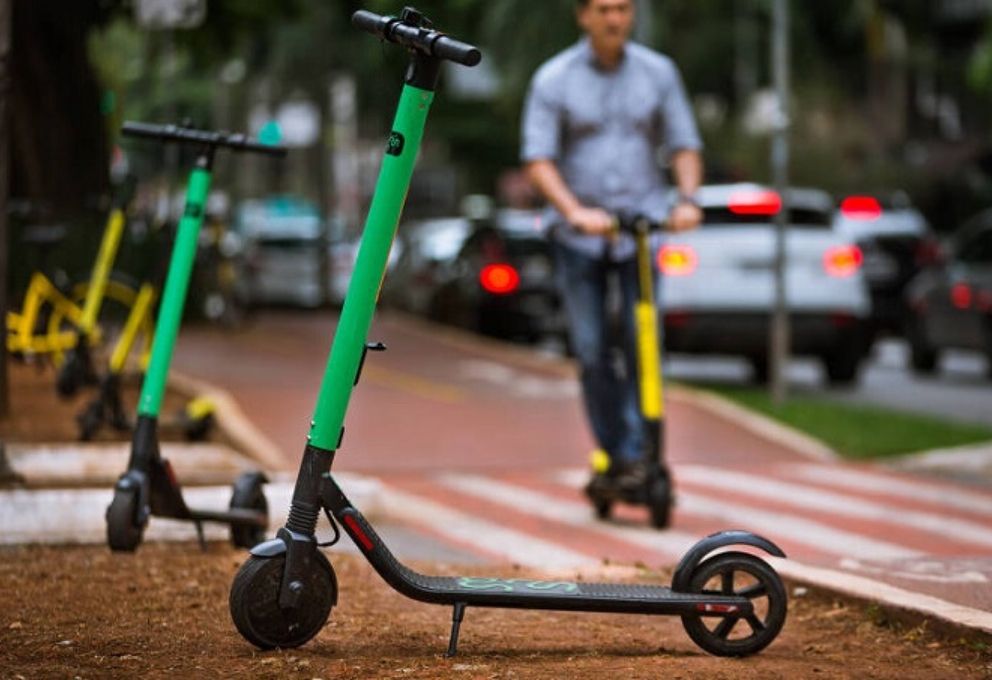
After the merger with Grin, the brand Yellow was closed and the equipment with its yellow colors was gradually replaced by Grin’s green scooters. The Grin brand also continued to be used in Mexico and other Latin American countries.
Yellow was founded by Brazilians Ariel Lambrecht, Eduardo Musa, and Renato Freitas. Lambrecht and Freitas co-founded the App and Brazilian unicorn 99, while Musa was once president of the Caloi bicycle manufacturer.
The feud between the founders of Yellow and Grin may have been one of the reasons that prevented a potential contribution of up to R$150 million from the Softbank investment fund.
Lambredcht, Freitas, and part of Yellow’s remaining group left the company earlier this year, while rumors spread that the founders of the Brazilian startup had disagreements with Grin’s Mexican partners. The Brazilian group, for one, was removed from the chief leadership positions shortly after the merger with the Mexicans. Yellow’s third founder, Eduardo Musa, had already left the company after the merger in January 2019.
At the peak of optimism with the scooters, Grow began an unprecedented expansion to the micromobility model, reaching more than ten Brazilian cities and including more distant neighborhoods, totaling over 20 million rides undertaken.
But the format was challenged by high costs. One of the main challenges in Grow’s business model is the plundering of scooters and bicycles. The company does not use fixed stations for the equipment, which can be left in a wider perimeter, thus raising the cost of the operation.
In an attempt to reduce expenses, at the start of this year, Grow launched Grin4U, a system of individual and monthly equipment rentals.
The scooter and bicycle model spread throughout the city, but despite the rush of recent years, it has not yet proved financially feasible. Tembici, which manages Itaú’s branded bicycles and uses fixed stations, received a US$47 million investment, announced in June, despite the pandemic.
The Tembici startup made its model of fixed stations one of its flags, as opposed to Grow and other competitors. In a previous interview, Scott Sobel, managing partner of Valor Capital, one of Tembici’s investor funds, said that the main advantage the startup model has over its competitors is the use of fixed stations to pick up and drop off bicycles. The fund believes that this model prevailed in relation to the one used by Grow.
Over the past two years, in addition to Yellow and Grin, a number of new competitors have emerged in Brazilian cities, such as the American Lime, which left Brazil in January this year, six months after its arrival. Uber also tried its luck here by introducing its scooters to Brazil in March this year but left the country less than four months later amid the coronavirus crisis and the downturn in global operations. Uber’s scooter operations were eventually acquired globally by Lime in May.
Source: Exame
More: Brazil news in English, every day from The Rio Times.
This article was produced by The Rio Times’ automated newsroom system. How we use AI · Report an error
Read More from The Rio Times