El Salvador Net FDI Falls 92% to US$9.77 Million in the Second Quarter of 2026
ECONOMY · EL SALVADOR
Key Facts
- —The country El Salvador, the smallest country in Central America by area, which has used the US dollar as its official currency since 2001.
- —What happened Net foreign direct investment (FDI) fell 92% year on year to US$9.77 million in April–June 2026, preliminary Central Reserve Bank data released on 30 September show.
- —The numbers US$120.68 million in Q2 2025, US$216.26 million in Q1 2026. First-half 2026 net FDI was US$226.03 million, down 53.57% (BCR).
- —What it means for you Strong growth is not yet pulling in long-term foreign capital. A single large outflow linked to Panama explains most of the quarter’s weakness.
- —Still open Which companies withdrew capital through Panama, and whether the outflow was a one-off. The central bank has not given a reason.
El Salvador net FDI fell to just US$9.77 million in the second quarter of 2026, down 92% from a year earlier. The Central Reserve Bank (BCR), the country’s central bank, published the data on Wednesday, Diario El Mundo reported.
A year earlier, the same quarter brought in US$120.68 million. Excluding quarters with net outflows, it is the lowest since the third quarter of 2019 (about US$8 million), El Mundo said.

How the Quarter Compares
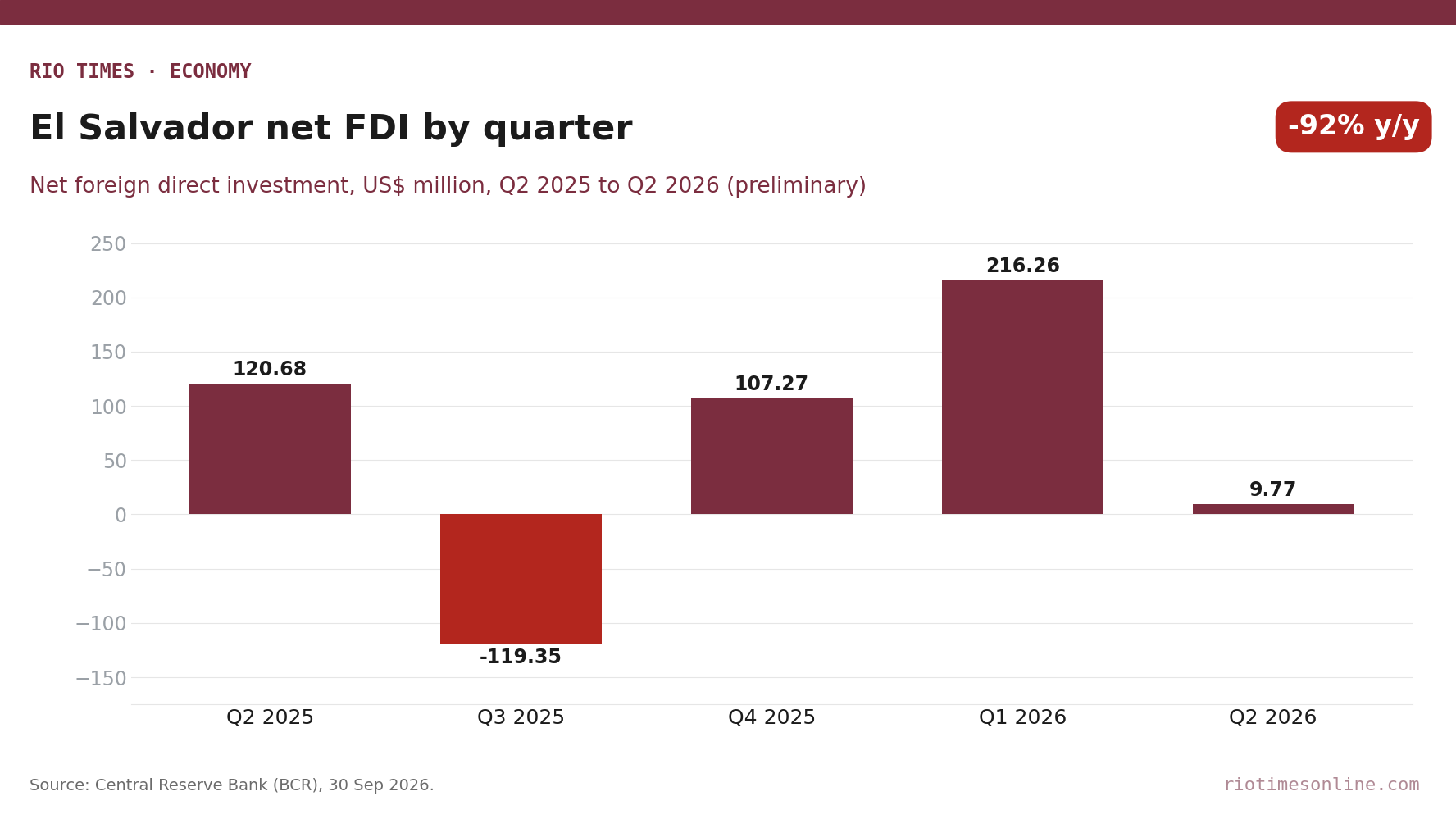
The slowdown is sharp even against the start of this year, when net inflows reached US$216.26 million. The fourth quarter of 2025 brought US$107.27 million.
Over the first half, El Salvador attracted US$226.03 million in net FDI. That is US$260.89 million, or 53.57%, less than the US$486.92 million of January–June 2025.
Net FDI is what stays in the country after outflows. These include loan repayments and transfers back to parent companies abroad.
Where the Money Went, and Where It Left
Other services drew the most capital, US$69.88 million, though that was 9.1% less than a year earlier. Electricity followed with US$44.69 million, up 66.3%.
El Mundo linked the electricity inflow to higher demand and more thermal generation. El Niño brought less rain and lowered hydroelectric reservoirs.
Information and communications recovered to US$41.27 million, from minus US$41.57 million a year earlier. Manufacturing, which drives exports, received US$30.9 million, down 64.59%.
Financial and insurance activities fell 70.5% to US$13.69 million. Transport recorded a net outflow of US$165.87 million, and commerce one of US$27.2 million.
By origin, the United States sent US$144.41 million, Spain US$72.11 million and Mexico US$43.28 million. Panama, however, showed a net outflow of US$194.64 million.
A Strong Economy, a Weak Investment Line
The data came on the same day the BCR reported that output grew 5.1% in the same quarter. Construction led that expansion, as covered in El Salvador Economy Grows 5.1% in Second Quarter as Construction Leads.
So the weak FDI figure does not signal a contracting economy. The BCR said construction credit grew 30.9% and housing finance 65.1% year on year as of June 2026.
The quarterly net balance is also volatile: in the third quarter of 2025 it was minus US$119.35 million, BCR data show. The Panama outflow alone exceeds the whole latest quarter’s net total.
Still, the first-half decline of 53.57% shows the weakness is not limited to one quarter. Gross inflows from the United States and Spain remain substantial.
What Is Not Yet Known
The BCR has not said which companies or transactions sit behind the Panama and transport outflows. It is also unclear whether they reflect loan repayments, profit transfers or a sale of assets.
The BCR statistics portal confirms the quarterly totals, which are preliminary and may be revised. The sector and country breakdown rests on El Mundo’s account of BCR data.
Sources: Diario El Mundo (1 October 2026, citing Central Reserve Bank data); Banco Central de Reserva de El Salvador, second-quarter GDP release (30 September 2026); BCR statistics portal, net FDI flows series (preliminary, data to Q2 2026).
LatAm Markets: Live Signals → — real-time movers, turnover leaders and FX across Latin America.
Read More from The Rio Times