Dominican Republic Drops 99% Rice Tariff After US Push

TRADE · DOMINICAN REPUBLIC
Key Facts
- —The country The Dominican Republic is a member of the DR-CAFTA free trade pact with the United States. Rice is its main staple and a large domestic crop.
- —Why it matters Washington asked for this repeal by name. It widens the opening for US rice in a staple market and clears an obstacle in talks on a reciprocal trade agreement.
- —Why now The repeal decree is dated 9 September but was first reported by Dominican newspapers on Monday 5 October.
- —What happened President Luis Abinader signed Decree 635-26 on Wednesday 9 September, repealing Decree 693-24 of December 2024 and its rice tariffs of up to 99%.
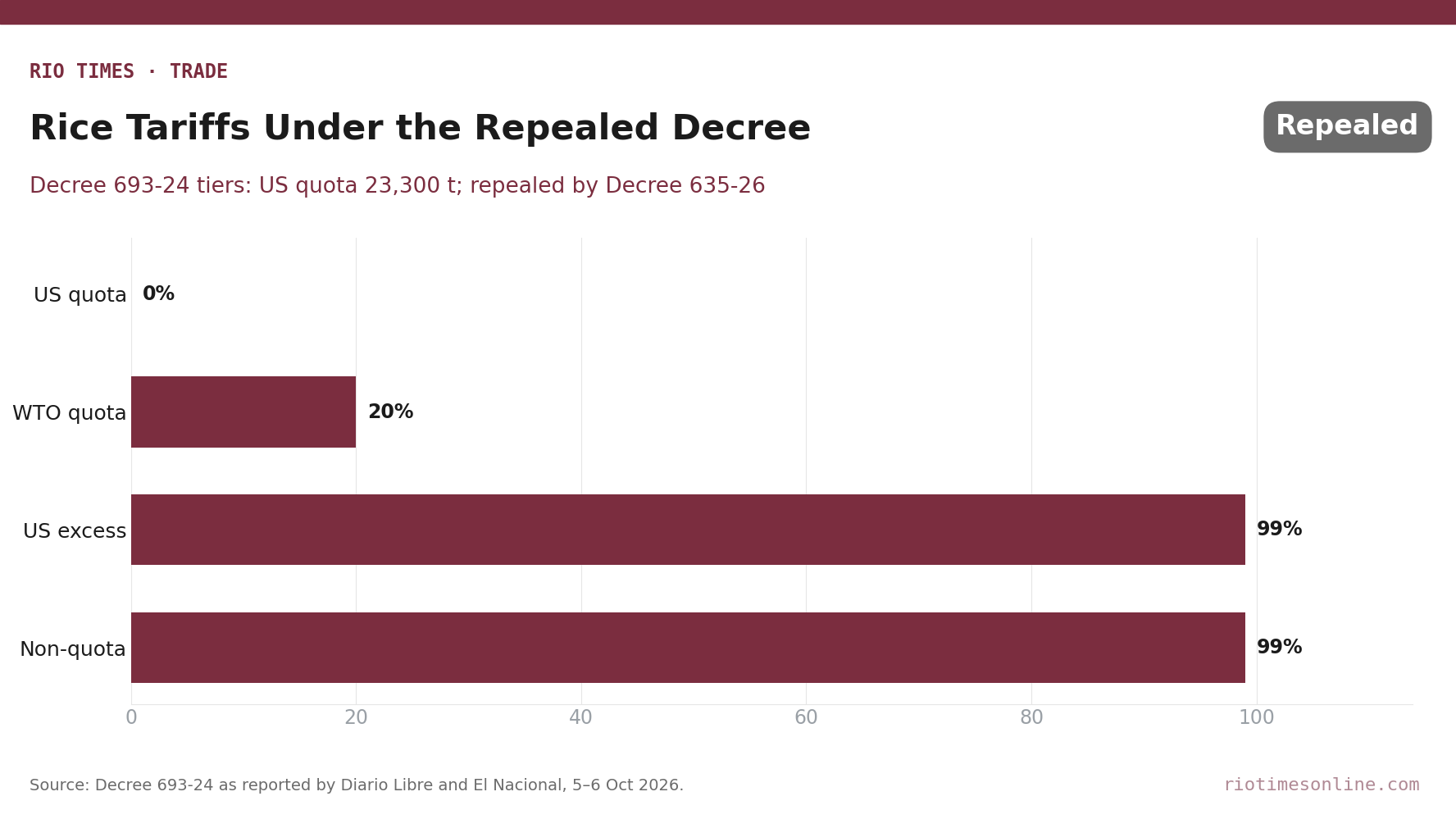
- —The numbers The old rules let 23,300 tonnes of US rice in duty-free each year. Above that, US rice paid 99%. Other in-quota rice paid 20%.
- —What it means for you US rice exporters gain easier access to a staple market. Dominican farmers lose their main shield against cheaper imports.
- —Still open Which tariffs customs now applies to rice, and whether the government will offer farmers any support, have not been announced.
The Dominican Republic rice tariff that Washington wanted gone has been repealed. President Luis Abinader scrapped the rules that charged up to 99% on imported rice, Dominican newspapers reported on Monday 5 October. For US readers, it means wider access for American rice and one fewer dispute in trade talks between the two countries.
The repeal is contained in Decree 635-26, which Abinader signed in Santo Domingo on Wednesday 9 September. Its first article cancels Decree 693-24, issued on Tuesday 17 December 2024 to protect rice growers. Diario Libre and El Nacional reported the text.
Abinader, of the governing Modern Revolutionary Party (PRM), has led the country since 2020. The new decree was not widely known until this week. Diario Libre, Listín Diario and El Nacional all reported it on Monday evening.
What the Old Rice Rules Did
Decree 693-24 set a 20% ad valorem tariff on several categories of rice. It applied within the quota the country registered at the World Trade Organization. Rice imported outside that quota paid 99%.
The decree also gave the United States a preferential quota of 23,300 tonnes a year at a 0% tariff. Once that was used up, US rice paid the most-favoured-nation rate of 99%, Diario Libre reported.
El Nacional reported that the 99% rate also applied to rice from Nicaragua. It said the 2024 rules followed a recommendation by Conassan, the national food security council, to protect rice farming in 21 provinces.
Diario Libre noted the timing. The DR-CAFTA schedule foresaw the end of tariffs on US rice from January 2025. In practice, it kept a protective wall in place after that date.
How Washington Pressed for the Repeal
The Office of the US Trade Representative (USTR) negotiates trade deals for the White House. It raised the decree in public on Friday 11 September.
In a post on X, it said two officials had met Dominican Foreign Minister Víctor Bisonó by video earlier that week. They were Deputy Trade Representative Jeffrey Goettman and Julie Callahan, its chief agricultural negotiator.
“The Ambassadors noted the opportunity to strengthen our countries’ bilateral economic relationship,” the post said. It said they highlighted the importance of Abinader’s repeal of Decree 693-24 to meet DR-CAFTA market-access obligations on US rice.
USTR also welcomed the chance to negotiate a reciprocal trade agreement with the Dominican Republic. It said it looked forward to a timely completion of the talks.
The dates are notable. Decree 635-26 carries a date two days before the USTR post. Neither the presidency nor the trade office has explained why the repeal was first reported almost four weeks after its signing.
Island trade is shifting on other fronts too, as covered in Haiti Transit Ban Orders Overseas Imports to Bypass Dominican Republic.
What It Means for You
For US rice exporters, the Dominican Republic rice tariff was a ceiling on sales. The decree’s 23,300-tonne cap on duty-free US rice falls away with it, although the rules that replace it are not yet clear.
For investors, the case shows how USTR uses reciprocal-agreement talks to clear specific farm barriers in Latin America. A named decree was raised in public and repealed within weeks.
For Dominican farmers, the outlook is harder. Marcos Rodríguez heads Fenarroz, the national rice growers’ federation. In mid-September, before the repeal was known, he spoke on the programme El Día. “Today we feel as if we are in uncertainty again,” he said.
Tito Hernández, who heads the National Association of Agricultural Professionals (ANPA), said in September that about 30,000 producers could be affected. He warned of lower farm-gate prices and closures of rice mills.
There are stabilisers. Domestic output remains large, and Fenarroz itself has argued that imports should fill any shortfall rather than replace local rice. The opposition is also split. Carlos Segura Foster, a leader of the opposition Dominican Liberation Party (PLD), has argued the country must honour its DR-CAFTA commitments, Vértice Crítico reported.
For visitors and residents, rice is the country’s staple. Any change in shop prices is likely to be gradual. For background on the country’s place in the region, see Dominican Republic and Its Neighbours in the Caribbean.
What Is Not Known
The text of Decree 635-26 was not available on the presidency’s decree register on Tuesday morning. El Nacional reported that it was published in the Official Gazette. The details here come from Dominican newspapers that reported its contents.
It is not clear which tariff customs now applies to rice from the United States and from other countries. No replacement rules have been announced.
The government has not said whether it will compensate rice farmers or offer credit, irrigation or other support. Fenarroz and the opposition parties had not publicly responded to the repeal in the reports published by early Tuesday.
The opposition Fuerza del Pueblo, led by former president Leonel Fernández, and the Frente Amplio party both opposed a repeal in September. How they act now is open.
The state of the reciprocal trade talks with Washington, and whether other farm products are on the table, has not been disclosed.
What did the Dominican Republic change on rice imports?
President Luis Abinader signed Decree 635-26 on 9 September 2026, repealing Decree 693-24. That decree had set rice tariffs of 20% within the WTO quota and 99% outside it.
Why did the United States want the decree repealed?
The US Trade Representative said on 11 September that the repeal was needed for the Dominican Republic to meet its DR-CAFTA market-access obligations for US rice.
How much US rice could enter duty-free before?
Up to 23,300 tonnes a year at a 0% tariff. US rice above that quota paid 99%, according to the repealed decree as reported by Diario Libre.
Sources: USTR on X (11 Sep 2026) · Diario Libre (5 Oct 2026) · Diario Libre (6 Oct 2026) · El Nacional · Listín Diario · Diario Libre on the USTR post (11 Sep 2026) · N Digital (Fenarroz) · Apunte (ANPA) · Vértice Crítico
This article was produced by The Rio Times’ automated newsroom system. How we use AI · Report an error · Editorial responsibility: Matthias Camenzind, Editor-in-Chief
LatAm Markets: Live Signals → — real-time movers, turnover leaders and FX across Latin America.