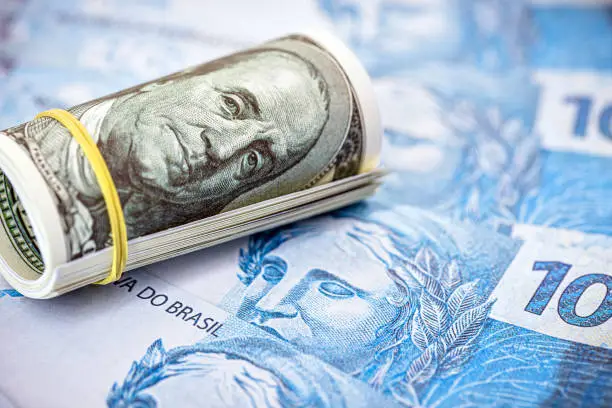
On Friday, June 21, the US dollar slipped against the Brazilian real to R$5.441, showing a modest retreat of 0.39%.
Despite the day’s decline, the dollar marked its fifth consecutive week of gains.
These fluctuations are attributed to broader economic uncertainties globally and concerns about domestic fiscal policies.
The dollar reached a significant peak the day before, hitting its highest level in nearly two years, and concluded the week with a total rise of 1.1%.
This performance was influenced by the decision to keep the benchmark interest rate steady at 10.50%.
Additionally, a stronger dollar performance in international markets contributed to these outcomes. Financial experts are concerned about economic slowdowns in Europe.
They also highlight political changes, such as unexpected election advancements in France. These factors contribute to cautious trading behaviors globally.
In the currency markets, the dollar ended at R$5.440 for buying and R$5.441 for selling, while futures slightly decreased by 0.41% to 5,435 points by the close of trading.
The Central Bank‘s action in the morning to release all available currency swaps for August was part of its ongoing currency management strategy.
The dollar initially opened lower but recovered by midday, responding to a mix of domestic and global policy influences.
Currency analysts note that fiscal uncertainties within the country are contributing to fluctuations in the currency’s stability.
Recent criticisms of monetary policy by national leaders also play a significant role in these fluctuations.
Currency Movements and Policy Dynamics
By midday, the dollar reached R$5.4623 after critical remarks about interest rate policies, indicating market sensitivity to policy discussions.
Despite a downturn later in the day, the overall gains for the week were maintained.
Financial commentators observe that political discourse can significantly influence market dynamics, especially concerning the real.
Looking forward, the financial sector is closely monitoring potential leadership changes at the Central Bank, which could affect approaches to inflation and monetary policy.
Internationally, the dollar demonstrated strength against major and emerging market currencies as trading closed, with the dollar index up by 0.21%.
This overview contextualizes the day’s currency movements within a global economic framework and national policy debates.
It underscores their profound impact on financial markets and investor sentiments.
This article was produced by The Rio Times’ automated newsroom system. How we use AI · Report an error
LatAm Markets: Live Signals → — real-time movers, turnover leaders and FX across Latin America.
Read More from The Rio Times