Djibouti Has US$600 Million Waiting, and the World Bank Says Not in Ports
DJIBOUTI · INVESTMENT
Key Facts
- —The headline At least US$600 million in private investment potential over five years, and around 12,000 jobs, the World Bank Group said on 14 September 2026.
- —The sectors Off-grid solar energy, data centres and tourism. Logistics is not one of them.
- —The breakdown Up to US$394.4 million in off-grid solar, US$160 million to US$240 million in data centres, and US$66 million to US$180 million in tourism.
- —The obstacle Commercial electricity costs about 25 US cents per kilowatt hour, against an African average of about 14 cents.
- —The debt External public debt was 68.9% of GDP in 2024. The IMF assesses Djibouti as in debt distress, with debt unsustainable.
- —The creditor Exim Bank of China holds about US$1.47 billion, or 49.8% of external debt and 34.3% of GDP.
- —The currency The Djiboutian franc has been pegged at 177.721 to the dollar under a currency board since 1973, with no exchange controls.
Djibouti has spent two decades monetising its position on the Bab-el-Mandeb strait. The World Bank Group now says the next US$600 million lies somewhere else entirely. The electricity price is what stands in the way.
What the Report Actually Says
The World Bank Group published a Country Private Sector Diagnostic for Djibouti on 13 September 2026, with a press release the following day. Its headline is at least US$600 million in private investment potential over five years, and around 12,000 jobs.
The three sectors are off-grid solar energy, data centres and tourism. That list matters more than the number, because logistics is not on it.
This is the report’s central argument, not an oversight. The diagnostic says Djibouti has largely exhausted what it can earn from monetising its location, and must now build productive capacity instead. The finance ministry’s own framing, quoted in the release, is a move from monetising geography to transforming it.
The individual sector figures are more specific than the headline. Off-grid solar carries the largest estimate at up to US$394.4 million and about 8,700 jobs. Data centres run from US$160 million to US$240 million, with 700 to 1,300 jobs. Tourism ranges from US$66 million to US$180 million, with about 2,600 jobs.
Summed, the sector ranges come to between US$620.4 million and US$814.4 million. The press release rounds down and says at least US$600 million, which is the safer figure to quote.
Every number is conditional on reform. The report names four cross-cutting priorities: strengthening regulatory institutions, reducing energy costs, improving access to finance and investing in the workforce.

The Electricity Price Is the Whole Story
The diagnostic names one obstacle above all others, and it recurs in every sector chapter.
Commercial electricity in Djibouti costs about 25 US cents per kilowatt hour. The African regional average is about 14 cents. The report calls power the largest single cost factor for businesses, with a cascading effect on competitiveness everywhere else.
That is why solar dominates the investment estimate. Roughly 10 megawatts of private off-grid capacity was deployed between 2022 and 2025, against a government target of 100% renewable electricity by 2035. The pending reforms are raising the ceiling on self-generation and clarifying power purchase agreements and feed-in tariffs.
Data centres run into the same wall twice. Djibouti has eight operational submarine cables, which is the reason to build there. But wholesale internet bandwidth costs at least twice what it does out of Mombasa. A state-owned operator exercises effective control of the wholesale capacity market.
The 2025 Digital Code has passed. Its implementing decrees have not been issued, and access to cable landing stations remains highly restricted.
Behind all of it sits the ownership structure. The report identifies monopolistic control by state-owned enterprises in telecommunications, water and electricity. The state is also the primary owner of all land. Outside the free zones serviced land is described as scarce, unaffordable or subject to delay.
An Economy That Is Really One Asset
Djibouti is small and unusually concentrated. Nominal GDP was about US$4.3 billion in 2024, with GDP per capita of US$4,114.
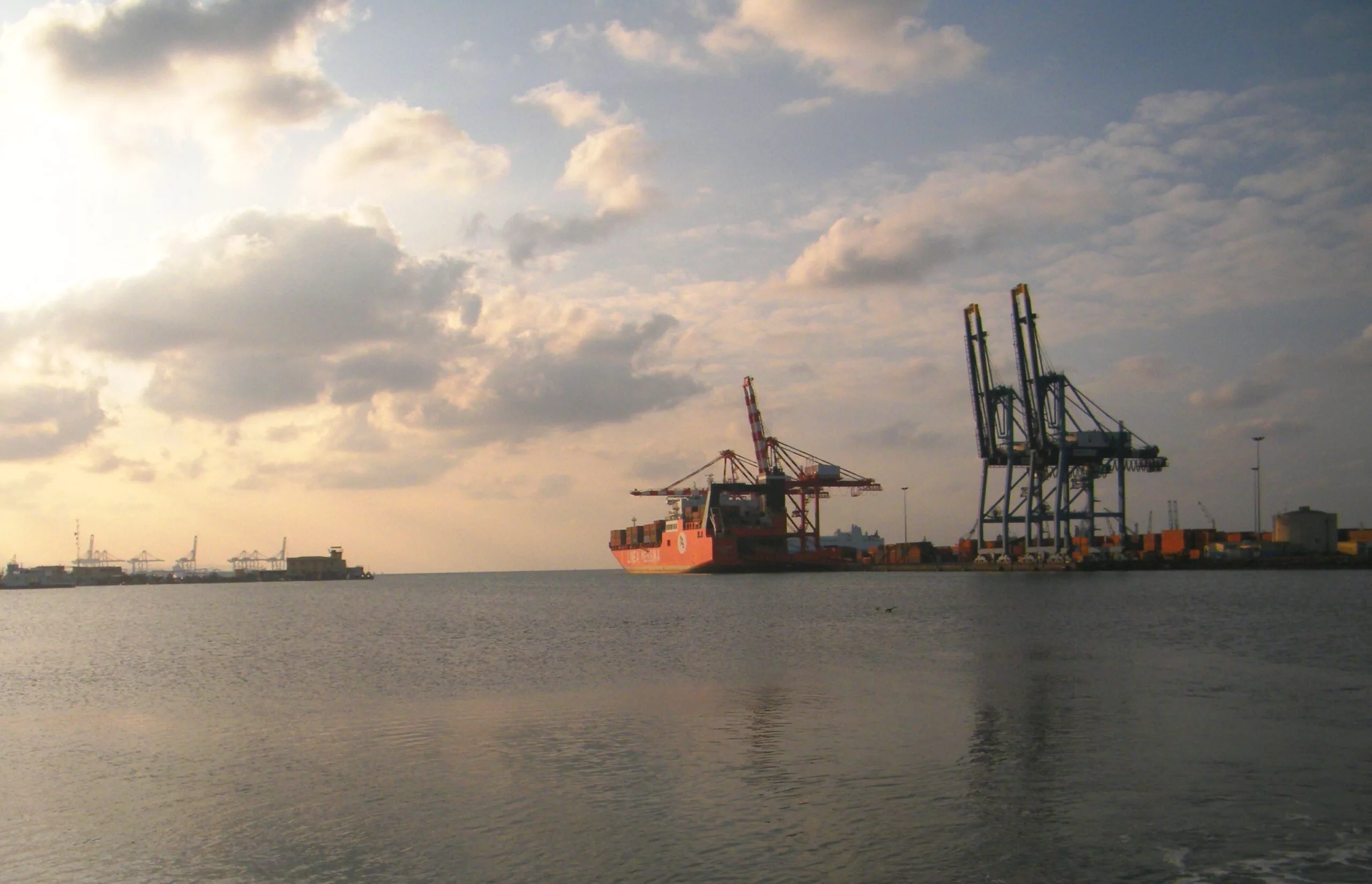
Services account for nearly 78% of GDP and about 93% of employment. More than 90% of goods exports are re-exports in transit to Ethiopia. The country functions as infrastructure: a port, a railway, submarine cables and foreign military bases at the mouth of the Red Sea.
Growth has been strong, averaging 5.3% a year from 2016 to 2024, and 6.5% in 2024. The IMF projected about 6.0% for 2025 and about 5.5% over the medium term. Inflation is very low, at 2.1% in 2024.
The labour market is the report’s other structural worry. Participation among those aged 15 to 64 is 33.6%, against 49.7% across the wider Middle East and North Africa region. Just over half of employed workers have no formal education.
The financial system is shallow. Banks hold about 97.5% of financial system assets and there is no active capital market.
One number looks anomalous and deserves a caveat. Djibouti runs a current account surplus of 14.1% of GDP for 2024, which is unusual for a debt-distressed economy. The IMF simultaneously reports balance of payments errors and omissions of up to 31% of GDP over 2013 to 2024. These are driven by timing mismatches between imports and Ethiopian re-exports.
Debt Distress, and Who Holds the Paper
The IMF’s language here is precise and worth quoting carefully. Djibouti is in debt distress, and its debt is assessed as unsustainable. That is a more severe category than the high risk of debt distress that applies to many of its neighbours.
Total public and publicly guaranteed debt was 68.9% of GDP in 2024, or about US$2.96 billion. Debt-carrying capacity is classified as weak.
Exim Bank of China holds about US$1.47 billion of that. This is 49.8% of external debt and 34.3% of GDP. Multilateral creditors hold about 36.2%, and the Paris Club only 1.8%.
A Chinese moratorium limits interest payments on railway and water projects to roughly US$20 million across 2024 to 2027, against US$276 million previously. The IMF notes that the repayment terms after the moratorium expires have not been disclosed. Those terms will be central to any future assessment.
External arrears stood at 2.7% of GDP across eleven creditors as of March 2025. Gross official reserves were about US$338 million at the end of 2024, covering 2.4 months of imports.
There is no published restructuring agreement or timetable. Negotiations with Exim Bank of India and contact with the Paris Club have been reported as ongoing.
What This Means If You Invest Here
On currency, Djibouti is among the most straightforward places in Africa, and this is not a small advantage.
The Djiboutian franc operates under a currency board pegged at 177.721 to the dollar, unchanged since 1973. Djibouti has accepted the obligations of Article VIII of the IMF’s articles. It maintains an exchange system free of restrictions on payments and transfers for current international transactions.
There is no parallel market problem and no exchange control regime to navigate. The currency board requires full foreign exchange backing of the monetary base, and the central bank cannot finance the public deficit.
The serious counter-signal is the record on honouring agreements with foreign investors. In February 2018 Djibouti unilaterally terminated a 50-year container terminal concession granted in 2006 to a Gulf port operator, and expelled its staff.
Multiple arbitration tribunals have since ruled that seizure unlawful and the concession still valid. The operator states it holds roughly US$685 million in enforceable but unpaid awards against the government. It continues to pursue about US$1 billion in further claims.
Enforcement litigation has run through the English High Court, Washington and Hong Kong. A judgment of 24 July 2026 records the ownership chain, including that the state indirectly owns 76.5% of the port holding company. A separate construction claimant holds awards exceeding US$100 million, also unpaid.
Set that against an economy of US$4.3 billion already assessed as in debt distress. For an investor, the relevant fact is not the dispute’s merits but the pattern: a binding international award has not been treated as binding.
Two regulators to know are the multisectoral regulatory authority and the national standards agency. Both were recently created and, in the World Bank’s assessment, are not yet at full operational capacity. A credit register and a guarantee fund exist but the report says both need acceleration.
Why This Report Is Different From the Last One
The World Bank Group published a Djibouti private sector diagnostic in 2023 as well. The change between the two is the useful signal.
The earlier framing treated Djibouti’s location as the asset to be developed further. The 2026 report treats it as an asset whose returns have largely been collected. It argues the next stage has to be productive capacity built behind the port, rather than more capacity at it.
That is a harder proposition. Transit trade earns fees without requiring a skilled workforce, cheap power or a deep financial system. Solar installation, data centre operation and tourism all require at least one of the three.
It is also why the sequencing question matters. Energy reform is named the most urgent priority precisely because it is upstream of the other two sectors. A data centre in a 25-cent power market competes badly against one in Nairobi or Johannesburg.
The World Bank Group’s own portfolio in Djibouti runs to close to US$500 million in commitments, so the institution is not a disinterested observer. That does not make the diagnosis wrong, but it is worth knowing when reading the optimism.
The report was completed in early April 2026 and published in September. Its macroeconomic backbone is the 2025 Article IV consultation, concluded in September 2025. So the debt and reserve figures in it are roughly a year old.
What Is Not Known
How the unsustainable debt gets resolved. There is no published restructuring agreement, no timetable, and no disclosure of the repayment terms that apply once the Chinese moratorium expires.
Whether the reforms the US$600 million depends on have any adoption timetable. The digital code’s implementing decrees are pending, the two new regulators lack capacity, and the national land policy is still being drafted. No source gives a date for any of them.
Djibouti’s unemployment rate. The World Bank describes unemployment as high but publishes no figure, and we could not obtain one from a named institution.
Whether the current account surplus is real. The IMF reports a 14.1% of GDP surplus while documenting errors and omissions of up to 31% of GDP. It attributes the tension to data quality.
How the outstanding arbitration awards are treated in Djibouti’s public accounts, and what the unresolved dispute costs the sovereign in market access. Neither is disclosed anywhere we could find.
Connected Coverage
- Taxes in Ghana for Expats 2026: Residency Can Raise Your Rate
- Kenya Residency Visa Requirements 2026: Class K Starts at 35
- Open a Bank Account in Kenya as a Foreigner, Step by Step
Sources
- World Bank — report identifies significant private investment potential for Djibouti, 14 September 2026
- IFC — Djibouti Country Private Sector Diagnostic, September 2026
- IMF — Executive Board concludes the 2025 Article IV consultation with Djibouti
- IMF — Djibouti 2025 Article IV staff report and debt sustainability analysis
Frequently Asked Questions
What is the US$600 million figure for Djibouti?
It is the World Bank Group’s estimate of private investment potential over five years across three sectors: off-grid solar energy, data centres and tourism. It is a potential conditional on reform, not committed money.
Is logistics part of the World Bank’s US$600 million?
No. The three sectors are off-grid solar, data centres and tourism. The report’s argument is that Djibouti has largely exhausted the returns from monetising its location and needs to build productive capacity instead.
Can you repatriate profits from Djibouti?
Yes. The Djiboutian franc runs under a currency board pegged at 177.721 to the dollar since 1973. Djibouti maintains an exchange system free of restrictions on current international payments and transfers under IMF Article VIII.
How much does Djibouti owe China?
Exim Bank of China held about US$1.47 billion at end-2024, equal to 49.8% of external debt and 34.3% of GDP. Total external public and publicly guaranteed debt was 68.9% of GDP, and the IMF assesses Djibouti as in debt distress with unsustainable debt.
Why is electricity a problem for investors in Djibouti?
Commercial power costs about 25 US cents per kilowatt hour against an African average of about 14 cents. The World Bank calls it the largest single cost factor for businesses and names energy reform the most urgent priority.
This article was produced by The Rio Times’ automated newsroom system. How we use AI · Report an error
LatAm Markets: Live Signals → — real-time movers, turnover leaders and FX across Latin America.
Read More from The Rio Times