Bitcoin Slips as Iran Snub Lifts Oil; LatAm Sticks to Stablecoins
Key Facts
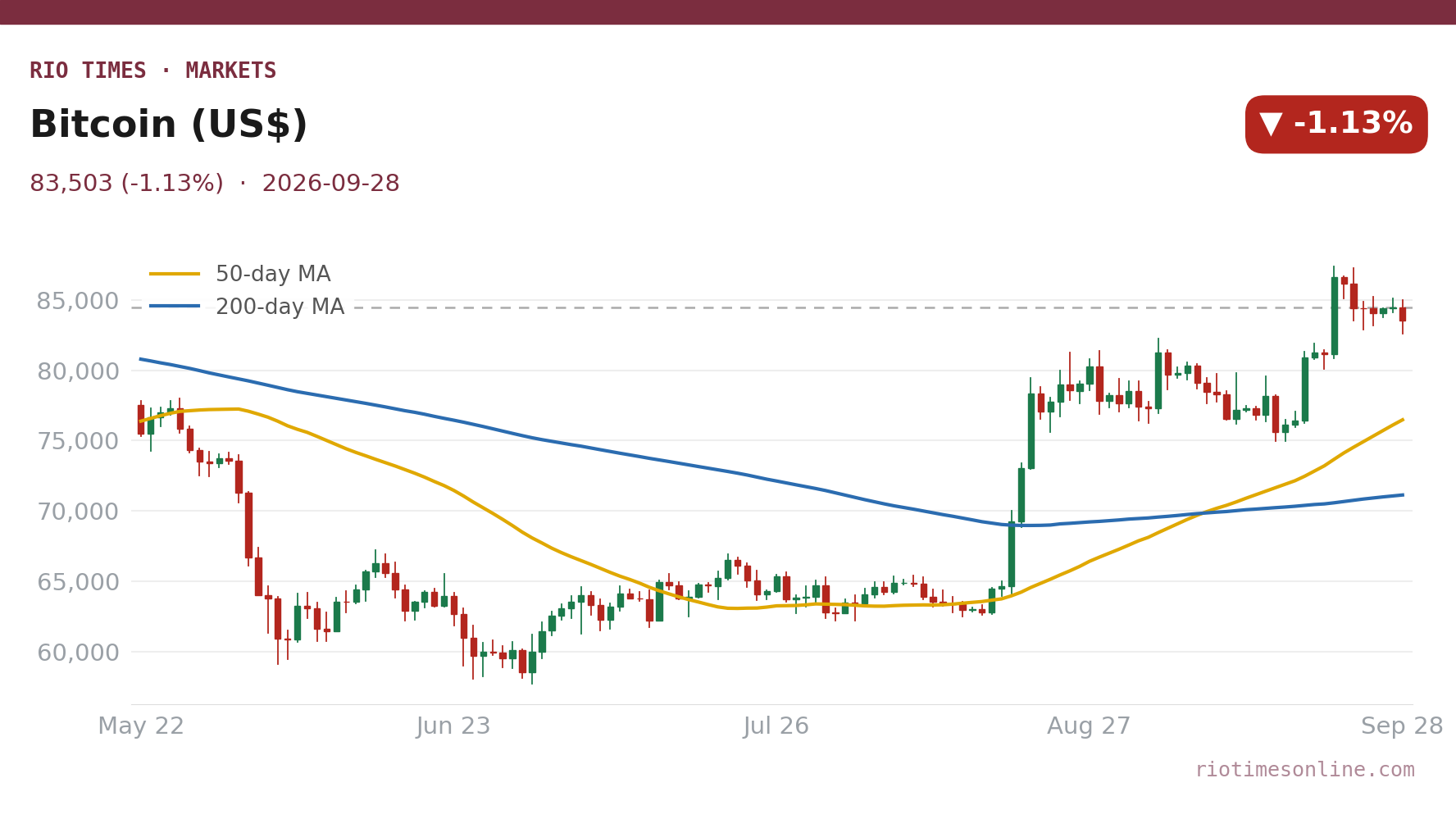
- Bitcoin settled at US$83,503 on Monday, September 28, down 1.13 percent. The decline extended last week’s pullback after President Donald Trump rejected Iran’s seven-day ceasefire proposal at the weekend, pushing Brent crude above US$105 and lifting bond yields.
- Ethereum was the outlier, closing at US$2,689 with a 0.06 percent gain. The marginal rise came after co-founder Vitalik Buterin published a long-term plan to turn the network into a ‘cryptographic world computer’ using recursive STARKs.
- Solana fell hardest among the majors, down 2.64 percent to US$118.84. XRP also retreated, settling at US$1.4963 for a 1.45 percent loss, with the CLARITY Act still stalled after a failed 49–50 Senate procedural vote on 15 September.
- Corporate treasury buying continued despite the spot decline. Strategy bought 1,665 Bitcoin for US$142.7 million, lifting its holdings to 847,666 BTC, while Strive purchased 1,107 BTC for US$94.5 million.
- Stablecoins dominate Latin American crypto flows. In Brazil, dollar-linked tokens were about 98 percent of US$6.9 billion in first-quarter 2026 crypto volume, according to reports citing central bank data.
- El Salvador’s crypto remittances reached US$41.11 million from January through July 2026. That is a 35.7 percent year-on-year rise, yet it remains just 0.69 percent of total remittances, according to central bank data.
Today’s Focus
Bitcoin lost 1.13 percent on Monday, September 28, settling at US$83,503 as geopolitical risk and higher oil prices weighed on non-yielding assets. Ethereum held near flat at US$2,689, while Solana and XRP fell more sharply.
The trigger was President Donald Trump’s weekend rejection of Iran’s ceasefire proposal. Brent crude closed at US$105.28 a barrel, and the U.S. 10-year Treasury yield rose to 5.24 percent ahead of Wednesday’s PCE inflation data. The dollar index firmed 0.22 percent.
In Latin America, the session barely shifted behaviour. Stablecoins accounted for about 98 percent of Brazil’s US$6.9 billion first-quarter crypto volume, and in Argentina USDT and USDC made up more than 70 percent of purchases on the Bitso exchange in 2025.
Corporate buyers stayed active: Strategy and Strive together added more than 2,700 Bitcoin worth over US$237 million.
What matters today. Bitcoin’s dip was a macro story, while Latin America’s crypto trade remains anchored in dollar-linked stablecoins for payments and savings.
01 The session in one read
Bitcoin settled at US$83,503 on Monday, September 28, down 1.13 percent after President Donald Trump rejected Iran’s proposed ceasefire. The refusal kept Brent crude above US$100 a barrel and lifted U.S. bond yields, drawing capital away from assets that pay no income.
Ethereum was the exception, finishing at US$2,689 for a 0.06 percent gain. On Sunday the network’s co-founder, Vitalik Buterin, said the Hegota upgrade planned for 2027 is likely to be Ethereum’s last ‘normal’ fork before a shift to a ‘cryptographic world computer’ built on recursive STARKs.
Solana led the losses among major tokens, falling 2.64 percent to US$118.84. XRP closed at US$1.4963, down 1.45 percent, with the CLARITY Act still stalled in the U.S. Senate, keeping regulatory overhang in place.
Bitcoin is still trading as a risk asset rather than a safe haven. A geopolitical shock that lifted oil and bond yields pushed the cryptocurrency lower, even as corporate treasuries bought the dip. For Latin American users, the signal is unchanged: stablecoins are the working tool, and Bitcoin remains a secondary store of value. The variable to watch is Wednesday’s U.S. PCE inflation report, which could harden or soften expectations for another Federal Reserve rate hike in October.
02 The board
Bitcoin’s 1.13 percent decline to US$83,503 made it a macro-driven session rather than a crypto-specific sell-off. Ethereum’s 0.06 percent rise to US$2,689 left it the only major token in positive territory.
Solana’s 2.64 percent drop to US$118.84 and XRP’s 1.45 percent fall to US$1.4963 pointed to thinning speculative interest. Traders sold the more volatile beta plays while corporate treasuries, including Strategy and Strive, bought Bitcoin on the dip with combined purchases above US$237 million.
| Asset | Level | Change |
|---|---|---|
| Bitcoin | US$83,503 | -1.13% |
| Ethereum | US$2,689 | +0.06% |
| Solana | US$118.84 | -2.64% |
| XRP | US$1.4963 | -1.45% |
Source: RT close, 2026-09-28. Where a commodity has no spot feed, an exchange-traded tracker or leading producer is shown as a labelled proxy.
Live Market IntelligenceThe live market board
Rio Times · Live Market Intelligence
Latin America — Cross-Market Board
| Instrument | Last | Change | YoY | Prev. | High | Low | Volume |
|---|---|---|---|---|---|---|---|
| IBOV | 182,991.13 | -0.26% | +21.85% | 183,476.86 | 168,310 | 167,142 | — |
| IPSA | 11,137.59 | -1.06% | — | 11,256.80 | 11,210 | 10,984 | 1,513,213,483 |
| IPC MEX | 64,737.82 | -0.39% | +12.17% | 64,992.23 | 66,121 | 65,405 | 108,886,187 |
| MERVAL | 2,798,925 | -3.28% | +30.51% | 3,022,485 | 3,042,365 | 2,991,150 | — |
| COLCAP | 2,579.33 | -0.21% | — | 9.04 | 9.05 | 9.02 | 4,133 |
| BVL PERÚ | 60,698.35 | -0.79% | — | — | — | — | — |
| USD/BRL | 5.16 | +0.01% | -5.13% | 5.16 | 5.18 | 5.14 | — |
| EUR/BRL | 5.95 | +1.01% | -5.83% | 5.89 | 5.98 | 5.94 | — |
| USD/MXN | 17.06 | -0.24% | -8.58% | 17.10 | 17.08 | 17.01 | — |
| USD/CLP | 913.98 | +0.04% | -5.67% | 913.65 | 915.11 | 906.68 | — |
| USD/COP | 3,140 | +0.03% | -22.04% | 3,139 | 3,141 | 3,105 | — |
| USD/PEN | 3.36 | -0.66% | -4.82% | 3.38 | 3.38 | 3.35 | — |
| USD/ARS | 1,493 | +0.10% | +12.96% | 1,491 | 1,494 | 1,480 | — |
| USD/UYU | 40.27 | +1.24% | +1.80% | 39.77 | 40.27 | 40.23 | — |
| USD/PYG | 5,939 | +1.68% | -19.54% | 5,841 | 5,939 | 5,925 | — |
| USD/BOB | 11.64 | -0.76% | +72.04% | 11.73 | 11.72 | 11.64 | — |
| USD/DOP | 58.34 | +1.25% | -3.44% | 57.62 | 58.34 | 58.04 | — |
| USD/CRC | 445.92 | +0.89% | -9.71% | 441.97 | 448.50 | 445.92 | — |
03 What moved it
The immediate driver was geopolitical. President Trump rejected Iran’s seven-day ceasefire plan on Saturday. Brent crude closed at US$105.28 on Monday, and U.S. yields rose ahead of Wednesday’s PCE inflation report.
The dollar index rose 0.22 percent, which reduces the appeal of Bitcoin for holders measuring wealth in other currencies. The CLARITY Act, which failed a 49–50 Senate procedural vote on 15 September, remains stalled, a regulatory chill that weighs most on XRP.
Corporate buying provided a floor. Strategy sold 1.47 million MSTR shares for US$246.2 million in net proceeds and used US$142.7 million of it to buy 1,665 Bitcoin, lifting its stack to 847,666 BTC. Strive added 1,107 BTC for US$94.5 million, reaching 27,462 BTC.
04 The Latin American read
For Latin America, the Bitcoin price move is secondary. In Brazil, stablecoins accounted for about 98 percent of US$6.9 billion in reported first-quarter 2026 crypto volume, according to reports citing central bank data. That money is paying invoices and protecting savings, not speculating on Bitcoin.
In Argentina, USDT and USDC made up more than 70 percent of crypto purchases on the Bitso exchange in 2025. High inflation has made digital dollars the default hedge, a habit that no single Bitcoin session changes.
El Salvador’s official Bitcoin project still lags. Crypto-wallet remittances reached US$41.11 million from January through July 2026, up 35.7 percent year on year but only 0.69 percent of total remittances, according to central bank data.
05 The names to watch
Strategy, led by Michael Saylor, remains the largest corporate holder of Bitcoin after the US$142.7 million purchase it disclosed on Monday. Its stock sales to fund Bitcoin purchases show how equity markets can be used as a crypto funding engine.
Strive, the asset manager founded by Vivek Ramaswamy, has now assembled 27,462 BTC, with sales of its SATA preferred stock supplying about 85 percent of the capital it raised last week. These corporate treasuries are becoming a structural bid under the market.
On the institutional rails, Citi and Coinbase announced an expanded partnership on Monday so Citi’s institutional clients can accept stablecoin payments that settle in fiat. Bybit also began accepting Franklin Templeton tokenised money market fund shares as off-exchange collateral for stablecoin credit lines, deepening the link between conventional finance and crypto.
06 The outlook
Wednesday’s U.S. PCE inflation report is the next test. A hot reading would strengthen the case for another Federal Reserve rate hike in October, likely pushing Bitcoin lower and keeping pressure on Solana and XRP.
The corporate bid from Strategy and Strive suggests that long-term holders are treating pullbacks as accumulation windows. What is absent is fresh retail enthusiasm, which is precisely what the stalled CLARITY Act and higher yields suppress.
For Latin American readers, the more practical signal is institutional plumbing. Citi and Coinbase integrating stablecoin payments, plus Brazil’s 98 percent stablecoin share of crypto volume, shows that dollar-linked tokens are the infrastructure story that matters.
07 What to watch
- U.S. PCE inflation: Wednesday’s data will shape expectations for another Fed rate hike, which would pressure Bitcoin and other non-yielding assets.
- CLARITY Act: Further Senate progress or collapse will directly affect XRP and broader U.S. regulatory sentiment.
- Corporate treasuries: Strategy and Strive buying on dips shows whether institutional demand can absorb geopolitical sell-offs.
- El Salvador remittance data: Monthly figures will show whether crypto-wallet remittances keep growing from their 0.69 percent share of the total.
Frequently Asked Questions
Why did Bitcoin fall on Monday, September 28, 2026?
President Trump rejected Iran’s ceasefire plan, keeping Brent crude above US$100 and lifting U.S. bond yields, which drew capital away from Bitcoin.
Why did Ethereum rise while other majors fell?
Ethereum edged up 0.06 percent after Vitalik Buterin published a long-term plan to turn the network into a ‘cryptographic world computer’ using recursive STARKs.
Are stablecoins bigger than Bitcoin in Latin America?
Yes. In Brazil, stablecoins represented about 98 percent of US$6.9 billion in first-quarter 2026 crypto volume, and in Argentina USDT and USDC made up more than 70 percent of purchases on the Bitso exchange in 2025.
What is El Salvador’s crypto remittance figure?
Crypto-wallet remittances reached US$41.11 million from January through July 2026, up 35.7 percent year on year but still only 0.69 percent of total remittances.
Source: RT live market data, close of Monday 28 September 2026
This article was produced by The Rio Times’ automated newsroom system. How we use AI · Report an error
LatAm Markets: Live Signals → — real-time movers, turnover leaders and FX across Latin America.
Read More from The Rio Times