Chile Markets: IPSA & the Peso — September 29, 2026
Key Facts
- The S&P IPSA, Chile’s benchmark stock index, fell 1.06% to 11,138 on Monday, surrendering recent gains as sellers took control of the Santiago exchange.
- The Chilean peso weakened to 968.37 per US dollar, up 0.71% on the day, meaning it now costs more pesos to buy a single dollar.
- The session tracked a broader global pullback with the S&P 500 down 0.77% and the Nasdaq off 0.92%, leaving Chilean assets exposed to the same cautious mood.
- Copper, Chile’s main export, fell about 1.3% to US$6.60 a pound in London trading during the session, according to La Tercera, adding pressure on the peso.
- Retailers and Copec led the decline, with Copec down 2.6%, Falabella 2.2% and Cencosud 2.1%, while the peso closed at its weakest level in more than a year.
Today’s Focus
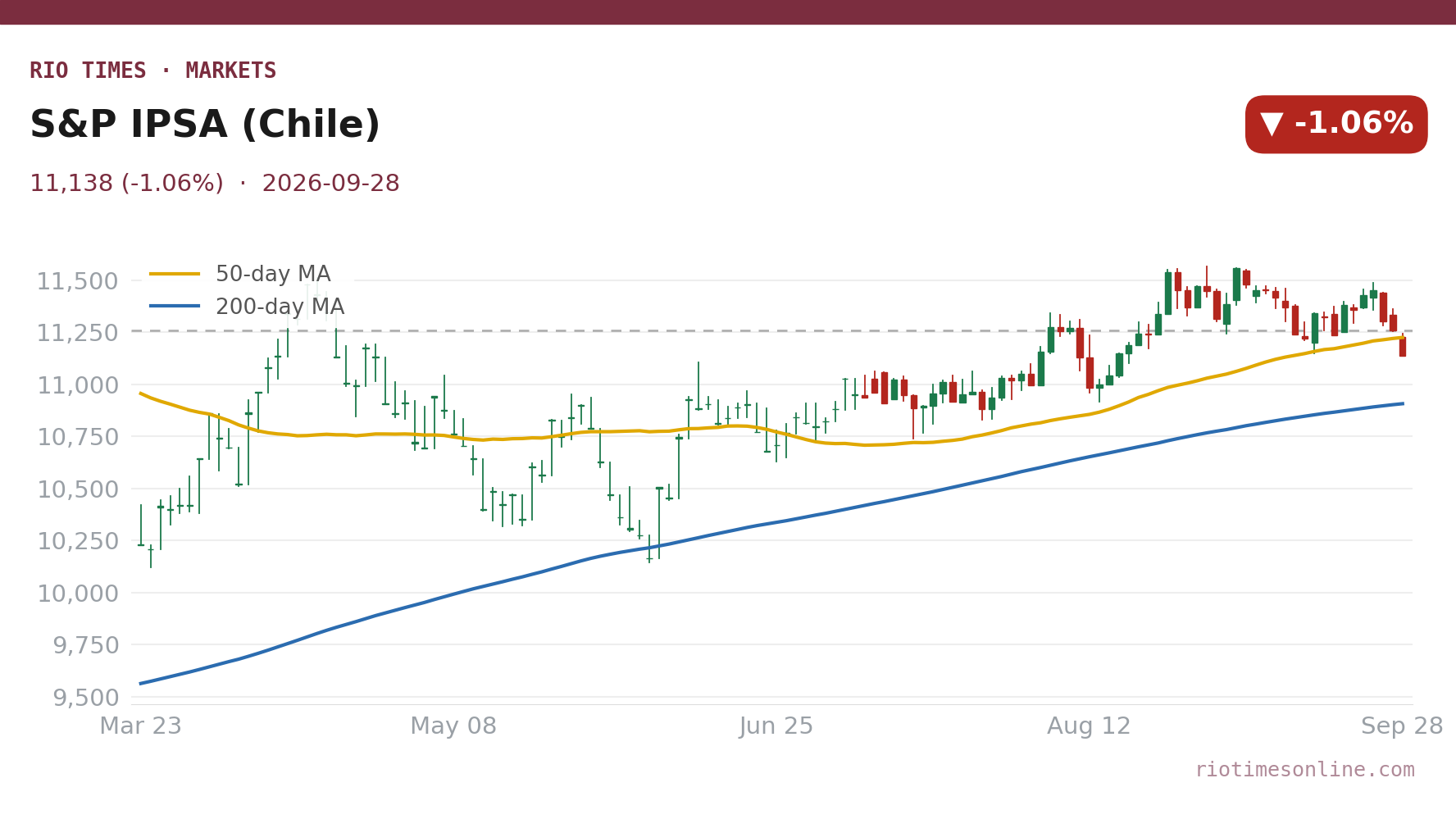
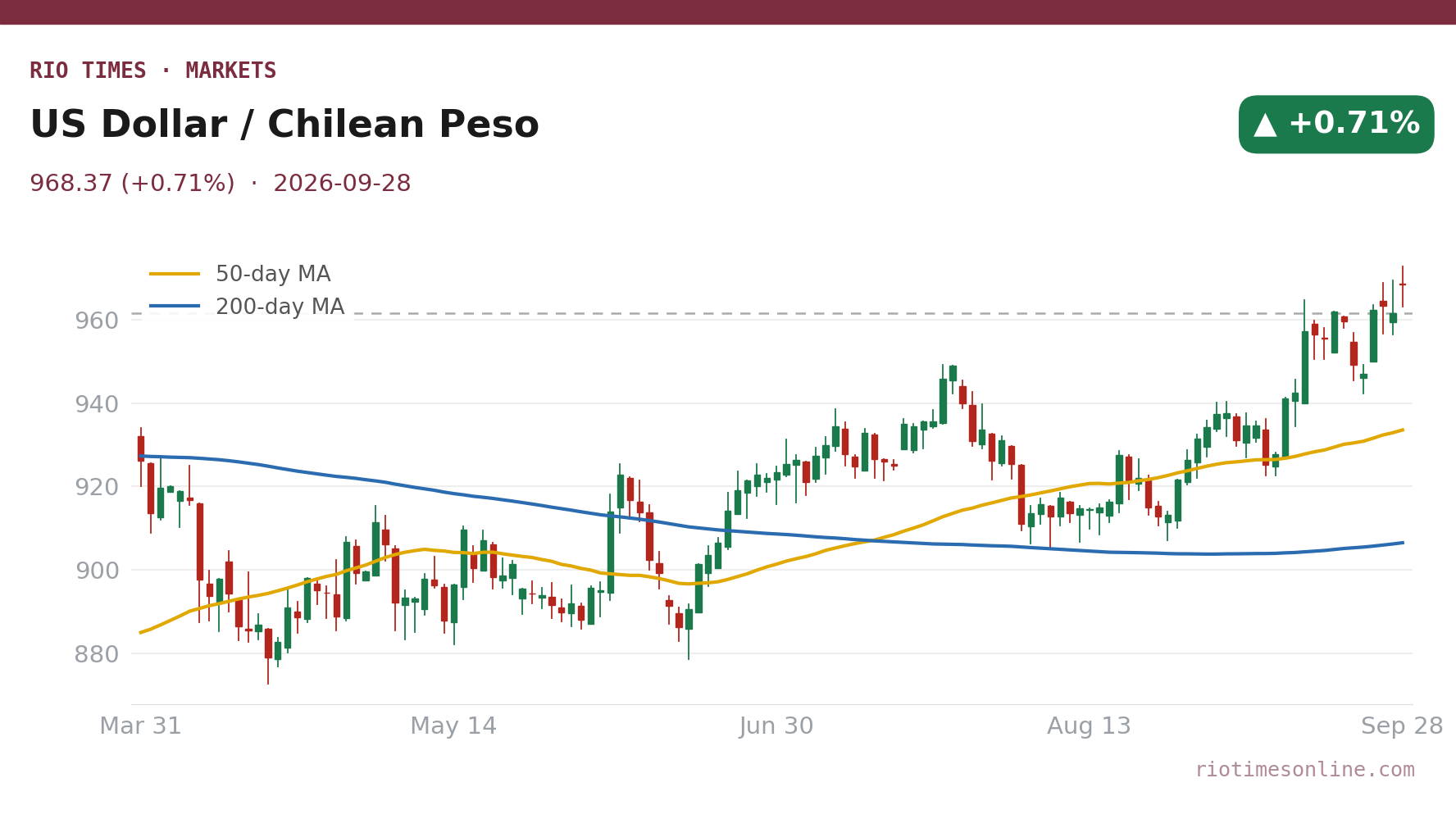
Chilean shares fell on Monday as the S&P IPSA, the index that tracks the largest companies listed in Santiago, lost 1.06% to close at 11,138. The peso also slipped, weakening 0.71% to 968.37 per US dollar.
The decline was not a Chile-specific scare. US stocks fell too, with the S&P 500 down 0.77%, and the VIX volatility gauge, often called Wall Street’s fear index, jumped 8.07%.
For foreign investors, the message was familiar: when global markets turn cautious, Chile’s open, export-heavy bourse tends to follow. The peso’s slide to its weakest close in more than a year reinforces that external sensitivity.
What matters today. Chile’s market fell with global stocks, and the peso is now testing the weak end of its yearly range.
01 The session in one read
Santiago’s market started the week on the back foot. The S&P IPSA — the index that tracks around 30 of the largest and most-traded companies on the Chilean stock exchange — closed at 11,138, a decline of 1.06%.
The peso, Chile’s currency, weakened to 968.37 per US dollar. That means it costs more pesos to buy one dollar, which is often a sign that investors are moving money into US assets or reducing exposure to Chile.
The session was not a dramatic sell-off, but it was broad. Copec, Falabella and Cencosud each lost more than 2%. The local index followed the mood set overseas, where US shares also fell as the VIX volatility gauge rose more than 8%.
For newcomers: a falling index and a weaker peso together usually mean foreign money is leaving or staying on the sidelines, waiting for a better moment.
The data show a clear if modest risk-off session. The IPSA fell more than 1%, the peso closed at its weakest level in more than a year, and US benchmarks declined. The selling was broad, with retailers and energy group Copec leading the losses.
The key variable is whether the peso holds around 968 per US dollar or weakens further, as a break higher could signal deeper foreign outflows.
02 The day’s numbers
| Measure | Level | Change | Read |
|---|---|---|---|
| S&P IPSA | 11,138 | −1.06% | Chile main share index |
| USD/CLP | 968.37 | +0.71% | Pesos per US dollar |
| USD/BRL | 5.2255 | +0.86% | Brazil’s real, per US dollar |
| USD/MXN | 17.9927 | +1.74% | Mexico’s peso, per US dollar |
| S&P 500 | 7,684 | −0.77% | US benchmark |
| VIX | 16.07 | +8.07% | Wall Street fear gauge |
The IPSA’s 1.06% drop put the index at 11,138, a level around 4.2% below its 52-week high of 11,628. The index’s 52-week range runs from 8,676 to 11,628, so the market is still trading in the upper half of that band.
The peso’s move to 968.37 per US dollar matters because it is the highest USD/CLP close of the past 52 weeks — the weakest level for the peso in more than a year. In currency terms, a higher USD/CLP number means a weaker peso.
Live Market IntelligenceChile — Live Market Board
Rio Times · Live Market Intelligence
Chile — Live Market Board
| Instrument | Last | Change | YoY | Prev. | High | Low | Volume |
|---|---|---|---|---|---|---|---|
| IPSA | 11,137.59 | -1.06% | — | 11,256.80 | 11,210 | 10,984 | 1,513,213,483 |
| USD/CLP | 913.98 | +0.04% | -5.67% | 913.65 | 915.11 | 906.68 | — |
| COPPER | 6.61 | +0.03% | +46.70% | 6.61 | 6.71 | 6.61 | 39,543 |
| SQM-B | 65,305 | -0.84% | +49.03% | 65,860 | 66,949 | 64,978 | 76,539 |
| COPEC | 5,964 | -1.09% | -11.70% | 6,030 | 6,100 | 5,960 | 634,331 |
| BSANTANDER | 78.37 | -2.28% | +35.94% | 80.20 | 81.69 | 78.34 | 36,288,711 |
| FALABELLA | 6,334 | -1.48% | +23.28% | 6,429 | 6,450 | 6,300 | 26,085,814 |
| ENELAM | 87.09 | +0.10% | -10.13% | 87.00 | 87.40 | 86.50 | 13,106,417 |
| CENCOSUD | 1,946 | -2.19% | -35.30% | 1,990 | 2,010 | 1,945 | 966,528 |
| CMPC | 1,020 | -1.96% | -29.10% | 1,040 | 1,050 | 1,015 | 3,526,677 |
| BANCO CHILE | 184.96 | -1.01% | +32.87% | 186.85 | 189.99 | 184.33 | 18,101,240 |
| LATAM AIR | 24.08 | -1.11% | +16.61% | 24.35 | 24.59 | 23.88 | 573,612,753 |
| SOUTHERN COPPER | 193.97 | -0.26% | +104.01% | 194.48 | 199.36 | 192.59 | 367,102 |
03 Why it moved — global risk-off reaches Santiago
The simplest explanation is global. The S&P 500 fell 0.77% and the Nasdaq lost 0.92%, while the VIX, a gauge of expected US stock volatility, jumped 8.07% to 16.07.
When investors in New York get cautious, those in Latin America often follow, especially in a market like Chile where mining and export companies depend heavily on global demand and foreign capital.
Rising US Treasury yields and a firmer dollar index, up 0.22% to 101.197, added pressure on emerging-market currencies. The peso’s 0.71% decline was in line with Brazil’s real, which weakened 0.86%, and Mexico’s peso, down 1.74%.
On the local macro side, economists cited by La Tercera expect September inflation in Chile to reach up to 0.6% monthly, partly due to higher fuel prices linked to the US-Iran conflict and rain damage to vegetable crops. That is a domestic detail, but it adds to the general caution.
Copper, Chile’s main export, was also on the back foot. Spot copper on the London Metal Exchange was down 1.33% at US$6.597 a pound during the session, La Tercera reported, after reaching US$6.71 the week before.
04 The day’s movers
| Stock | Turnover | Change | Note |
|---|---|---|---|
| Copec (COPEC) | US$4.8m | −2.6% | Fuel and forestry group led the decline |
| Falabella (FALABELLA) | US$10.5m | −2.2% | Retailer extended its recent slide |
| Cencosud (CENCOSUD) | US$4.0m | −2.1% | Supermarket group under pressure |
| CMPC (CMPC) | US$2.6m | −1.1% | Pulp and paper maker slipped |
| Santander Chile (BSANTANDER) | US$5.1m | −1.0% | Banks followed the market lower |
| SQM (SQM-B) | US$13.1m | −1.0% | Lithium producer eased again |
| Banco de Chile (CHILE) | US$11.6m | −0.8% | Lender fell less than the index |
| LATAM Airlines (LTM) | US$18.9m | −0.4% | Most-traded name, small loss |
The selling hit every major name in the table. Copec fell 2.6%, the heaviest loss among the large caps, while retailers Falabella and Cencosud dropped 2.2% and 2.1%.
Lithium producer SQM lost 1.0% on about US$13 million of turnover. LATAM Airlines was the most-traded stock, with about US$19 million changing hands, and slipped only 0.4%. Banks fell less than the index, with Banco de Chile down 0.8% and Santander Chile 1.0%.
05 The regional scoreboard
| Index | Country | Change |
|---|---|---|
| Ibovespa | Brazil | −0.26% |
| S&P/BMV IPC | Mexico | −0.07% |
| S&P MERVAL | Argentina | −3.28% |
| MSCI COLCAP | Colombia | −0.33% |
| S&P IPSA | Chile | −1.06% |
Chile’s 1.06% drop was the second-largest among the main Latin American indices shown here, behind only Argentina’s MERVAL, which fell 3.28%.
Brazil’s Ibovespa slipped 0.26% and Mexico’s IPC edged down 0.07%. Colombia’s COLCAP fell 0.33%. The live market board above carries the full closing figures.
06 The technical picture
The IPSA closed at 11,138, which is 4.2% below its 52-week high of 11,628 but comfortably above the low of 8,676. The index remains in the upper half of its yearly range, even after Monday’s decline.
The peso’s close at 968.37 per US dollar is the highest USD/CLP close of the past 52 weeks — the weakest point for the Chilean currency in more than a year. That makes the 968 area a line about which traders are likely to be sensitive.
Should the IPSA hold above 11,000, the pullback could look like a pause rather than a reversal. A decisive break below that level, combined with the peso staying weak, would suggest more cautious positioning.
07 What to watch
- Copper prices: Chile’s main export and the IPSA’s macro anchor; any move in copper directly affects mining revenue expectations
- USD/CLP at 968: The peso is at its weakest in more than a year; a break above could signal deeper outflows and more local inflation pressure
- US Treasury yields: Rising US yields draw capital away from emerging markets, so the 5.244% on the 10-year is a real headwind
- September CPI: Chilean inflation expectations are rising, which could shape the central bank’s next policy moves
Background: Chile’s Market Shuts for Fiestas Patrias as the Peso Ends the Week Weaker.
Frequently Asked Questions
What is the S&P IPSA?
It is the main stock index of Chile, tracking the most-traded large companies on the Santiago exchange, including banks, miners and retailers.
Why did the IPSA fall on Monday?
The index slipped 1.06% as global markets turned cautious — the S&P 500 fell 0.77% and investors moved money away from riskier assets like emerging-market shares.
What does a weaker peso mean for Chile?
When USD/CLP rises, it takes more pesos to buy one dollar. This can fuel inflation through imported goods, but it can also help Chile’s exporters by making their products cheaper abroad.
Why does copper matter for Chilean stocks?
Copper is Chile’s most important export. Its price affects mining company earnings, tax revenue and the peso, so it ripples across the whole market.
IPSA — Source: RT live market data, close of Monday 28 September 2026; exchange figures from Bolsa de Santiago
This article was produced by The Rio Times’ automated newsroom system. How we use AI · Report an error
LatAm Markets: Live Signals → — real-time movers, turnover leaders and FX across Latin America.
Read More from The Rio Times