Chile Markets: IPSA & the Peso — September 10, 2026
Key Facts
- S&P IPSA closed at 11,370 points, down 0.39% on the Santiago exchange’s benchmark index for the most-traded local shares.
- The peso slipped 0.26% to 927.66 per US dollar, moving back toward the weaker end of its recent trading band.
- Trading focused on SQM-B, the lithium giant, which edged down 0.1% on turnover of $24 million, the session’s heaviest.
- BCI was the standout gainer, rising 4.2% on $8 million in turnover as bank stocks diverged sharply.
- The index remains about 2.2% below its 52-week high of 11,628, leaving it in a cautious consolidation range.
Today’s Focus
Chilean equities slipped on Wednesday as investors kept an eye on the global backdrop and local economic downgrades from the central bank. The S&P IPSA, the index tracking the most-traded shares in Santiago, closed 0.39% lower at 11,370 points.
The Chilean peso also weakened, with the dollar fetching 927.66 pesos, a rise of 0.26% on the session. That left the currency about 3.9% stronger than its 52-week low, but still shy of its best levels.
Copper prices did not offer much help, with the broad session showing modest risk-off moves across US equities. For Chile, where copper is the macro anchor, that translated into soft performance from the mining and industrial names.
What matters today. A subdued session, with banks and select retail names providing the only real pockets of strength.

01 The session in one read
Trade date: Wednesday 9 September 2026.
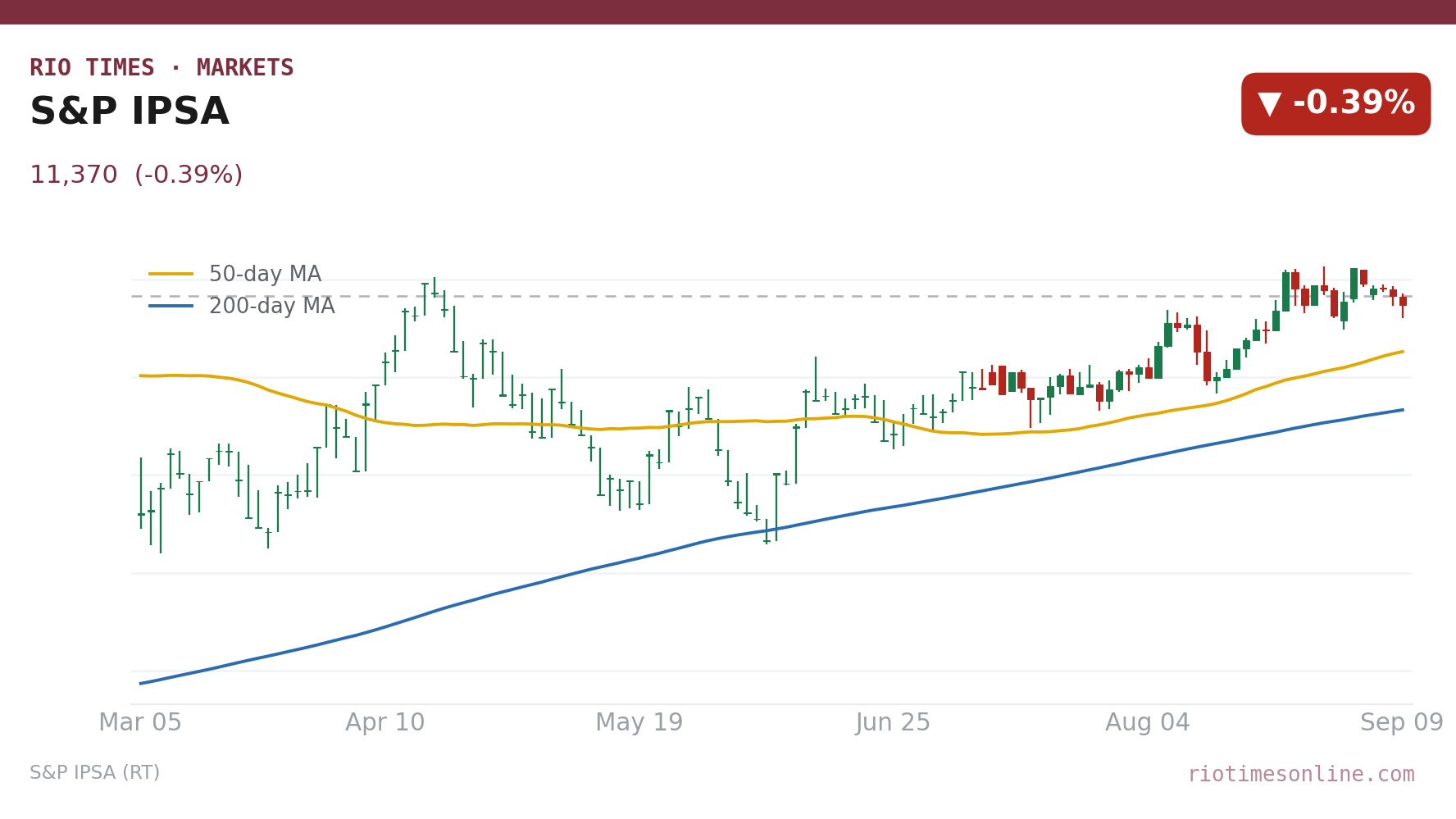
Santiago’s main stock index fell for the session, but the move was orderly rather than dramatic. The S&P IPSA — the benchmark that tracks Chile’s most-traded shares — closed at 11,370 points, down 0.39%.
That left the index about 2.2% below its 52-week high of 11,628, a range investors have watched closely after a strong run. The Chilean peso also softened, with the US dollar buying 927.66 pesos, up 0.26% on the day.
The tone matched a mild pullback in the S&P 500, which dropped 0.48% to 7,636 points. For Chile, that global caution compounded domestic headlines around a more downbeat central bank growth outlook.
The 0.39% drop in the IPSA and the 0.26% peso weakening are consistent with a market digesting a weaker US tape and the central bank’s more downbeat GDP view for 2026. Turnover in leading names such as SQM-B and Falabella was respectable but not forceful. The variable to watch now is whether BCI’s 4.2% surge carries into the broader banking group or fizzles out.
02 The day’s numbers
| Measure | Level | Change | Read |
|---|---|---|---|
| S&P IPSA | 11,370 | −0.39% | Below 52-week high of 11,628 |
| 52-week range | 8,676 – 11,628 | — | Index sits in upper half of range |
| USD/CLP | 927.66 | +0.26% | Peso slightly weaker; dollar stronger |
| USD/CLP 52-week | 851.67 – 965.50 | — | Peso still 3.9% below weakest level |
| S&P 500 | 7,636 | −0.48% | US equities also eased |
The session put the IPSA in the lower-middle of its recent range, but nowhere near the kind of stress that marks a correction. The index remains comfortably above its 52-week low of 8,676.
The peso’s 0.26% move was minor in the context of its 12-month range, which runs from 851.67 to 965.50 pesos per dollar. It was a drift, not a break. Rio Times · Live Market Intelligence
Live Market IntelligenceChile — Live Market Board
Chile — Live Market Board
Instrument Last Change YoY Prev. High Low Volume
IPSA
10,746.36
-0.31%
—
10,780.31
11,210
10,984
1,513,213,483
USD/CLP
913.98
+0.04%
-5.67%
913.65
915.11
906.68
—
COPPER
6.61
+0.03%
+46.70%
6.61
6.71
6.61
39,543
SQM-B
65,305
-0.84%
+49.03%
65,860
66,949
64,978
76,539
COPEC
5,964
-1.09%
-11.70%
6,030
6,100
5,960
634,331
BSANTANDER
78.37
-2.28%
+35.94%
80.20
81.69
78.34
36,288,711
FALABELLA
6,334
-1.48%
+23.28%
6,429
6,450
6,300
26,085,814
ENELAM
87.09
+0.10%
-10.13%
87.00
87.40
86.50
13,106,417
CENCOSUD
1,946
-2.19%
-35.30%
1,990
2,010
1,945
966,528
CMPC
1,020
-1.96%
-29.10%
1,040
1,050
1,015
3,526,677
BANCO CHILE
184.96
-1.01%
+32.87%
186.85
189.99
184.33
18,101,240
LATAM AIR
24.08
-1.11%
+16.61%
24.35
24.59
23.88
573,612,753
SOUTHERN COPPER
193.97
-0.26%
+104.01%
194.48
199.36
192.59
367,102
03 Why it moved — global caution meets local growth doubts
US markets slipped, with the S&P 500 losing 0.48% and the Dow Jones Industrial Average down 0.77%. That muted tone tends to spill over into Santiago, particularly when copper lacks a bullish headline.
Local news added a layer of caution. Chile’s central bank cut its 2026 GDP projection sharply, moving the expected range to between 0.25% and 0.75% from a previous 1.0% to 1.75%.
That kind of revision matters for an index heavy with banks, retailers and industrial groups — sectors whose earnings hinge on domestic growth. It was not enough to trigger heavy selling, but it kept buyers from stepping in aggressively.
04 The day’s movers
| Driver | Level / Move | Change | Note |
|---|---|---|---|
| SQM-B | $24m turnover | −0.1% | Lithium giant, heaviest-traded name |
| Falabella | $15m turnover | −0.5% | Retailer soft in quiet trade |
| Banco de Chile | $12m turnover | −0.3% | Bank slipped despite sector divergence |
| BCI | $8m turnover | +4.2% | Standout gainer among banks |
| Copec | $5m turnover | −1.0% | Industrial and fuel group under pressure |
| Cencosud | — | +1.4% | Retailer bucked the softer trend |
The turnover table shows where the action was — and where it wasn’t. SQM-B, the lithium producer, saw $24 million change hands yet closed just 0.1% lower, a sign of two-way trade.
BCI’s 4.2% jump on $8 million was the session’s clearest positive signal. It contrasted with Banco de Chile’s 0.3% dip, showing investors were picking winners rather than dumping the whole banking sector.
05 The regional scoreboard
| Index | Country | Change |
|---|---|---|
| Ibovespa | Brazil | −0.93% |
| IPC | Mexico | −0.06% |
| Merval | Argentina | +1.11% |
| COLCAP | Colombia | +0.57% |
| BVL Perú | Peru | +0.76% |
The region was mixed, not uniformly risk-off. Brazil’s Ibovespa — its main stock index — fell nearly 1%, the weakest of the group. Mexico’s IPC was barely changed.
Argentina’s Merval stood out with a 1.11% gain, while Colombia and Peru also advanced. The live market board above carries the closes for all these indices.
06 The technical picture
The IPSA’s 11,370 close leaves it roughly 2.2% below its 52-week high of 11,628. That is close enough to keep the index’s bullish structure intact, but not near enough to spark quick buying.
Support sits well lower, with the 52-week range low at 8,676. For now, the index is consolidating in the upper half of that range, with 11,628 as the obvious level to reclaim if risk appetite returns.
07 What to watch
- Copper prices: The macro anchor for Chile; sustained weakness would pressure mining-linked shares and the peso.
- Central bank rate path: After the GDP downgrade, any signal on the policy rate will shape bank and retail stocks.
- BCI momentum: Whether the 4.2% gain carries into other banking names will test the sector’s breadth.
- US market tone: The 0.48% S&P 500 dip kept Santiago cautious; a deeper US drop could drag the IPSA further.
Background: Chinese Automakers Reshape Chile’s Car Market.
Background: Record Copper Prices Reshape Chile’s 2027 Budget.
More: Chile news in English, every day from The Rio Times.
Frequently Asked Questions
What is the S&P IPSA?
It is the main stock index of Chile, tracking the most-traded shares on the Santiago exchange. A higher number means those Chilean companies are generally worth more.
Why did the Chilean peso weaken?
The dollar rose 0.26% against the peso to 927.66. Mild global caution and local growth doubts made investors slightly less eager to hold pesos.
Which stock performed best on the session?
BCI, a Chilean bank, gained 4.2% on $8 million in turnover, the best move among the most-traded domestic names.
How far is the IPSA from its record?
The index closed at 11,370 points, about 2.2% below its 52-week high of 11,628 points.
Market data: RT; exchange figures from Bolsa de Santiago
This article was produced by The Rio Times’ automated newsroom system. How we use AI · Report an error · Editorial responsibility: Matthias Camenzind, Editor-in-Chief
LatAm Markets: Live Signals → — real-time movers, turnover leaders and FX across Latin America.