Colombia’s Puracé Volcano Stays on Orange Alert as Ash Column Reaches 3,250 Metres
COLOMBIA · VOLCANO
Colombia latest: Colombia news — latest coverage · Colombia Starts Clearing 553 Stalled Infrastructure Permits
Key Facts
- —What happened Colombia’s Puracé volcano emitted ash three times in 24 hours, with a top column of 3,250 metres.
- —Where it fell Residents of Coconuco, beside the volcano, reported ashfall and noise in three hamlets and the town.
- —What the alert means Orange signals an eruption is more likely, not that one is imminent.
- —The catch The volcano has been on orange since 1 August, so this is escalation within an old alert.
- —Who is watching The geological service runs 97 monitoring stations on the volcano, 60 of them with live telemetry.
- —What comes next A return to yellow needs a sustained calm, and officials see no stable trend yet.
The Puracé volcano in Colombia’s Cauca department has delivered its strongest ash column of the current crisis, 3,250 metres above the summit, while the geological service keeps the orange alert it declared on 1 August.
Three emissions in a day
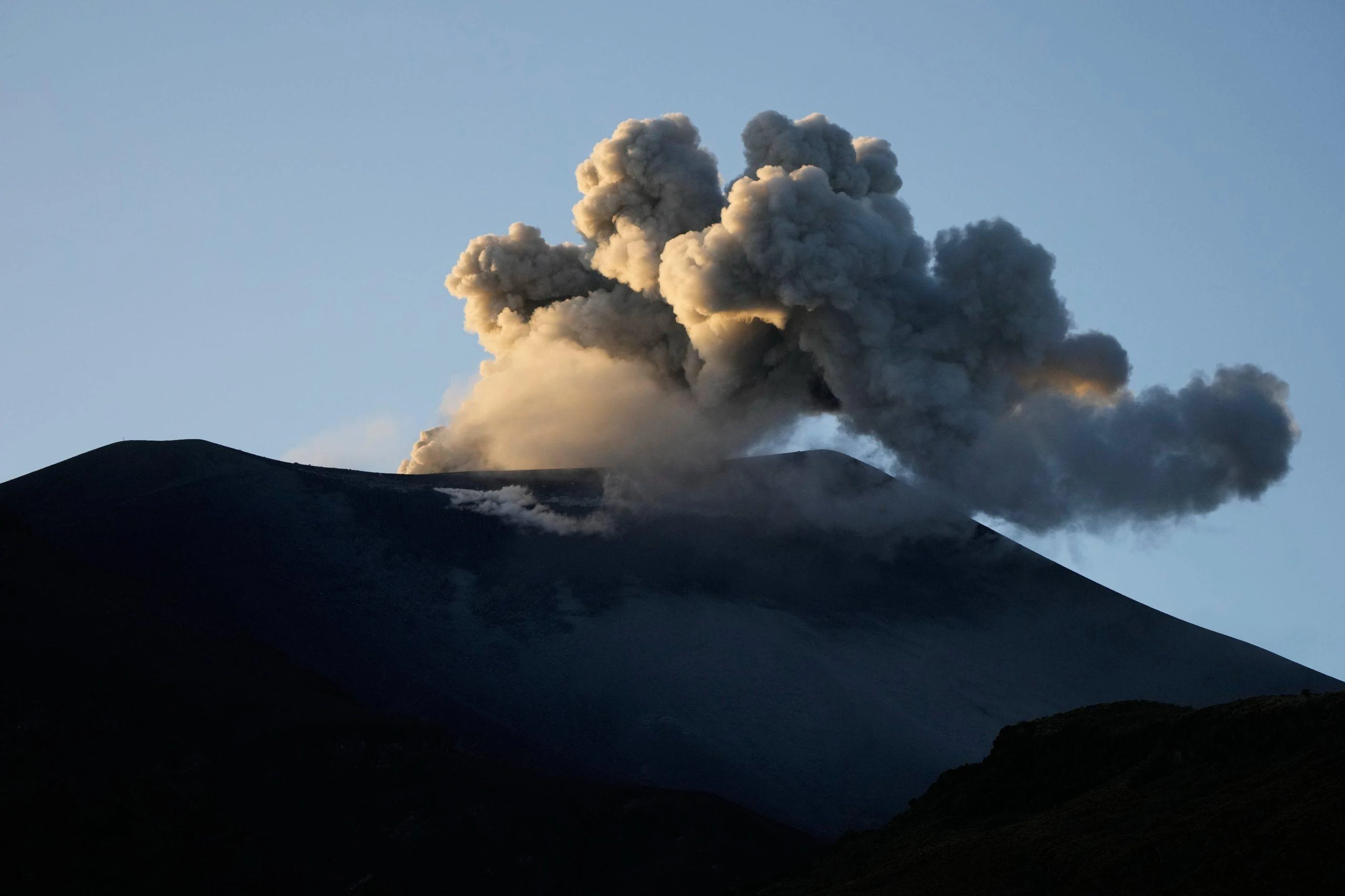
The Servicio Geológico Colombiano, the state geological service known as SGC, counted three ash emissions in its latest 24-hour bulletin. The tallest column reached 3,250 metres above the summit of the Puracé volcano.
One emission, at 10:08 on the morning of Thursday 27 August, was captured on camera. The image came from a monitoring camera 27 kilometres north-west of the crater.
Ash did not stay on the mountain. Residents and community watchers reported ashfall and noise in Cristales, Campamento and 20 de Julio, and in Coconuco town itself.
The bulletin’s 24-hour window opened at 2 p.m. on Wednesday. All three emissions fell inside it.
The same bulletin recorded a magnitude 2.3 rock-fracture earthquake eight kilometres north-east of the crater. It struck at a depth of nine kilometres.
Other seismicity sat beneath Piocollo, a neighbouring cone, at depths of one to two kilometres. The slow ground deformation between the three volcanoes continues, the SGC said.
A month on orange
The current orange alert began on 1 August, after activity climbed from 20 July. It is the second orange period in nine months.
Since the climb began, gas and ash columns have reached 3,400 metres above the crater. Estimated emission temperatures touched 140 degrees Celsius.
Sulphur dioxide output reached an estimated 4,200 tonnes per day. Carbon dioxide in the soil measured 688 parts per million.
Those readings are the highest since monitoring of the Puracé volcano began in 1993. Only ground deformation stays slow and constant, as it has since 2022.
The previous orange period ran from 29 November 2025 to 22 January 2026. An earlier one lasted from May to July 2024.
The service declared the change in an extraordinary bulletin from Popayán. Jaime Raigosa, the observatory’s coordinator, asked communities to trust only official channels.
The alert scale defines orange as important changes in monitored behaviour. Earthquake swarms, gas surges and morphological changes all qualify.
The volcano and the people around it
The Puracé volcano is a stratovolcano of explosive character, rising 4,650 metres above sea level. It stands 27 kilometres south-east of Popayán, the capital of Cauca.
It is the youngest of 15 volcanoes in the Los Coconucos chain. Its summit holds two craters, one 900 metres across and an inner one of 550 metres.
Its last considerable eruption came in March 1977. At least 14 smaller ones are on record since 1827, several of them deadly.
The official threat map names the municipalities of Puracé, Popayán and Sotará. Pyroclastic flows threaten the first, and mudflows called lahars threaten Paletará and Popayán.
The hazard zone is also indigenous territory. The Kokonuko and Paletará reserves of the Nasa people, and a Misak settlement, all sit inside it.
The service watches 25 active volcanic structures across Colombia. The Puracé volcano is among the best instrumented, with 97 stations listening day and night.
Villages like Coconuco sit on the slopes themselves. Their community watchers, the vigías comunitarios, feed the observatory with ground truth.
Popayán, a city of colonial facades, sits within lahar range on the threat map. Its airport is the region’s air link to Bogotá.
What orange actually means
Orange is the second-highest rung on Colombia’s four-level volcano scale. It means the monitored parameters show important changes, and an eruption is more likely.
It does not mean an eruption is imminent. The SGC repeats that distinction in every bulletin.
Temporary lulls are expected inside an orange period. A drop in daily activity does not mean the volcano has stabilised.
A return to yellow requires a prudent stretch of calmer readings across all parameters. Officials say that trend has not appeared.
The standing advice is to keep away from the craters of Puracé, Piocollo and Curiquinga. Sudden emissions of gas and ash can happen without warning.
Ash is the everyday hazard even without an eruption. It degrades air quality and visibility, and it hits people with respiratory problems first.
Why the earthquake did not cause this
When the magnitude 7.4 earthquake struck on 10 August, social media tied it to the volcano. The SGC rejected the link within hours.
The agency said the tectonic quake had no relation to the Puracé volcano. It also changed nothing in the volcano’s already-reported behaviour.
Cristian Santacoloma of the Popayán observatory addressed the rumours directly. The quake and the volcano answer to different machinery underground.
The current unrest predates the earthquake by weeks. The parameter climb began on 20 July, three weeks before the quake.
Columns measured around 700 metres were reported in bulletins earlier in August. This week’s 3,250-metre column is the tallest of the crisis so far.
What to watch from here
The SGC now publishes daily bulletins on the Puracé volcano while orange lasts. Any extraordinary bulletin signals a faster change.
The numbers that matter are seismic energy, sulphur dioxide flow and deformation. A jump in all three at once would precede a bigger event.
For travellers, the nearest airport is Popayán’s Guillermo León Valencia. Ash has restricted operations there during earlier episodes this month, so check before flying.
For residents, the practical kit is official channels and a mask for ash days. The service asks people to ignore social-media rumours and follow its bulletins.
The disaster agency UNGRD keeps a national response plan for the volcano. It maps who evacuates, who shelters and who decides.
An eruption is not the base case, and calm is not guaranteed either. The honest position is a watch with no fixed end date.
Frequently Asked Questions
Is the Puracé volcano erupting now?
It is emitting ash and gas, with three emissions in the latest 24-hour bulletin. The geological service keeps it on orange alert, which means an eruption is more likely, not imminent.
How high was the latest ash column from the Puracé volcano?
The maximum measured on 27 August was 3,250 metres above the summit. Columns reported in bulletins earlier in August reached around 700 metres.
Which communities are at risk from the Puracé volcano?
The threat map names the municipalities of Puracé, Popayán and Sotará in Cauca. The Kokonuko and Paletará indigenous reserves also sit inside the hazard zone.
Connected Coverage
We tracked air travel after the quake in Colombia Airports After the Quake: What’s Open and What’s Closed and the reconstruction effort in Colombia’s Earthquake Reconstruction Turns to 8 Percent Mortgages.
Sources: Servicio Geológico Colombiano bulletins of 1 and 27 August 2026, NTN24, Parques Nacionales, UNGRD planning documents.
This article was produced by The Rio Times’ automated newsroom system. How we use AI · Report an error · Editorial responsibility: Matthias Camenzind, Editor-in-Chief