COLCAP Drops 3.8% in Worst Week of 2026 as Petro-Trump Thaw Fails to Lift Sentiment
Colombia’s equity market suffered its steepest weekly decline of the year on Thursday, with the COLCAP index tumbling 3.8% from last Friday’s all-time high as investors aggressively booked profits following Banco de la República’s hawkish pivot.
The selloff accelerated despite an unexpectedly cordial Trump-Petro White House summit and the release of BanRep’s January Monetary Policy Report, which painted a sobering picture of persistent inflationary pressures.
Meanwhile, the Colombian peso gave back gains mid-week, with USD/COP rebounding to 3,645 after briefly touching multi-year lows near 3,592.
COLCAP Drops 3.8% in Worst Week of 2026 as Petro-Trump Thaw Fails to Lift Sentiment
Key Market Data
| Indicator | Current Value | Weekly Change | YTD Change |
|---|---|---|---|
| COLCAP Index | 2,381.04 | -3.79% | +15.1% |
| USD/COP (TRM) | 3,644.93 | -0.83%* | -2.99%* |
| BanRep Policy Rate | 10.25% | Unchanged | +100 bps |
| Inflation (Dec 2025) | 5.1% | — | — |
| Inflation Expectations (2026) | 6.4% | — | +180 bps vs prior survey |
*Negative USD/COP change indicates peso appreciation
Performance Analysis
The COLCAP index closed Thursday’s session at 2,381.04, shedding 2.29% on the day and marking a brutal 3.79% weekly decline from the record close of 2,474.76 set on January 30.
The index opened Wednesday near 2,438 before cascading lower through the session, briefly testing intraday support at 2,335 before recovering partially on late-session bargain hunting.
The damage erased roughly half of January’s extraordinary 19.7% monthly gain, underscoring the vulnerability of a market that had run up aggressively into overbought territory.

The selloff was broad-based, with financial heavyweights Bancolombia, Grupo Sura, and Davivienda leading losses as rising interest rate expectations weighed on lending growth forecasts.
Ecopetrol drew additional attention as shareholders gathered on February 5 for the extraordinary general meeting to elect a new board of directors for the 2025-2029 term, a politically charged event given the government’s 88.49% ownership stake.
ISA and Grupo Energía Bogotá showed relative resilience within the utilities space but could not shield the broader index from selling pressure.
On the currency front, USD/COP rebounded sharply from its intraweek low of 3,592 to close at 3,645.4, as the dollar regained footing following Trump’s nomination of Kevin Warsh as the next Federal Reserve Chair.
The TRM for February 5 was fixed at 3,644.93, up COP 22.93 from the previous session. Despite the mid-week bounce, the peso remains down 0.83% for the week and nearly 3% stronger year-to-date, with the 12-month appreciation exceeding 12%.
Key Drivers
The dominant catalyst this week was a confluence of macro-level events that reshaped investor positioning.
The release of BanRep’s January 2026 Monetary Policy Report on February 3 confirmed the central bank’s deeply hawkish assessment: headline inflation stalled at 5.1% through 2025, failing to converge toward the 3% target, while the economy continued to grow above potential driven by vigorous consumption.
The report stated explicitly that excess demand conditions and rising inflation expectations for 2026 justified the dramatic 100-basis-point hike to 10.25%, the first increase in 33 months.
BBVA Research noted that inflation expectations had surged to 6.4% for end-2026 and 4.8% for end-2027, a dramatic deterioration from the prior survey readings of 4.6% and 3.8% respectively.
The much-anticipated Trump-Petro summit at the White House on February 3 delivered a surprisingly positive outcome.
After a year of escalating tensions that included visa revocations, OFAC sanctions, and veiled military threats, both leaders struck a conciliatory tone.
Trump told reporters they “got along very well,” while Petro characterized the meeting as a dialogue “between equals” focused on concrete problems. Petro even left with a MAGA hat customized to read “Make Americas Great Again.”
Markets initially rallied on the diplomatic thaw, but the relief was short-lived as investors refocused on domestic monetary tightening and the dollar’s global recovery following the Warsh nomination.
Bank of America added a note of caution in a research note released Monday, stating that Colombia is “not yet in receiver territory” and warning that elevated election uncertainty creates fiscal scenarios where BanRep might be forced to implement even more aggressive rate hikes than markets currently anticipate.
The firm recommended relative value trades rather than outright positioning, noting 5-year rates appear too high relative to the rest of the curve.
Technical Outlook
| Asset | Support Level | Resistance Level | RSI (Daily) | Trend Signal |
|---|---|---|---|---|
| COLCAP | 2,314 / 2,280 | 2,448 / 2,475 | 56.29 | Correcting from Overbought |
| USD/COP | 3,598 / 3,592 | 3,693 / 3,720 | 46.03 | Neutral-Bearish |
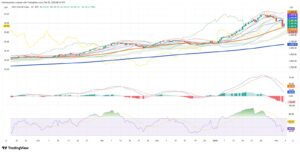
The COLCAP’s sharp retreat has brought its daily RSI down from extreme overbought levels above 80 to a more neutral 56, suggesting the most acute selling pressure may be subsiding.
However, the weekly RSI remains elevated near 78, indicating the broader trend may need further consolidation. The index bounced firmly off the 2,335 level, which aligns with the lower Bollinger Band on the 4-hour chart and the Ichimoku cloud support zone.
A break below 2,314 would open the door toward the 200-day moving average cluster near 2,280. On the upside, the gap between 2,415 and 2,448 represents immediate resistance that bulls must reclaim to restore momentum toward the January highs.
USD/COP is consolidating within a neutral channel after its strong downtrend. The daily RSI at 46 and weekly RSI near 36 suggest the dollar is approaching oversold territory on longer timeframes, pointing to limited downside for the pair in the near term.
The 3,598 level, corresponding to the year-to-date low, serves as critical support, while resistance clusters at the 3,693 zone, where the 4-hour moving averages converge.
The weekly chart shows the pair has broken decisively below the 200-week moving average at 3,831, a structurally bearish signal, though a short-term bounce toward the 3,710-3,720 zone cannot be ruled out amid post-Warsh dollar strength.
Analyst Perspectives
Analysts at BBVA Research emphasized the significance of BanRep’s hawkish reversal, noting that “the first rate hike in 33 months signals a clear message that the board will not tolerate a further de-anchoring of inflation expectations, even at the cost of near-term economic growth.”
The firm highlighted that the 100-basis-point move was supported by four board members, while two voted for a 50-basis-point cut and one for no change, revealing an unusually divided board.
Meanwhile, Bank of America strategists cautioned that “elevated election uncertainty creates fiscal scenarios where BanRep might be forced to implement more aggressive rate hikes than markets currently anticipate,” adding that a front-loaded hiking cycle could paradoxically allow for a lower terminal rate by anchoring expectations more quickly.
The firm’s recommendation to avoid outright duration bets in Colombian bonds reflects the institutional skepticism about near-term stability.
Looking Ahead
The outcome of Ecopetrol’s extraordinary shareholders’ meeting on February 5 will set the tone for corporate governance at Colombia‘s largest company over the next four years, with the government-backed board slate facing scrutiny from minority shareholders and ADR investors ahead of the company’s Q4 2025 earnings release scheduled for March 3. Investment plans targeting COP 22-27 trillion for 2026 will be under the microscope.
January inflation data, expected mid-February, will provide the first test of whether BanRep’s shock therapy is beginning to temper price pressures, particularly following the 22.7% minimum wage increase and new fuel taxes that took effect January 1.
BanRep’s next monetary policy meeting is scheduled for late March, where the board will evaluate whether further tightening is necessary.
Politically, campaign activity is accelerating ahead of the May 31 presidential election, with economic policy taking center stage as Petro’s Pacto Histórico coalition seeks to capitalize on the diplomatic thaw with Washington while managing the fallout from higher borrowing costs at home.
Colombian markets face a critical juncture as the sharpest equity correction of the year tests whether January’s record rally was built on sustainable fundamentals or speculative excess, with the interplay between tighter monetary policy, diplomatic recalibration, and pre-election uncertainty likely to define the path forward through the first quarter.
This is part of The Rio Times’ daily coverage of Colombian markets and Latin American financial news.
For context on regional markets, see Brazil’s Ibovespa for the same session.
Also tracking regional peers: Chile’s IPSA closed the same session.
Live Market IntelligenceColombia — Live Market Board
Rio Times · Live Market Intelligence
Colombia — Live Market Board
+0.46%
206,505.98
-0.18%
66,790.35
-0.26%
10,966.21
-0.49%
2,835,843
+0.00%
2,582.29
+0.46%
60,511.74
-1.60%
| Instrument | Last | Change | YoY | Prev. | High | Low | Volume |
|---|---|---|---|---|---|---|---|
| COLCAP | 2,582.29 | +0.46% | — | 9.04 | 9.05 | 9.02 | 4,133 |
| USD/COP | 3,140 | +0.03% | -22.04% | 3,139 | 3,141 | 3,105 | — |
| BRENT | 88.88 | -0.03% | +34.42% | 88.91 | 90.07 | 88.12 | 29,713 |
| WTI | 83.11 | -0.11% | +31.57% | 83.20 | 84.35 | 82.40 | 166,848 |
| ECOPETROL | 16.92 | -0.53% | +98.01% | 17.01 | 17.05 | 16.79 | 737,591 |
| BANCOLOMBIA | 95.87 | -2.18% | +96.15% | 98.01 | 100.36 | 95.73 | 188,740 |
| GRUPO AVAL | 5.40 | +2.66% | +76.89% | 5.26 | 5.49 | 5.32 | 146,447 |
| TECNOGLASS | 42.30 | -1.10% | -48.04% | 42.77 | 42.73 | 42.05 | 60,908 |
| CREDICORP | 375.17 | -0.49% | +49.60% | 377.00 | 384.43 | 372.27 | 88,375 |
| BUENAVENTURA | 34.45 | -1.02% | +88.07% | 34.80 | 35.62 | 34.33 | 275,831 |
| SOUTHERN COPPER | 193.97 | -0.26% | +104.01% | 194.48 | 199.36 | 192.59 | 367,102 |
Key Facts
— Deep Dive
— For the complete picture, read our in-depth guide: Latin America Stock Markets 2026: Ibovespa, Merval, COLCAP, IPSA and IPC Guide
This article was produced by The Rio Times’ automated newsroom system. How we use AI · Report an error · Editorial responsibility: Matthias Camenzind, Editor-in-Chief
Read More from The Rio Times