City of Rio Offers R$250 Million to Host Formula 1 From 2021
RIO DE JANEIRO, BRAZIL – According to reports from the newspaper Estado de S. Paulo, the summit of the world’s leading auto racing category recently received an offer with a schedule of bank deposits relating to fees and the submission of financial guarantees to ensure the signing of the contract and, consequently, the event to be held in the neighborhood of Deodoro, West Zone of the City of Rio de Janeiro.

According to the report, the Rio de Janeiro bid guaranteed the F1 it would transfer up to US$60 million per year (R$250 million), approximately three times the amount that São Paulo is offering in the negotiation to renew the contract to host the event at Interlagos. The agreement in São Paulo expires in late 2020.
Also according to the report, the proposal submitted by the City of Rio provides for the payment of the first installment by March of next year. After that, a letter of credit with a bank guarantee for the transfer of the remainder up to US$60 million must be submitted by June.
The official figures for these two operations are being kept confidential. The deadline is set for the end of the semester, as the meeting defining the schedule for the 2021 races is scheduled for July. The reply by F-1 to Rio’s proposal should be made in January.
The US$60 million per year pledged by the City of Rio to the F-1 includes the GP promoter fee, plus income from VIP tickets and profit share from the sale of official products.
To pay the fee, Rio Motorsports, the company that won the bid to build the racetrack, is investing R$302.4 million, approved in late November by Rio de Janeiro’s Secretariat of Sports, Leisure, and Youth, and will come from a tax waiver.
The funds will be transferred to Rio Motorsports in four annual installments up to 2022 in a non-cumulative way. In 2019, the first agreed transfer is R$30 million, then it will increase over the following two years to R$60.6 million and finally reach R$151.2 million.
These details are found in the project entitled “Formula 1 Rio de Janeiro 2021-2030”, passed under the State Sports Incentive Law. The money would come from companies interested in transferring up to three percent of ICMS (Tax on Distribution of Goods and Services) to be paid into the project.
“For each year of the race, the direct and indirect impact on the economy of the State of Rio de Janeiro is estimated to reach US$160 million, around R$670 million at the current exchange rate, an amount based on events that have already taken place in the country and around the world,” the Rio de Janeiro Sports Secretariat said in a statement.
Rio Motorsports says it has a confidentiality agreement with the F-1, so it can not comment on the ongoing negotiations.
During the last race of this year’s championship, held in Abu Dhabi, the leader of the consortium seeking to bring the event to Rio, JR Pereira, the Municipal Secretary of Public Order, Gutemberg Fonseca, and Senator Flávio Bolsonaro held talks with the head of the F-1 Company, Chase Carey.
At the time, a document was also signed guaranteeing Rio exclusivity in the negotiations with F-1 until March 2020.
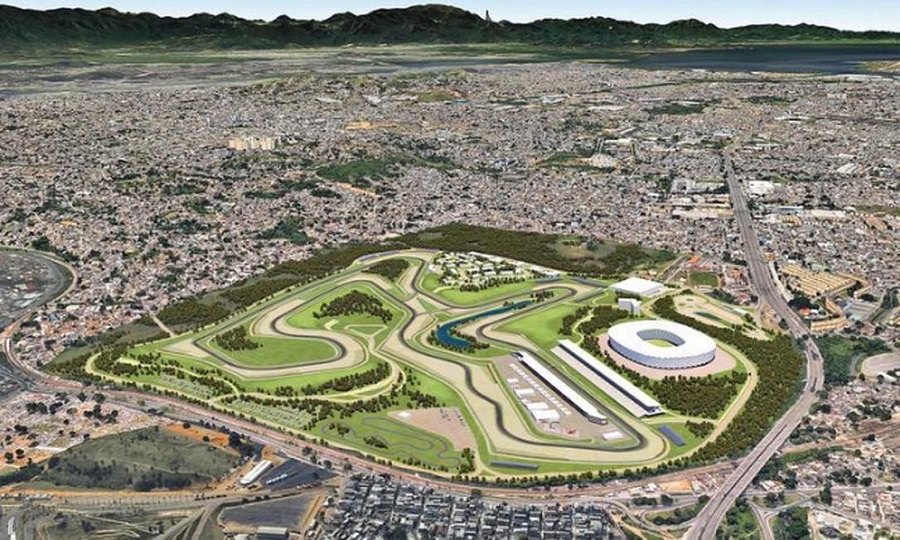
In a statement, Rio’s City Hall said that “the city’s representatives had a meeting in Abu Dhabi with Mercedes pilot Lewis Hamilton. Two weeks earlier, the six-time world champion had criticized the construction of the new Rio racetrack for having caused the deforestation of the Camboatá Forest.
In that conversation, the English pilot learned about the project’s environmental compensation, like the project to replant six trees for each species that is felled.
The Rio Racetrack is expected to cost R$700 million. The funds would be provided by the private sector. The bidding for the project is currently suspended as it awaits approval of the environmental impact study.
The city signed an agreement in October to host the MotoGP circuit as of 2022 for five years.
In June of that year, President Jair Bolsonaro stated that Rio had a “99 percent chance” to host Formula 1 from 2021.
More: Brazil news in English, every day from The Rio Times.
This article was produced by The Rio Times’ automated newsroom system. How we use AI · Report an error · Editorial responsibility: Matthias Camenzind, Editor-in-Chief
Living in or visiting Rio de Janeiro? See this month's events and our Rio de Janeiro city guide with rents, safety and upcoming concerts.