Key Facts
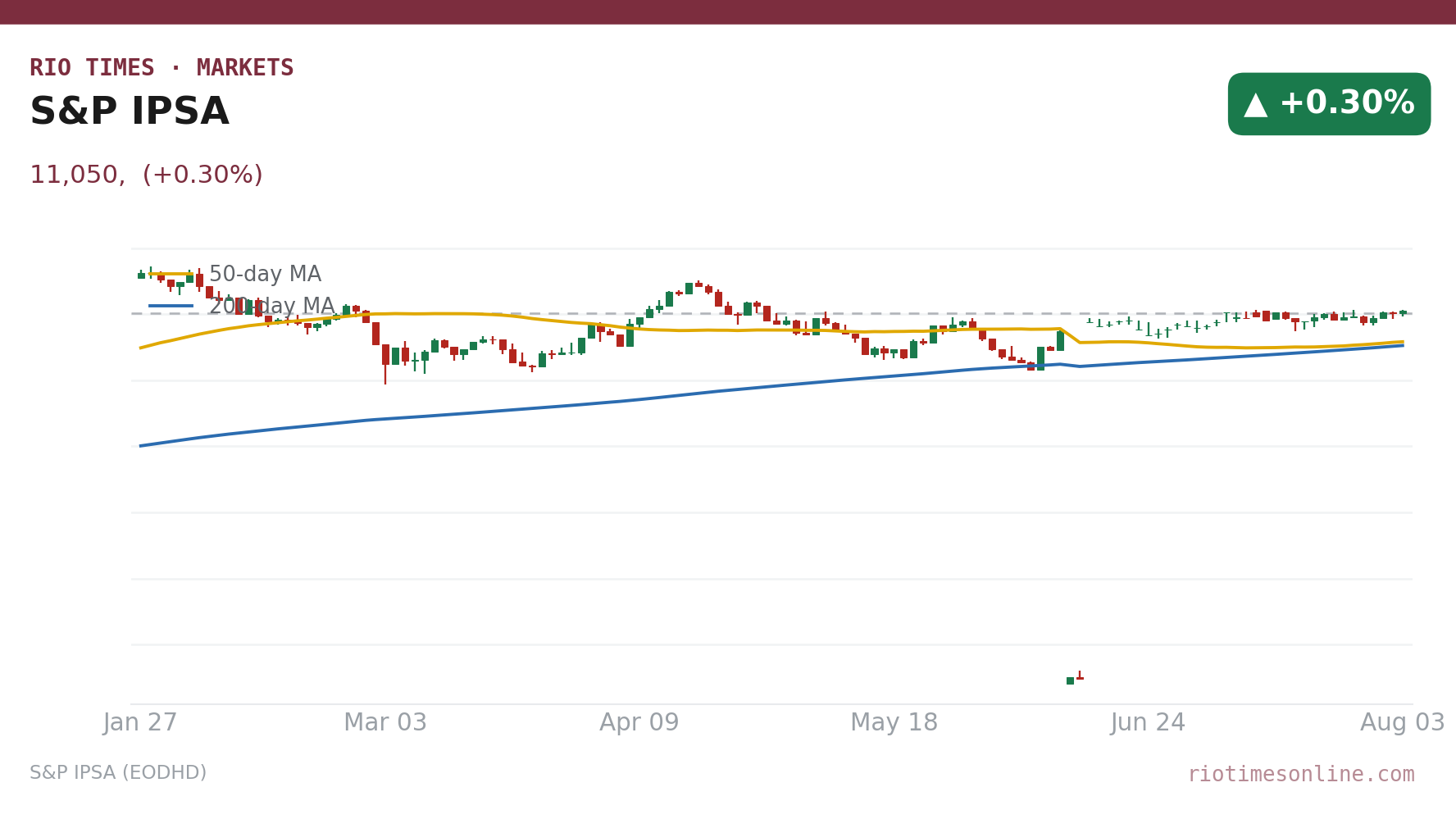
- The S&P IPSA, Chile’s benchmark stock index, added 0.30% to close at 11,050, clawing back a slice of recent losses.
- The Chilean peso strengthened markedly against the US dollar, with the USD/CLP pair falling 0.60% to 925.48, its firmest level in weeks.
- Copper, Chile’s export anchor, jumped 2.45%, the day’s second-biggest move, while banks lagged: the financials sector slipped 0.66%.
- Lithium giant SQM-B was a notable drag, slipping 1.3% with US$13 million in shares changing hands, weighing on the materials sector.
- Retailers were in favour as Falabella, a major department store chain, rose 2.7% on heavy volume of US$17 million, making it the session’s most-traded name.
Today’s Focus
Chilean equities edged higher on Monday as a collapse in crude oil drained the risk premium out of global markets, lifting the S&P IPSA 0.30% to 11,050. Brent fell 4.73% after President Trump called off planned strikes on Iran, and Wall Street ran with it: the Nasdaq Composite jumped 1.78%, encouraging investors to pick up shares of beaten-down Chilean retailers and airlines.
The peso joined the move, strengthening 0.60% against the dollar to close at 925.48. Currency traders took their cue from a softer greenback and renewed appetite for risk, which tends to benefit the commodity-linked Chilean peso.
Banking shares were a drag rather than a driver. The financials sector slipped 0.66%, with Banco de Chile down 0.65% and Banco Santander Chile off 0.68%, a sign that local investors remain wary of the domestic credit outlook. Leadership came from elsewhere: Falabella led turnover at US$17 million with a 2.7% gain and LATAM Airlines climbed 2.1% on US$16 million, signalling that consumer-facing and travel names found the eager buyers.
Under the surface the tape was not especially healthy: just 45% of the tracked instruments advanced, five up against six down. SQM-B, the lithium producer, fell 1.3%, a decline that came despite the upbeat headline tone and hints at nagging worries over global lithium supply and demand that are specific to the battery-metal sector.
What matters today. A narrow, retail- and airline-led bid, backed by a stronger peso and a 2.45% jump in copper, nudged the IPSA higher even as banks and lithium heavyweight SQM-B lost ground.
01 The session in one read
Chile’s S&P IPSA, the barometer for the country’s largest and most liquid stocks, ticked 0.30% higher on Monday, closing at 11,050. The move ran parallel with a muscular rally on Wall Street, where the tech-heavy Nasdaq Composite surged 2.13%, coaxing buyers back into emerging-market equities.
The Chilean peso joined the party in style. The USD/CLP exchange rate—how many pesos you need to buy one US dollar—fell 0.60% to 925.48, meaning the peso strengthened. A cheaper dollar is often a tailwind for Chilean assets, as it eases the burden of dollar-denominated debt and buoys the local-currency returns that foreign investors care about.
Behind the headline index move, the action was anything but uniform — and anything but broad. More lines fell than rose, with only 45% of the tracked instruments advancing. Banks, far from leading, lagged: the financials sector shed 0.66%. The bid landed instead on consumer and travel names, and it stopped at the door of the mining sector, where lithium producer SQM-B fell 1.3%, a reminder that Chile’s market remains a tale of two worlds: one sensitive to interest rates, the other to the globe’s fickle appetite for raw materials.
Monday’s session felt more like a relief rally than a decisive turn. The gains were narrow and concentrated in consumer and travel names, while banks actually lost ground, which points to the slide in crude—Brent fell 4.73% after Washington called off strikes on Iran—as the primary engine, with a slightly softer US 10-year yield, down 1.24% to 4.686%, in a supporting role rather than any new local catalyst. With the IPSA still sitting 5% below its 52-week high of 11,628, the index needs follow-through buying in heavyweight resource names to confirm a genuine change in trend. Copper already did its part, climbing 2.45%; the question is whether that bid holds long enough to drag the mining complex with it.
02 The day’s numbers
| Measure | Level | Change | Read |
|---|---|---|---|
| S&P IPSA | 11,050 | +0.30% | A modest gain; remains 5% below its 52-week high |
| Session range | 10,970 – 11,063 | — | Intraday low and high; the close sat near the top of the band |
| USD/CLP | 925.5 | −0.60% | Peso strengthens; 5.0% firmer than its weakest point of the past year |
| 52-week high (IPSA) | 11,628 | — | The benchmark’s ceiling over the past 12 months |
| 52-week low (IPSA) | 8,195 | — | The benchmark’s floor over the past 12 months |
The IPSA’s close at 11,050 leaves the index near the top of its 52-week range of 8,195 to 11,628. The benchmark is up about 35% from that floor and now needs to climb only about 5.2% to reclaim record territory, a gap that nonetheless underscores the market’s cautious view of the economic outlook.
The peso’s performance was the session’s clear bright spot. At 925.48, the currency is trading comfortably below its 52-week high in USD/CLP terms of 973.62—a level that represents peak peso weakness. A 0.60% single-day move is significant for a major Latin American currency and points to genuine buying interest rather than mere technical noise. Rio Times · Live Market Intelligence
Live Market IntelligenceChile — Live Market Board
Chile — Live Market Board
Instrument Last Change YoY Prev. High Low Volume
IPSA
11,381.18
+1.30%
—
11,235.60
11,210
10,984
1,513,213,483
USD/CLP
913.98
+0.04%
-5.67%
913.65
915.11
906.68
—
COPPER
6.61
+0.03%
+46.70%
6.61
6.71
6.61
39,543
SQM-B
65,305
-0.84%
+49.03%
65,860
66,949
64,978
76,539
COPEC
5,964
-1.09%
-11.70%
6,030
6,100
5,960
634,331
BSANTANDER
78.37
-2.28%
+35.94%
80.20
81.69
78.34
36,288,711
FALABELLA
6,334
-1.48%
+23.28%
6,429
6,450
6,300
26,085,814
ENELAM
87.09
+0.10%
-10.13%
87.00
87.40
86.50
13,106,417
CENCOSUD
1,946
-2.19%
-35.30%
1,990
2,010
1,945
966,528
CMPC
1,020
-1.96%
-29.10%
1,040
1,050
1,015
3,526,677
BANCO CHILE
184.96
-1.01%
+32.87%
186.85
189.99
184.33
18,101,240
LATAM AIR
24.08
-1.11%
+16.61%
24.35
24.59
23.88
573,612,753
SOUTHERN COPPER
193.97
-0.26%
+104.01%
194.48
199.36
192.59
367,102
03 Why it moved — a global risk-on tide lifts Chile
Monday’s gains were driven almost entirely by events thousands of miles from Santiago. The trigger was geopolitical: President Trump called off planned strikes on Iran, draining the war premium out of energy markets and sending Brent crude down 4.73%. The S&P 500, a benchmark for US stocks, climbed 1.48% to 7,600, closing within a whisper of its own 52-week high, and the Nasdaq Composite’s 2.13% leap signalled that investors were piling back into growth-sensitive assets, a mood that quickly rippled across the Pacific to Chile.
Falling US government bond yields helped at the margin. The yield on the 10-year US Treasury note, a global reference rate that influences borrowing costs worldwide, eased 1.24% to 4.686%. Lower yields in the world’s anchor economy make the higher potential returns offered by Chilean stocks and the peso more attractive by comparison.
Copper, Chile’s economic anchor, did provide a spark of its own: the red metal climbed 2.45% to 6.59, the second-biggest move on the day’s board. The wider commodity complex was firm alongside it, with gold rising 0.27% to 4,054 and silver 0.81% to 58.26. The peso’s 0.60% rally is of a piece with that bid, which was plainly constructive for the local currency.
04 The day’s movers
| Driver | Level / Move | Change | Note |
|---|---|---|---|
| Falabella | US$17m turnover | +2.7% | Most-traded name; retailer rallied with consumer optimism |
| LATAM Airlines | US$16m turnover | +2.1% | Airline stock climbed on strong volume as crude collapsed |
| Copper | 6.59 | +2.45% | The day’s second-biggest move; a tailwind for Chile’s export engine |
| Banco de Chile | US$14m turnover | −0.6% | Banks lagged the tape, on solid turnover |
| Banco Santander Chile | — | −0.68% | The financials sector as a whole fell 0.66% |
| SQM-B | US$13m turnover | −1.3% | Lithium giant fell with the materials complex; sector-specific drag |
Retail giant Falabella was the session’s volume champion, with US$17 million worth of shares traded as the stock jumped 2.7%. The surge hints that investors are betting on resilient consumer spending, or at least that the department-store chain’s earlier sell-off had gone too far. LATAM Airlines, a cross-border carrier based in Santiago, added 2.1% on US$16 million in turnover, a move that often tracks the broader emerging-market bid.
The banking sector, by contrast, was where the tape lost its footing. Financials fell 0.66% as a group. Banco de Chile slipped 0.6%, though the US$14 million in turnover indicates active trading rather than a stampede for the exits, and Banco Santander Chile shed 0.68%. With both heavyweight lenders lower, the index’s advance rested on an unusually narrow base. Lithium miner SQM-B gave back 1.3% in a US$13 million session, a counter-intuitive move that suggests investors harbour sector-specific worries about lithium pricing or output that outweighed the day’s sunny macro mood.
05 The regional scoreboard
| Index | Country | Change |
|---|---|---|
| S&P IPSA | Chile | +0.30% |
| Ibovespa | Brazil | 0.00% |
| IPC | Mexico | −0.35% |
| Merval | Argentina | −0.51% |
| COLCAP | Colombia | −0.31% |
Chile stood nearly alone in positive territory on a mixed day for Latin American equities. Brazil’s Ibovespa, the region’s largest stock market by value, finished flat at 178,000, while Mexico’s IPC dropped 0.35% to 66,700.17. Argentina’s Merval continued its volatile ways, sliding 0.51% to 3,274,443, and Colombia’s COLCAP dipped 0.31% to 2,385.
The divergence underscores that Monday’s rally was not a broad-based emerging-market event, but rather a selective bid — and a selective one inside Chile too, where fewer than half the tracked lines rose. Chile likely benefited from its retailers and travel names, plus a firm copper price, while the domestically challenged markets of Mexico and Argentina failed to catch the bid.
06 The technical picture
The IPSA’s close at 11,050 leaves the index in a technical no-man’s land. The 52-week high of 11,628, set during a period of peak optimism, looms as the next major resistance level—a price ceiling where sellers have historically emerged. The 52-week low of 8,195, recorded during last August’s risk-off move, is a distant memory: at 11,050 the index sits roughly 83% of the way up its annual range, far nearer the ceiling than the floor.
For chart-watching traders, the key level to monitor is the 11,600 zone. A decisive weekly close above that threshold would signal that the market has absorbed all the bad news that knocked it 5% off its highs and is ready to challenge new peaks. On the downside, the peso’s strength at 925.48 offers a cushion: a firmer currency tends to anchor equity prices by making local assets more attractive to foreign investors converting dollar returns.
07 What to watch
- Copper prices: Chile’s economic anchor already delivered, jumping 2.45% on Monday. The test now is whether that bid holds; follow-through would lend fundamental backing to the rally and could pull mining stocks out of their funk.
- Oil and US bond yields: Monday’s bounce owed most to the crude collapse that followed Washington’s decision to call off strikes on Iran, with a marginally lower US 10-year yield helping at the edges. A sharp reversal in either — a rebound in oil or a jump in yields — would yank the risk-on rug from beneath Chilean assets.
- SQM-B lithium sentiment: The divergence between a rising market and falling SQM-B is a yellow flag. Watch for news on lithium quotas, pricing or global EV demand that could explain the weakness.
- Chilean bank shares: Financials fell 0.66% on a day the index rose. Until the big lenders — Banco de Chile and Banco Santander Chile — stop leaking, any advance rests on a narrow base.
Background: Chile Environmental Approvals Fast-Track US$20B Projects.
Background: Coca-Cola Embonor Doubles Profit to US$52M Despite Bolivia Hit.
More: Chile news in English, every day from The Rio Times.
Frequently Asked Questions
What is the S&P IPSA?
The S&P IPSA is Chile’s main stock market index, tracking the 30 most actively traded shares on the Santiago Stock Exchange. It is the benchmark that professionals use to gauge the health of Chile’s equity market.
Why did the Chilean peso strengthen?
The peso strengthened to 925.48 per dollar, a 0.60% gain, largely because a 4.73% slide in Brent crude and slightly lower US bond yields revived appetite for commodity-linked emerging-market currencies. A firmer copper price, up 2.45%, added to the tailwind.
Why did SQM-B fall when the index rose?
SQM-B, a major lithium producer, slipped 1.3% even as the index closed higher on a day when more lines fell than rose. This suggests that investors have specific concerns about the lithium market—possibly linked to global supply, falling battery-metal prices, or Chilean regulatory developments—that outweighed the day’s positive macro tone.
What does the IPSA’s 5% discount to its 52-week high mean?
It means the index remains in a short-term correction. The high of 11,628 acts as a ceiling. Until buyers push the IPSA decisively above that level, the market is in a wait-and-see mode, vulnerable to slipping back if the global mood sours.
IPSA — Sources: RT market data; Bolsa de Santiago; Banco Central de Chile.
This article was produced by The Rio Times’ automated newsroom system. How we use AI · Report an error
LatAm Markets: Live Signals → — real-time movers, turnover leaders and FX across Latin America.
Read More from The Rio Times