Brazilian Education Council: Remote Teaching May Continue Until End of 2021
RIO DE JANEIRO, BRAZIL – The National Education Council (CNE) yesterday passed a resolution to allow remote teaching in public and private schools in the country until December 31st, 2021.
This way, the state and municipal education systems may organize their calendars, with the replacement of missed lessons and assessments, not only by the end of this year. The document also recommends that schools do not mark students as absent during this whole pandemic period.
As in other resolutions during the pandemic, once again a CNE document does not recommend failing students in 2020. It is suggested that “continuous school years” be adopted, i.e., combine the grade in which the student is in 2020 with the next one, in 2021.

“The curricular reorganization of what remains of the 2020 school year and the next school year can be reprogrammed, increasing the school days and workload of the 2021 school year to meet, on an ongoing basis, the learning and development targets of the preceding school year,” the document says.
“This year’s consequences will take time to be solved in the schools,” says the resolution’s rapporteur and CNE counselor, Maria Helena Guimarães de Castro, who was once executive secretary of the Ministry of Education (MEC) in the Fernando Henrique Cardoso and Michel Temer governments.
“Even if one assumes there is a vaccine next year, schools need to readjust, that’s what all the countries in the world are doing. It’s a flexibilization that provides peace of mind in planning for 2021”.
Some public school systems have already announced that they will combine the two school years, as a measure not to penalize students who could not attend online teaching. Among them is the São Paulo system, which on Tuesday opened enrollments for a new 4th grade for students who want to continue studying in 2021.
But, according to Secretary of Education Rossieli Soares, failing students will not be forbidden in the network. “We know of students who are not handing in their assignments. We will give them all opportunities, they can hand them in late, but the very least is needed,” she said. In cases of lack of online access, students have the printed materials and may return the lessons this way, she explains.
The CNE’s calendar flexibilization, however, does not mean that classes do not need to restart, according to Maria Helena. In her opinion, in locations where a favorable decision by the Health area has already been reached, in-person classes should be restarted. “The return is very important, even for people to learn how to cope with fear, to be cared for, so that the teachers can talk about how they are feeling.”
Secretary Rossieli also said that returning in compliance with the protocols is “crucial”, mentioning cases of depression of isolated adolescents. “If possible, send your children to school, safely, be it a public or private school”. Today, only 100 of the more than one thousand state schools in the capital will open, despite the authorization for in-person activities.
Federal Law 14.040/2020 provided that the CNE should provide guidelines for educational establishments during the “state of public calamity” caused by the Covid pandemic. When passed, it will be the most important national resolution on the matter, since the ministry of education (MEC) has not taken any official position. Minister of Education Milton Ribeiro said that the return to school was not a federal government issue.
The CNE Resolution also states that it must be the parents or guardians’ decision to send students to in-person classes and that grading of performance is optional for schools at this time. But those who decide to keep their children in remote activities must commit to fulfilling “activities and assessments”.
About recommending schools not to record students’ absences, Maria Helena says it is impossible to check attendance during the remote classroom period since students are often provided with videos to study at their chosen time.
For kindergarten schools (3 to 5 years old) the document also frees them from the 800-hour teaching schedule, as this year’s elementary and high school should do. However, these hours can be filled with online activities.
The text also states that all technology resources can be used in teaching and mentions social media such as WhatsApp, Facebook, Instagram, “to encourage and guide studies, research, and projects”.
Anxious students
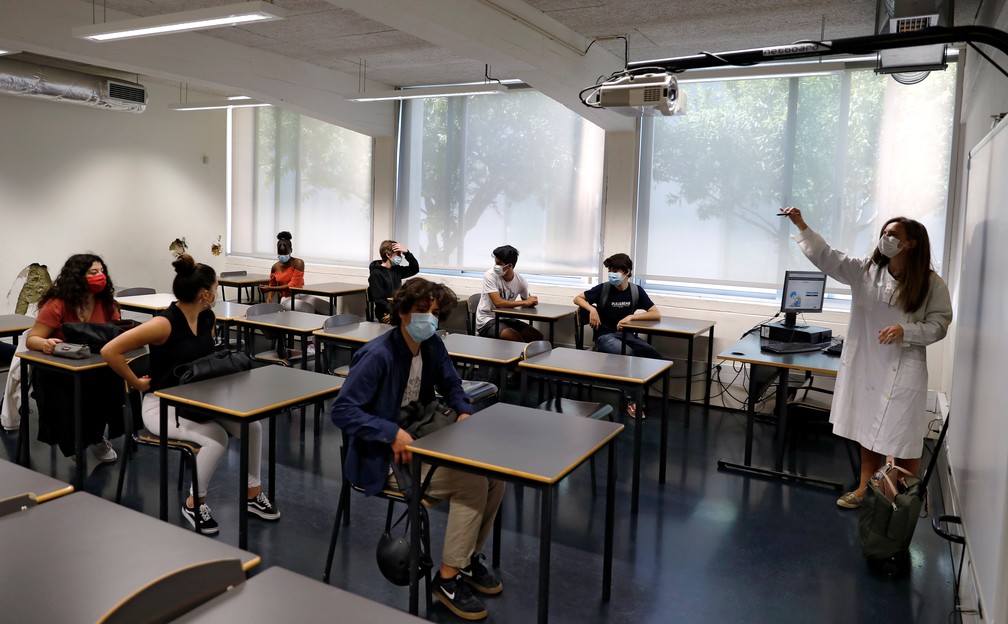
On the eve of the reopening of schools for extracurricular activities, which will take place on Wednesday, parents and students were anxious about the restart and to be prepared for the new rules imposed by the pandemic. Despite understanding that keeping their distance will be required, students were excited to be able to catch up with their classmates.
Pedro Maio Gamarra, eight years old, already knew what he would take with him on his first day at school: “My snack, sanitizer gel, mask, and gloves”. He also said that he would be seeing his friends again. “The teacher has already told who is going.”
The boy’s mother, entrepreneur Taciane de Almeida Maio Gamarra, 38 years old, says that the family has been preparing for the return to school and that it will be beneficial for Pedro and his sister Giulia, four years old.
“My eldest is stressed, impatient. He is anxious to pick up the uniform and is loving this return to in-person activities. It will be also good for them to adjust to how things will be from now on,” says the entrepreneur.
Those returning to school next week are also counting the days to reestablish contact with classmates and teachers, despite the distancing rules, wearing masks, and sanitizer gel. Gustavo Miranda Leal, 41 years old, has already sorted sanitizer gel and additional masks to place in his children’s schoolbags – Samuel, eight years old, Sarah and Luisa, five years old – and has also stepped up guidelines.
“They are very anxious, they miss socializing. They even demanded us, about 30 days ago, to go back to school. What I observed is that the dialogue worked and the school will take the protective measures.”
Siblings Sophia and Theo Larcher, 17 and 12 years old, will also attend extracurricular activities as of next week and they can’t conceal their anxiety. “I have high expectations because I can’t stand staying home anymore. I think it’s cool to come back for three hours so we can see each other for a while.”
Theo’s feelings are mixed when he talks about restarting school activities. “On the emotional level, it’s hard to describe. It’s a mixture of longing and anxiety. While I’m eager to see my friends, I’m scared of Covid-19.”
The students’ mother, teacher Melissa Larcher, 46, says the return is more difficult than when her children migrated to online lessons because of the pandemic. “There are many doubts. But what we really expect is that they have social interaction. Although I am insecure about the health component – my son is asthmatic – I authorized him to return.” Melissa bets on information and transparency. “They are happy, they want their school building, but we are preparing them for things to be different.”
Marta Gonçalves, a teacher at Instituto Singularidades and a psycho-pedagogue, stresses the relevance of dialogue and assistance in the process. “No matter the age, talk is needed. We run the risk of children going to school and not wanting to return. This disappointment must be addressed.”
She says anxiety is common in the return, but parents should watch and try to help if the symptoms are prolonged.
Source: O Estado de S. Paulo
More: Brazil news in English, every day from The Rio Times.
This article was produced by The Rio Times’ automated newsroom system. How we use AI · Report an error · Editorial responsibility: Matthias Camenzind, Editor-in-Chief