Bolivia rejects “commercializing nature” to curb climate change
Next November, the COP27 will be held in Egypt, where the United Nations will seek solutions to the climate crisis.
Deputy Foreign Minister Freddy Mamani spoke with Sputnik about Bolivia’s position against carbon markets and the greater responsibility that industrialized countries have for the emission of harmful gases.
There are two months to go before the 2022 United Nations Climate Change Conference (COP27) will be held in Sharm El Sheikh in Egypt.
The Government of Luis Arce is preparing, together with social organizations, the proposal that will lead to the negotiations, which will involve the 193 countries of the United Nations.
Read also: Check out our coverage on Bolivia
Sputnik spoke with the Bolivian deputy foreign minister, Freddy Mamani, in charge of the negotiations on behalf of the Plurinational State.
He indicated that he would bring proposals and signs that Bolivia’s commitment to change the energy matrix is advancing solidly, with less use of fossil fuels.

For the authority, two issues are central. One is Bolivia’s rejection of carbon markets because they involve monetizing actions to mitigate the effects of global warming.
Another critical issue implies that the most developed countries provide resources to finance the necessary works in impoverished regions so that the planet’s average temperature does not exceed 1.5 °C in the coming years, which would be catastrophic for most ecosystems.
“Strengthening international cooperation with approaches not based on carbon markets should be prioritized. For us, the starting point is not to commodify the forest, nature, and biodiversity,” Mamani told Sputnik.
For this to happen, “international cooperation must allocate financial resources, technology transfer and capacity development of countries must be carried out, under the principle of leaving no one behind.”
And he assured: “Cooperation and solidarity between countries is part of the path with real solutions to the climate crisis. But, at the same time, from the countries of the South, we firmly reiterate our commitment to comply with international commitments to reduce environmental pollution effectively”.
A PROPOSAL WITH ALL THE VOICES
Since Evo Morales became president (2006-2019), Bolivia began to bring large delegations to the COPs, mostly made up of leaders of peasant and indigenous organizations.
This was not the case in 2019, after the coup that put Jeanine Áñez in the presidency (2019-2020). Nor in 2020 and 2021, due to the restrictions imposed to face the COVID-19 pandemic.
This year, the Government of Bolivia and social organizations are working on a joint proposal, which will be ready until September 30.
“We are in the process of national and global dialogue to discuss and build proposals towards COP 27,” to be held between November 6 and 18, Mamani explained.
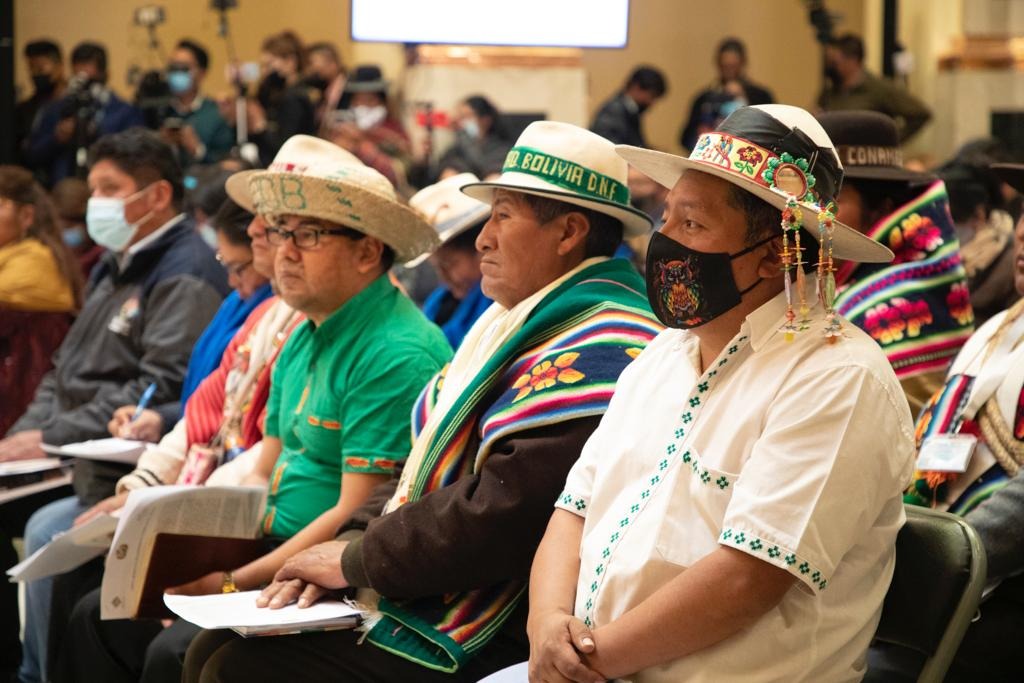
With the Bolivian organizations, “virtual dialogues are going to be developed about issues such as technology transfer, which has to do with climate change and indigenous peoples,” he added.
The Vice-Chancellor highlighted that the organizations are grouped in the Platform of Local Communities and Indigenous Peoples on Climate Change.
“It is an important instance, where the proposals of the indigenous peoples are collected, which throughout history could adapt to climate changes,” said Mamani.
This platform will deal with other issues, such as mitigation mechanisms, carbon market colonialism, adaptation mechanisms, and coverage for damages and losses that Bolivia has been implementing, among other points that the authority commented on.
“It is essential to focus on rejecting carbon markets because nature, forests, and biodiversity fulfill not only economic functions, but cultural, social, and spiritual ones as well,” Mamani observed.
And he stated: “It has to do with Living Well, in harmony and balance with Mother Earth.”
Towards the end of September, “a national dialogue will be held with all the organizations, in which the Bolivian proposal will be completed,” said the deputy foreign minister.
CHANGE OF ENERGY MATRIX
Also, “a meeting with the heads of delegation of like-minded countries” is scheduled for October, which includes 22 countries from Asia, Africa, Oceania, Latin America, and the Caribbean, Mamani said.
In addition to indigenous people and peasants, the Bolivian proposal is worked on with labor organizations, academics, and research centers.
At the next COP, Bolivia will share the data on its progress in abandoning fossil fuels, which are also used in several electricity generating plants.
“Our economic and social development plan until 2025 aims to rebuild the economy to Live Well, towards industrialization with import substitution. To achieve this, the energy transition is essential,” explained the deputy foreign minister.
For this, photovoltaic plants like the one in Oruro were built.
“The construction of hydroelectric plants has also been promoted, as well as the generation of wind energy.”
At the same time, “we are facing the great challenge of incorporating new technology in the direct extraction of lithium, for its industrialization from lithium carbonate and dioxide to produce cathode materials and lithium-ion batteries,” said Mamani.
But “to contribute to the energy transition, we require investment, technology transfer.
We hope there will be positive results in the coming months, mainly to work on the direct extraction of lithium.”
With information from Sputnik
More: Bolivia news in English, every day from The Rio Times.
Editorial responsibility: Matthias Camenzind, Editor-in-Chief · Editorial standards · Report an error