
ANALYSIS · BRAZIL
Key Facts
- —The country Brazil, Latin America’s largest economy, holds a presidential runoff on Sunday 25 October between President Luiz Inácio Lula da Silva and Senator Flávio Bolsonaro.
- —Why it matters More than 17.6 million people are registered as MEIs, Brazil’s simplest business form, according to Sebrae. About 3.6 million of them owe unpaid federal tax.
- —Why now The government launched its Prospera MEI package on Tuesday 13 October, 12 days before the runoff.
- —What happened Lula proposed forgiving about R$12.6 billion (about US$2.5 billion) in federal MEI tax debt, plus grants of up to R$5,000 (about US$1,000) per business.
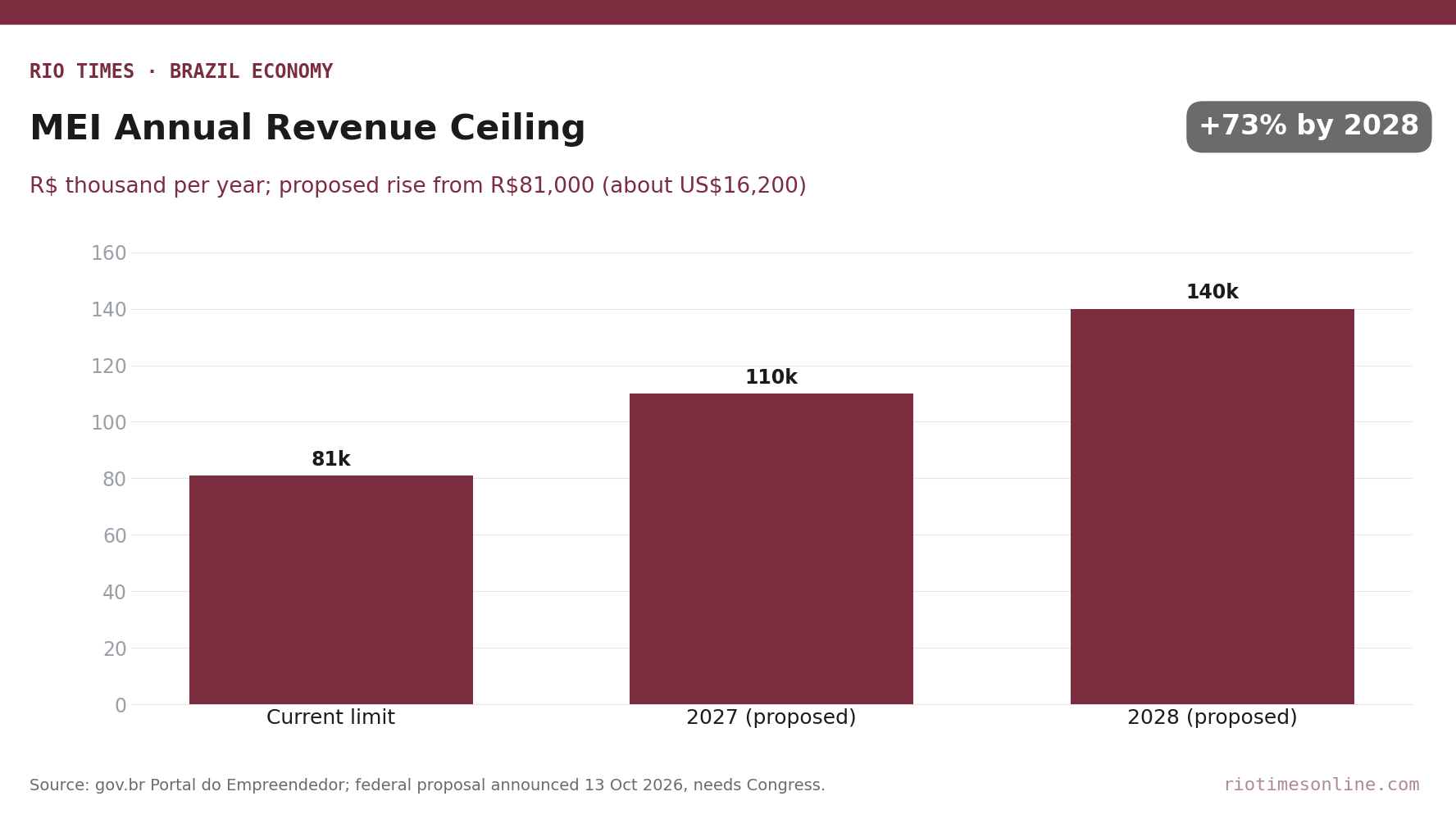
- —The numbers The annual revenue ceiling is R$81,000 (about US$16,200) today. The proposal lifts it to R$110,000 (about US$22,000) in 2027 and R$140,000 (about US$27,900) in 2028.
- —What it means for US readers Foreign residents with a Brazilian migration registration can open an MEI. Investors will watch whether the package adds to Brazil’s fiscal bill.
- —Still open Congress must approve the debt pardon and the higher ceiling. The full cost of the grants has not been published.
Brazil’s government on Tuesday 13 October proposed wiping out federal tax debts of one-person businesses under the Brazil MEI program. The package, called Prospera MEI, was announced at the Planalto presidential palace in Brasília, 12 days before the presidential runoff.
For foreign readers, it matters because the MEI is how most self-employed Brazilians, and some resident foreigners, do business legally. It also tests how far a government in an election fight will stretch public money, which investors in Brazilian assets follow closely.
This explainer sets out what an MEI is, who would get relief, what it may cost and which parts need Congress. Our news report on the announcement, “Lula Offers Small-Business Debt Relief Before Runoff”, covers the political reaction.
What an MEI Is
MEI stands for Microempreendedor Individual, or individual micro-entrepreneur, a legal status created by Brazil’s small-business law, Complementary Law 123 of 2006. It gives a hairdresser, street trader or delivery rider a company tax number, called a CNPJ, with almost no paperwork.
The federal government’s business portal sets the main limits. Revenue may not exceed R$81,000 (about US$16,200) a year, and the owner may employ at most one worker.
The owner cannot be a partner in another company or run a branch, and serving federal civil servants are barred. In return, taxes are a single fixed monthly payment, the DAS, whatever the business earns within the limit.
For 2026 the DAS ranges from R$82.05 (about US$16.40) for trade to R$87.05 (about US$17.40) for mixed trade and services. Most of it, R$81.05 (about US$16.20), is a pension contribution equal to 5% of the R$1,621 (about US$324) minimum wage.
That contribution gives the owner access to public pension, sickness and maternity benefits, which lapse when payments stop. Sebrae, the small-business support agency led by Décio Lima, counts more than 17.6 million MEIs, 7.8 million of them women.
Who Gets Debt Relief and Who Does Not
The headline measure targets MEIs who stopped paying the monthly DAS. The business portal says arrears go to the PGFN, the National Treasury Attorney’s Office, which can register and sue for them.
Small-business minister Paulo Pereira put the pardon at R$12.6 billion (about US$2.5 billion), owed by 3.6 million people. Finance Minister Dario Durigan said the PGFN’s technical staff consider much of that debt unrecoverable.
According to Sebrae, the pardon would cover the federal DAS debt of all MEIs and take effect from January 2027. Bank loans are treated separately, through a version of the government’s Desenrola debt-renegotiation scheme aimed at the sector.
Durigan told Exame that the government had mapped about R$150 billion (about US$30 billion) in MEI debts with banks. He said the state would buy them only at discounts of at least 90%, deepest cuts first.
The second benefit is the Pix MEI, named after Brazil’s instant-payment system but described by Pereira as a grant, not a loan. Each recipient could get up to R$5,000 (about US$1,000) to invest in equipment or improvements, with nothing to repay.
Sebrae says the grants should reach one million people between 2027 and 2030, through the federal Brasil Mais Produtivo programme. Senai, the industry-run training service, and Sebrae would help run it.
Cost, Congress and the Runoff Clock
Only one measure was enacted on Tuesday. Lula, of the left-wing Workers’ Party (PT), signed a decree ending invoice duties for MEIs selling to private individuals.
The announcement also covers so-called nano-entrepreneurs, who earn up to half the MEI ceiling, or R$40,000 (about US$8,000) a year. They would not need a company tax number or invoices when selling to individuals.
Everything else needs Congress. The pardon goes in an urgent complementary bill, which needs 257 of 513 deputies and 41 of 81 senators.
The government wants the lower house to vote the pardon together with its bill raising the MEI ceiling, already before Congress. That bill would lift the limit to R$110,000 (about US$22,000) in 2027 and R$140,000 (about US$27,900) in 2028, and allow two employees.
Exame reports the bill puts the higher ceiling’s cost at about R$8 billion (about US$1.6 billion) over three years. That is R$1.57 billion (about US$313 million) in 2027, rising to R$3.38 billion (about US$675 million) in 2029.
If all one million planned grants were paid in full, Pix MEI would cost R$5 billion (about US$1 billion). The government has not published its own estimate.
InfoMoney notes that Lula struggles to win micro-entrepreneurs’ votes. His opponent is Senator Flávio Bolsonaro of the conservative Liberal Party (PL).
The stabiliser is that the main payouts are scheduled for 2027 onwards, not before polling day. The risk is that a pardon can teach debtors that unpaid tax is eventually forgiven.
What It Means for US Readers
Americans living in Brazil can join the Brazil MEI program if they hold a Federal Police migration document, the government portal says. Those with unpaid DAS bills should keep records, because the pardon is not yet law.
For investors, the question is fiscal credibility in the final days of a close race. The central bank’s PTAX reference rate on 13 October was 5.0096 reais per US dollar, the rate used for every conversion here.
Anyone weighing the runoff’s market impact can read our guide “What Brazil’s Runoff Means for US Investors”. Our explainer “Brazil Election 2026 Runoff: How 25 October Works, What the Polls Show, and What a Second Round Changes” sets out the voting rules.
What Is Not Known
The text of the pardon bill had not appeared in the lower house’s public register by Tuesday evening. It is not clear whether state and municipal shares of the DAS are included, or only federal amounts.
The government has not said how Pix MEI recipients will be chosen or what the bank-debt purchases will cost. Nor is it known whether Congress will vote before the runoff, or whether the next government would keep the plan.
Frequently Asked Questions
What is an MEI in Brazil?
An MEI, or individual micro-entrepreneur, is Brazil’s simplest business status. It suits one-person firms earning up to R$81,000 (about US$16,200) a year, taxed by a fixed monthly payment.
Who would benefit from the MEI debt pardon?
MEIs with unpaid monthly DAS debts owed to the federal government. The government says about 3.6 million people owe a combined R$12.6 billion (about US$2.5 billion).
Is the Pix MEI a loan?
No. It is a non-repayable grant of up to R$5,000 (about US$1,000), planned for one million people from 2027 to 2030.
Does the Brazil MEI program change need Congress?
Yes, for the debt pardon and the higher revenue ceiling, which need complementary laws. Only the end of invoices on sales to individuals was ordered by presidential decree.
Can foreigners open an MEI in Brazil?
Yes, the federal business portal accepts foreigners who hold a Federal Police migration registration and a Brazilian taxpayer number. The usual MEI limits on revenue, staff and other company stakes apply.
Sources: gov.br Portal do Empreendedor, MEI rules and 2026 DAS values; Agência Sebrae, Prospera MEI measures, 13 October 2026; Exame, 13 October 2026; InfoMoney, 13 October 2026; Banco Central do Brasil, PTAX rate, 13 October 2026.
This article was drafted with automated assistance and reviewed before publication. How we use AI · Report an error · Editorial responsibility: Matthias Camenzind, Editor-in-Chief