Lula Offers Small-Business Debt Relief Before Runoff

POLITICS · BRAZIL
Runoff · Sunday, 25 October
Flávio Bolsonaro vs Lula: what happens next
First-round results, how the runoff works, the key dates and who backs whom, in one guide.
Key Facts
- —The country Brazil, Latin America’s largest economy, holds its presidential runoff on Sunday 25 October between President Lula and Senator Flávio Bolsonaro.
- —Why it matters Pre-election spending pledges shape how investors judge Brazil’s public finances, the real and the interest rates that drive Brazilian bonds and stocks.
- —Why now Lula finished behind Flávio Bolsonaro in the first round and needs votes among small entrepreneurs, a group where he polls weakly.
- —What happened On Tuesday 13 October the government proposed forgiving R$12.6 billion (about US$2.5 billion) in federal tax debts owed by about 3.6 million micro-entrepreneurs.
- —The numbers A one-off “Pix MEI” grant of up to R$5,000 (about US$1,000) per business would cost R$5 billion (about US$1.0 billion) over four years from 2027.
- —What it means for US readers More pre-election spending can weigh on the real and on Brazilian assets held by US funds, though much of the forgiven debt was unlikely to be collected.
- —Still open Congress must approve the debt forgiveness, and the grant cannot start before 2027 under electoral law; Flávio Bolsonaro’s response had not been reported.
- —Prediction markets Polymarket gives Flávio Bolsonaro an 87% chance and Lula 13.5% of winning (13 October, 3:14 p.m. ET). Polymarket puts Flávio Bolsonaro’s chance of winning at 87% and Kalshi at 86% (Lula: 14% and 14%), as of 13 October, 3:20 pm ET; prices are bets, not polls.
Brazil’s government on Tuesday 13 October announced MEI debt relief worth R$12.6 billion (about US$2.5 billion) for around 3.6 million micro-entrepreneurs. President Luiz Inácio Lula da Silva unveiled the package at the Planalto presidential palace in Brasília, 12 days before the presidential runoff.
For foreign investors, the move matters because it adds to pre-election spending at a time when markets watch Brazil’s budget closely. All amounts here are converted at the Central Bank of Brazil’s PTAX rate of R$5.0096 per US dollar on 13 October.
Lula, 80, leads the left-wing Workers’ Party (PT) and is seeking a fourth term. His rival, Flávio Bolsonaro, is a conservative Liberal Party (PL) senator for Rio de Janeiro and the eldest son of Jair Bolsonaro.
What Lula Announced
The centrepiece is a complementary bill, which needs an absolute majority in Congress, to cancel the federal tax debts of all MEIs. MEI stands for microempreendedor individual, a simplified tax status for one-person businesses that pay a small fixed monthly tax slip.
According to the Ministry of Entrepreneurship, about 3.6 million MEIs owe the federal government a combined R$12.6 billion (about US$2.5 billion). The debts stem from unpaid monthly tax slips, according to Exame, a Brazilian business magazine.
Finance Minister Dario Durigan said the debt is collected by the National Treasury’s attorneys, often through court action. “The conclusion of the technical staff is that this is debt that is largely unrecoverable,” he said, according to Exame.
The second measure is a direct grant called “Pix MEI” of up to R$5,000 (about US$1,000) per business for equipment and improvements. “It is not credit,” said Entrepreneurship Minister Paulo Henrique Rodrigues Pereira, who announced the scheme at the ceremony.
Planning Minister Bruno Moretti put the grant’s cost at R$5 billion (about US$1.0 billion) over four years. Electoral law bars creating the programme now, so it would start next year if Lula wins, InfoMoney reported.
The government will also use its Desenrola 3.0 programme to buy MEI debts from banks, demanding discounts of at least 90%. Creditors offering the largest discounts would have their loans bought first, Durigan said.
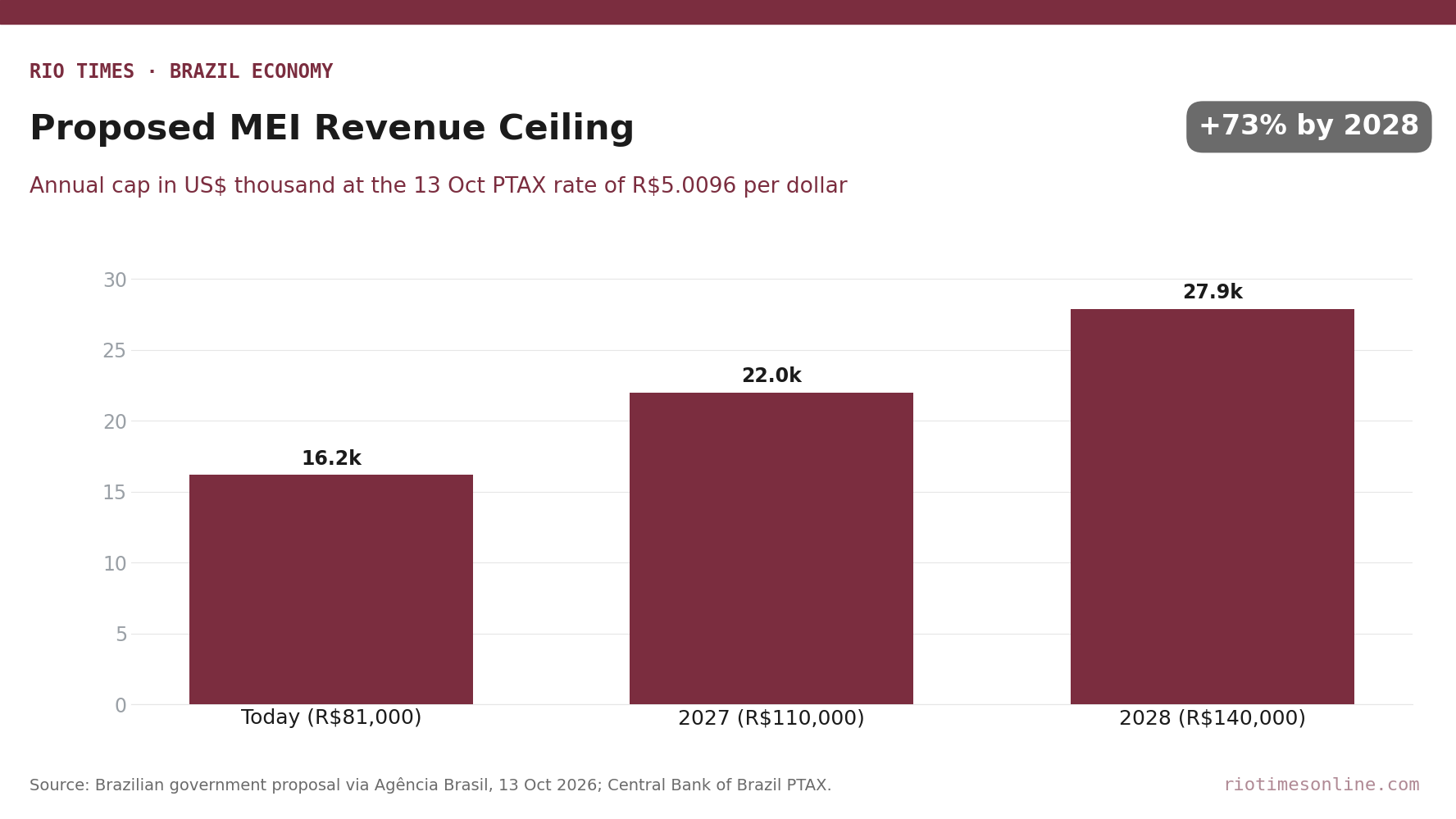
Lula also asked Congress to fast-track a bill already sent that would lift the annual MEI revenue ceiling from R$81,000 (about US$16,200). The cap would rise to R$110,000 (about US$22,000) in 2027 and R$140,000 (about US$27,900) in 2028, according to Agência Brasil.
The bill’s own justification puts the cost of the higher ceiling at about R$8 billion (about US$1.6 billion) over three years, Exame reported. A fifth measure, a decree, confirms that MEIs need not issue invoices on sales to private individuals.
Why the Timing Matters
The announcement came 12 days before the runoff on Sunday 25 October, after Flávio Bolsonaro finished ahead of Lula in the first round. InfoMoney, a São Paulo financial news site, noted that micro-entrepreneurs are a group where Lula struggles to win voters.
“We are going to help you get out of the squeeze,” Lula told entrepreneurs, according to the state news agency Agência Brasil. He said the measures came from demands raised by entrepreneurs themselves and would be turned into bills and decrees.
Under electoral law the grant cannot be created this year, which is why ministers presented it as a plan for 2027. The debt forgiveness and the higher ceiling, by contrast, must pass Congress as bills.
What It Means for US Readers
For US investors, the key question is Brazil’s fiscal path, which drives the real, local rates and New York-listed Brazilian shares. New spending promises can push up the premium investors demand to hold Brazilian government debt.
The direct cost may be smaller than the headline suggests, because the government itself calls much of the forgiven debt unrecoverable. The grant would add about R$1.25 billion (about US$250 million) a year from 2027, according to the planning minister.
US firms with Brazilian suppliers should note that millions of small businesses could clear their tax records if the bill passes. That could reopen access to credit for many one-person suppliers, from repair shops to street vendors.
What Is Not Known
Congress has not yet voted on the MEI debt relief bill, and the government gave no date beyond asking for urgency. The rules for who receives the Pix MEI grant, and how it will be checked, have not been published.
Reports differ on the size of the MEI bank debts the government plans to buy, so that figure is not given here. No response from Flávio Bolsonaro to the package had been reported by Brazilian outlets by Tuesday evening.
Related: What Brazil’s Runoff Means for US Investors. Earlier: Brazil Adds US$1.5 Billion to Fuel Subsidies.
What Prediction Markets Say
On Polymarket, bettors gave Flávio Bolsonaro an 87% chance and Lula a 13.5% chance of winning at 3:14 p.m. ET on 13 October. These are bets, not polls, and prices can move quickly after news.
The Brazil election market has drawn bets worth about US$181 million in total, including about US$385,000 in the past 24 hours. Lula’s price was up one point on the day but down two points over the week.
Prediction markets · who wins the runoff
Implied chance of winning Brazil’s presidency on 25 October, from traders’ prices.
Polymarket
Flávio Bolsonaro 86.6% · Lula 13.5% (US$181 million traded)
Kalshi (regulated in the US by the CFTC)
Flávio Bolsonaro 86% · Lula 14%
As of 13 October, 3:20 pm ET (20:20 Lisbon), updated every 20 minutes. Prices are bets, not polls, and can move fast.
Why we show this: prediction markets turn real-money bets into a live probability that moves within minutes of the news, which is why investors, campaigns and newsrooms in the United States now follow them closely. We show them next to polls and official results, never instead of them.
Why we show this: prediction markets turn real-money bets into a live probability that moves within minutes of the news, which is why investors, campaigns and newsrooms in the United States now follow them closely. We show them next to polls and official results, never instead of them.
Frequently Asked Questions
What is MEI debt relief?
It is a proposed law to cancel the federal tax debts of Brazil’s individual micro-entrepreneurs, known as MEIs. The government puts the total at R$12.6 billion (about US$2.5 billion) owed by about 3.6 million businesses.
What is the Pix MEI?
It is a proposed one-off grant of up to R$5,000 (about US$1,000) per micro-entrepreneur for equipment and improvements. It is not a loan, and the government says it can only start in 2027.
Does the debt forgiveness need Congress?
Yes. It is a complementary bill, so both houses of Congress must approve it before any debt is cancelled.
When is Brazil’s presidential runoff?
The runoff between Lula and Flávio Bolsonaro is on Sunday 25 October 2026. The package was announced 12 days before the vote.
How could this affect US investors?
Extra spending can weigh on the Brazilian real and on Brazilian assets held abroad. The government argues the cash cost is limited because much of the debt was unlikely to be collected.
Sources: Agência Brasil; Exame; InfoMoney (package); InfoMoney (Pix MEI cost); Central Bank of Brazil PTAX.
Editorial responsibility: Matthias Camenzind, Editor-in-Chief · Editorial standards · Report an error