Brazil’s Gripen Fighter Flies Abroad for the First Time, at Chile’s War Games
Brazil · Defense
Key Facts
—The first. Brazil’s F-39E Gripen, its new home-built fighter, left Brazilian soil for the first time to join Chile’s Salitre 2026 air exercise.
—The number. The Brazilian Air Force (FAB) sent five Gripens to Cerro Moreno air base in Antofagasta, in northern Chile.
—The company. They fly alongside US F-16s and Reaper drones and the air forces of Argentina, Colombia and Paraguay — six nations in all.
—The test. The jet flew a big exercise before (CRUZEX 2024), but only at home; slotting into a foreign-led coalition is a harder first.
—The program. Brazil ordered 36 Gripens in 2014; eleven have been delivered, and the first Brazilian-built jet was unveiled in March 2026.
—Why it matters. A fighter that performs abroad is a fighter Brazil can sell abroad — and its neighbours are already shopping.
Brazil’s biggest bet in the sky just left home for the first time. Five of the country’s new Gripen fighters landed in northern Chile this week to join South America’s largest air-combat exercise — a quiet milestone more than a decade in the making.
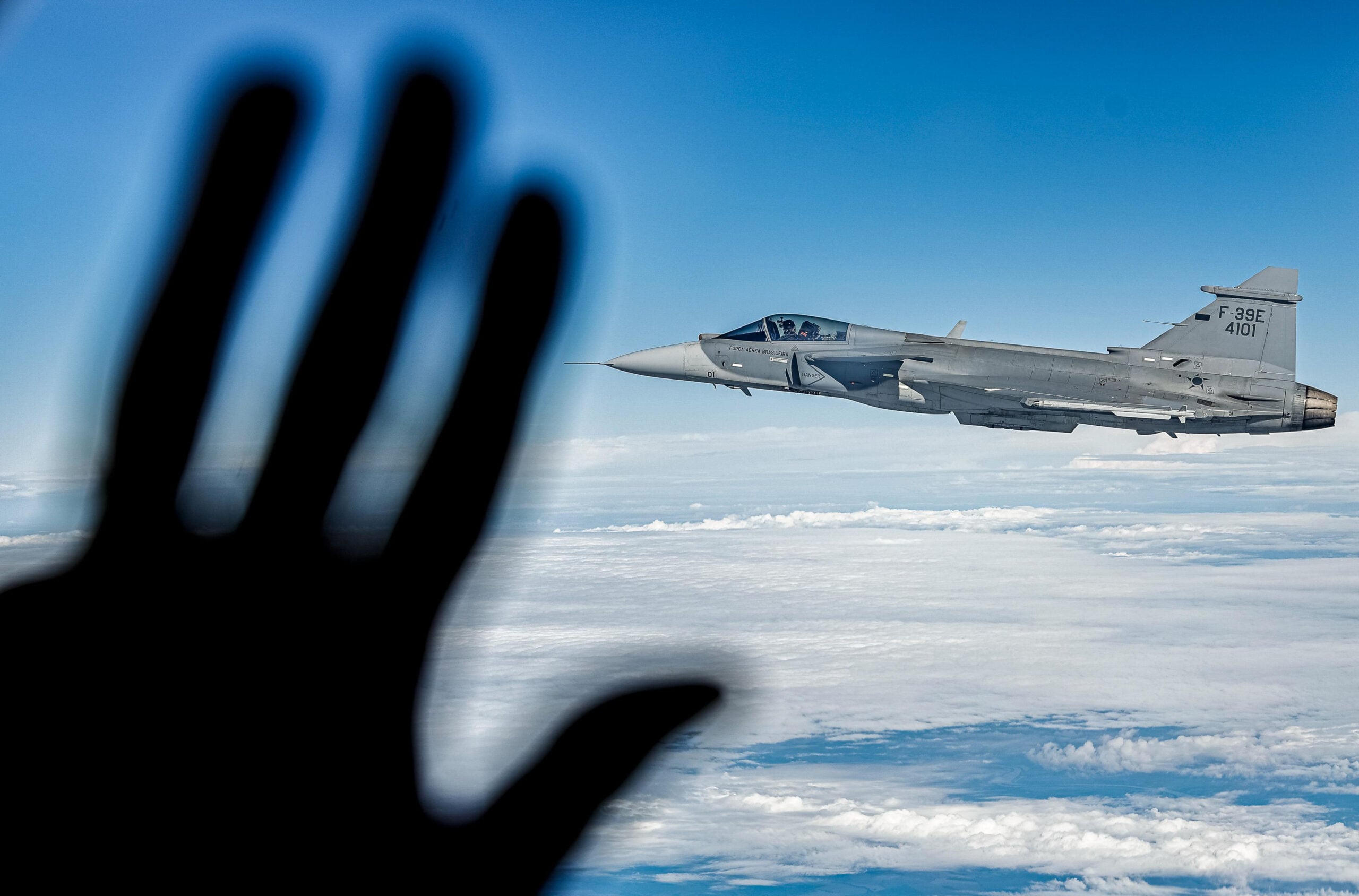
What the Gripen is, and why this flight matters
The Gripen is a single-engine, multi-role fighter jet designed by Sweden’s Saab. Brazil chose it in 2014 and now builds its own version, the F-39E, under a technology-transfer deal that brings the manufacturing know-how home.
Until this week, those jets had never left Brazilian airspace. Five of them flew to Cerro Moreno air base in Antofagasta, in Chile’s northern desert, for the multinational exercise known as Salitre.
The aircraft had flown one large exercise before, CRUZEX in 2024, but that was on home soil with Brazil as the host. Operating from a foreign base, inside a coalition run by another country, is a harder and more revealing test.
According to Saab, Brazil ordered 36 Gripens in all — 28 single-seat E models and eight twin-seat F models — with deliveries running since 2020 and eleven handed over so far. The first jet actually built in Brazil, rather than in Sweden, was unveiled in March 2026 at Embraer’s plant in Gavião Peixoto.
The fighters reached full combat readiness at the end of 2025 and have since stood air-defense alert over the capital, Brasília. Sending them abroad is the next step in proving the program works.
What sets the jet apart is less raw speed than its electronics. It carries an advanced AESA radar — a sensor that scans the sky without physically moving — and fuses data from several sources into one shared picture that pilots can pass across the formation.
Inside Salitre 2026
Salitre is a war game that Chile hosts every few years, and the 2026 edition opened on June 27 and runs through July 12. It gathers six air forces — Chile, Argentina, Brazil, Colombia, the United States and Paraguay — with Canada, Ecuador and Uruguay sending observers.
The point of the exercise is interoperability, the unglamorous skill of getting different nations’ aircraft to plug into one shared plan. Crews train to a NATO-style standard so a Brazilian jet, an American tanker and a Chilean fighter can fly the same mission as one force.
This fifth edition is billed as “multi-domain,” meaning the scripted scenario folds in not just air combat but space sensors and cyberattacks the crews must fend off. It mirrors how modern wars are increasingly fought, across several fronts at once.
The United States brought a heavy contingent: F-16 fighters, MQ-9 Reaper drones, U-28A Draco surveillance planes and a giant C-5 Super Galaxy transport hauling the support gear. Argentina sent its IA-63 Pampa III jets and a C-130 Hercules, and Paraguay’s A-29 Super Tucano made its own international debut.
From home defense to a flying showroom
For Brazil, Salitre is more than training — it is a sales pitch with wings. A fighter that performs well inside a foreign coalition is a fighter Brazil can credibly offer to other air forces.
The timing fits a wider push. In recent weeks Brazil has courted Chile and Argentina to buy from its defense industry, and it plans a similar approach to Peru in July.
That campaign runs across the services, from jets to warships, as Brazil casts itself as the region’s home-grown arms supplier. The same week the Gripen flew to Chile, Brazil’s navy launched its third domestically built frigate.
Whether the warm words turn into export contracts is the open question that will define the next year. But putting the jet in front of five other air forces, flying real missions, is exactly how that conversation starts.
There is national pride wrapped up in the flight, too. Brazil is now among the handful of nations that can build a supersonic fighter at home, a capability that took the 2014 contract, years of technology transfer and a dedicated Embraer line in São Paulo state to reach.
Why a foreign reader should care
Very few countries can both build a modern fighter and deploy it abroad, and Brazil is now edging into that club. For a nation that has spent more than a decade and billions of dollars on the program, the first foreign deployment is the moment the investment starts to look like influence.
It also lands as South America quietly rearms, with several neighbours shopping for aircraft, ships and missiles at the same time. A capable, locally built Brazilian jet reshapes who they might buy from — and who they fly alongside.
Background: Brazil Election Polls 2026: All Surveys, All Candidates.
Background: Brazil Overhauls Tax System: A New Era for Business and Economy.
Background: Church-Owned Bank Digimais Is the Next Test of Brazil’s Master Crisis.
More: Brazil news in English, every day from The Rio Times.
Frequently Asked Questions
What is Brazil’s F-39E Gripen?
The F-39E is the Brazilian version of Sweden’s Saab Gripen E, a single-engine multi-role fighter. Brazil ordered 36 (28 single-seat E and eight twin-seat F) in 2014 and builds them domestically under a technology-transfer deal; eleven have been delivered and the first Brazilian-made jet was unveiled in March 2026.
Why is the Salitre deployment a first for the Gripen?
It is the first time Brazil’s Gripen has operated outside Brazilian territory. The jet flew the CRUZEX 2024 exercise, but that was at home with Brazil as host; deploying to a foreign base inside a coalition led by another country is a new and harder test.
What is Salitre 2026 and who is taking part?
Salitre is a multinational air exercise hosted by Chile, opened June 27, 2026 at Cerro Moreno air base in Antofagasta and running through July 12. Its fifth edition gathers the air forces of Chile, Argentina, Brazil, Colombia, the United States and Paraguay, with Canada, Ecuador and Uruguay as observers; it is multi-domain, adding space and cyber elements to air combat.
How many Gripen fighters does Brazil have?
Brazil’s 2014 contract covers 36 aircraft. Deliveries began in 2020 and eleven had been handed over by mid-2026, with the rest to follow, including jets assembled in Brazil at Embraer’s Gavião Peixoto plant.
Connected Coverage
Six Nations Bring Their Air Forces to Chile for War Games
Two Jets, Two Camps: The Fighter Race Splitting South America
This article was produced by The Rio Times’ automated newsroom system. How we use AI · Report an error · Editorial responsibility: Matthias Camenzind, Editor-in-Chief
Brazil runoff, Sunday, October 25: Brazil runoff start time and results schedule. Latest: Brazil runoff polls, Flávio 51%, Lula 49%.
Read More from The Rio Times