Brazil Círio Draws 2.3 Million Pilgrims to Belém

RELIGION · BRAZIL
Key Facts
- —The country Brazil. Belém is the capital of Pará state, near the mouth of the Amazon, and hosted the COP30 climate summit in November 2025.
- —Why it matters The Círio de Nazaré draws crowds in the millions every October. UNESCO added it to its list of the intangible cultural heritage of humanity in 2013.
- —Why now The main procession, the Grande Círio, took place on Sunday 11 October, the second Sunday of October, after Saturday night’s Trasladação.
- —What happened About 2.3 million people followed the 3.6 km procession on Sunday, according to the organisers. It ended at around 12:15 p.m. local time after about five hours.
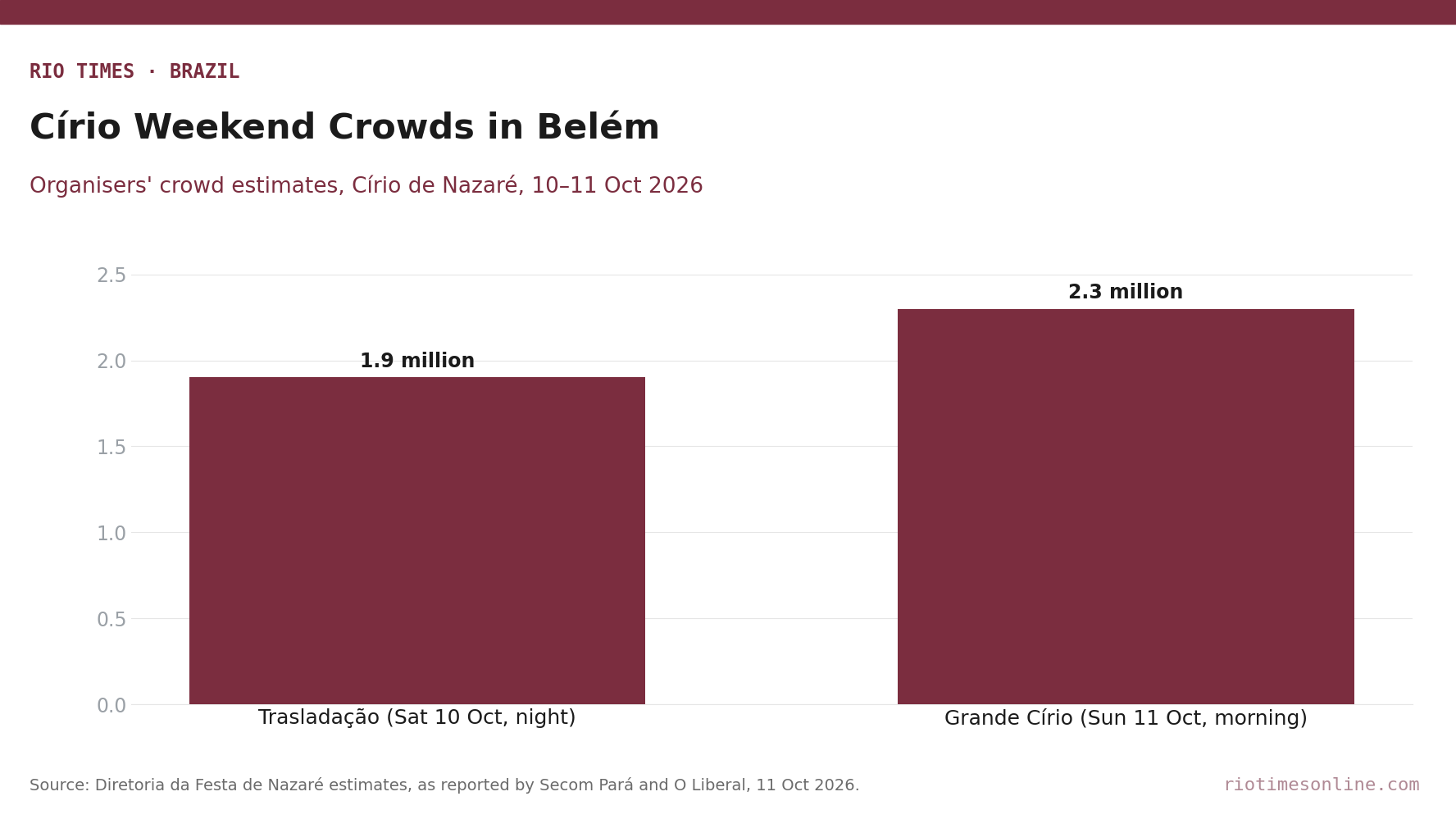
- —The numbers 1.9 million at Saturday’s Trasladação; 421 health calls from 9 to 11 October; no deaths; 31 police reports during Sunday’s procession.
- —What it means for you Belém handled two crowds of about two million each without serious incidents. Visitors this month should still expect intense heat and closed streets.
- —Still open Nobody has explained why the devotees’ rope was detached on Sunday. The organisers have not said how they count the crowd.
About 2.3 million people walked behind a small statue of the Virgin Mary through Belém, in northern Brazil, on Sunday 11 October. The Círio de Nazaré, the 234th edition of the procession, covered 3.6 km in about five hours. For foreign visitors, it shows that an Amazon city can move two million people safely on two consecutive days.
The figure comes from the Diretoria da Festa de Nazaré, the Catholic lay board that organises the festival. It also estimated that about 1.9 million people joined Saturday’s Trasladação. That night procession follows roughly the reverse route.
Both crowds passed without deaths or mass-casualty incidents, according to the state health and security secretariats. Our earlier Círio de Nazaré 2026 in Belém Visitor Guide sets out the full two-week programme.
How Sunday’s Procession Unfolded
The day began with a Mass at 6 a.m. at the Metropolitan Cathedral in the old town, Cidade Velha. It was led by Dom Júlio Endi Akamine, the Archbishop of Belém and head of the local Catholic Church.
At 7:31 a.m., the image known as the Imagem Peregrina was placed in the Berlinda, the flower-covered carriage that carries it. The route passed the Ver-o-Peso market and the Estação das Docas waterfront before climbing Avenida Presidente Vargas.
At around 9:15 a.m., the long rope that devotees pull as an act of penance was detached between stations 2 and 3. TV Liberal showed members of the festival’s guard cutting it, g1 reported. The organisers gave no reason.
Before 11 a.m., all five rope stations were empty, the organisers’ press office said, and the procession sped up along Avenida Nazaré. The Berlinda reached the Praça Santuário at around 12:15 p.m., only about 20 minutes behind schedule, according to g1.
Dom Paulo Andreoli, auxiliary bishop of Belém, then celebrated the closing Mass. The image will stay on display at the square in the coming days. This year’s theme was “Mary, the Missionary Who Gives Us Jesus”.
Saturday Night and the Safety Record
The Trasladação left the Colégio Gentil Bittencourt at 5:55 p.m. on Saturday and reached the cathedral at about 11:17 p.m., O Globo reported. The rope broke at several points at around 7 p.m., causing a delay of about an hour.
Pará’s governor, Hana Ghassan, watched the image pass at the Estação das Docas, according to the state communications office. She called the Círio “a moment of faith, emotion and gratitude”.
The state health secretariat, Sespa, runs a joint health centre with Belém city hall. It recorded 421 medical calls between 9 and 11 October. There were no deaths, no outbreaks and no accidents with multiple victims.
The busiest stretch was Sunday morning, with 193 calls. The SAMU ambulance service handled 18 of them and took two people to hospital. Most cases were minor: dizziness, faintness, muscle pain, cuts and bruises.
The state security secretariat, Segup, deployed more than 1,500 officers, 15 drones and about 70 cameras for Sunday’s procession. Police recorded 31 incidents. Security secretary Ed-lin Anselmo said the event passed calmly.
What It Means for You
For travellers, the main lesson is practical. Belém can host enormous crowds, but more processions are still to come this month. Heat is the biggest risk; civil defence teams sprayed water on pilgrims along Sunday’s route.
For anyone following Brazil from the United States, the weekend is a reminder of the Catholic Church’s weight in public life. The Círio fell two weeks before the presidential runoff on Sunday 25 October. Our explainer Religion in Brazil Explained sets out how faith shapes the country’s politics.
For business, the festival is a major draw for visitors to Belém and the wider Amazon region. We could not confirm an official figure for its economic impact this year.
What Is Not Known
The organisers have not explained why the rope was detached on Sunday. They have also not published the method behind the crowd estimates, which cannot be checked independently.
Health figures differ by source. Belém’s municipal health secretariat, Sesma, reported about 500 calls at its 11 first-aid posts over the weekend. That count differs from the state centre’s 421.
The festival is not over. Sunday’s Círio was the seventh of 14 official processions, so the festival programme continues in the coming weeks.
Frequently Asked Questions
How many people attended the Círio de Nazaré 2026?
The organisers estimate about 2.3 million people followed Sunday’s procession in Belém on 11 October, and about 1.9 million joined Saturday’s Trasladação.
Were there any serious incidents during the procession?
State authorities recorded no deaths, outbreaks or mass-casualty accidents. Health teams logged 421 calls from 9 to 11 October, mostly minor, and police registered 31 incidents on Sunday.
What is the Círio de Nazaré?
It is a Catholic festival in Belém honouring Our Lady of Nazareth; this year was its 234th edition. Its main procession takes place on the second Sunday of October, and UNESCO added it to its list of the intangible cultural heritage of humanity in 2013.
Sources: g1 Pará; O Liberal (crowd estimate); O Liberal (arrival); Secom Pará via RBTV (Trasladação); Secom Pará via RBTV (Segup); Sespa CIOCS balance; O Liberal (Sesma); O Globo; UNESCO.
This article was produced by The Rio Times’ automated newsroom system. How we use AI · Report an error · Editorial responsibility: Matthias Camenzind, Editor-in-Chief